




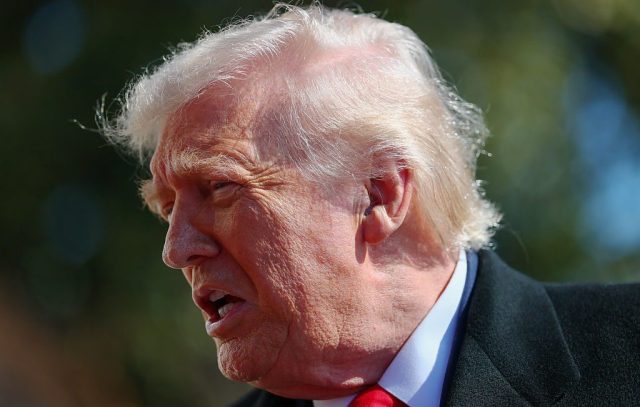
'He takes a positive delight in parading his power, turning it into theater and spectacle'. (Michael M. Santiago/Getty Images)





Karl Marx was in two minds about the middle classes. It’s commonly thought that he wanted to see the back of them, which is true enough; but it’s also commonly forgotten that he praised them as being in their heyday the most revolutionary force that history had ever witnessed. “Constant revolutionizing of production,” he writes in The Communist Manifesto, “uninterrupted disturbance of all social conditions, everlasting uncertainty and agitation distinguish the bourgeois epoch from all previous ones.” In a few brief centuries these armed rebels had dismantled the anciens regimes, beheaded kings, swept away feudal privileges and replaced autocracy with liberal values and democratic constitutions. They also fostered civil rights, humanitarian values and the greatest prosperity that humanity had ever known. It’s a far cry from their descendants in Dorking and Maidenhead.
In Marx’s view, this magnificent achievement involved one or two misfortunes: mass poverty, grotesque inequalities, blighted lives and grinding exploitation. It also brought with it perpetual wars between competing capitalist states, the extermination of colonial peoples, and a rapacious social order in which more or less everything from love to art to sport was subject to the profit motive. Yet Marx didn’t allow his fury at these atrocities to dim his admiration of the class that gave birth to Balzac and Dickens, Mozart and Mendelssohn, Rembrandt and Turner. “Bourgeois” for him was never simply a swear word. Instead, he held in tension a positive and negative judgment of that class, in what was known as a dialectical approach in the days when radical young men wore sideburns and denim suits. He especially appreciated their insolent upfrontness. The feudal order had concealed its brutality behind church, monarch and lord of the manor, but with capitalism it was out in the open. “All that is solid melts into air,” he remarks in the Manifesto, “all that is holy is profaned, and humanity is at last compelled to face with sober senses its real conditions of life.”
The middle classes worship fact rather than fancy, use rather than ornament, the material as against the ideal. They tell it like it is, instead of spinning utopian dreams or fantasizes of King Arthur. The dominant literary form was now not epic or romance but the realist novel, tales of ordinary men and women rather than of gods and demons. Religion was still an active force, but more for the sake of social cohesion than love of God. The Victorians feared that morality would collapse without the Almighty, and the collapse of morality might bring with it political disaffection. What Walter Bagehot called the “ceremonial” aspect of British society, with its quaint cults and esoteric rituals, still flourished, but truth and reality were increasingly a matter of land, cash and property. What mattered was what you could touch and taste, buy and sell.
In commending the middle class’s lack of hypocrisy, Marx is perhaps a touch too charitable. If the Victorians were crassly materialist, they were also remarkably high-minded. Fantasizes of King Arthur did indeed continue to be spun, not least by the man whose poetry was Queen Victoria’s bedside reading, Alfred Tennyson. In civilized circles, money was still as unmentionable as excrement, and Freud was to detect some fascinating relations between the two. This coyness lingers on: even today, the British speak of appointing someone to an academic post, while the Americans talk of hiring. Despite this, the gap between materialism and idealism has always been starker in the States than it is in Britain. Brits are more likely than Texans to be embarrassed by the high-toned rhetoric of Our Brave Men and Women in Uniform or This Wonderful Nation of Ours. Hyperbole like this borders on the impolite in the UK, where it’s customary to play yourself down, not wear your heart on your sleeve and not lavish praise on your own children.
The Americans, however, have invented an ingenious way of reconciling their spiritual high-mindedness with their love of money. This is to turn the pursuit of profit into an enterprise every bit as spiritual as Buddhism. America has a dream — but it’s a dream of power, prosperity and infinite self-expansion, not of community or humility or selfless devotion. It’s an idealism of the will, not of the soul, and only one can play at a time. This is why it’s not entirely true to see Donald Trump as having abandoned the usual lofty American talk of God’s Own Nation and other such blasphemies for a coarser, grosser, in-your-face discourse. There’s no denying that he’s coarse and gross, but one needs to remember that in the Land of the Free, making an enormous amount of money is itself a kind of spiritual project. Idealism is built into everyday life, not a spirit that soars above it. The Puritans who founded the United States believed that worldly success might be a sign of God’s favor, so that the material and the ideal were linked from the outset.
They’re also linked in the sense that the millionaire is a kind of magician. He can change the world with a stroke of the pen or a word on the phone. Money is a brute fact, but one which can make the most extravagant fantasy become real. Fantasists like Trump can’t stand the recalcitrance of the world and want it to be instantly pliable to their touch. Most of us have to adapt our desires to reality, whereas autocrats can do the opposite. No doubt it all goes back to the breast. The infant feels hungry and out pops a nipple. It’s not the smartest way of preparing for adult life, even if it keeps you alive.
There’s something to be said for the idea that Trump has stripped some of the veils of rhetoric from a brute reality. He doesn’t say much about God, freedom and democracy, which US Presidents are supposed to do. He was once photographed holding a Bible and looked as uneasy as if he was cradling a rattlesnake. Instead, he talks about oil, rare minerals, grabbing other people’s territories and flogging off their resources. 19th-century imperialism felt the need for some vacuous moral platitudes in order to explain why they were killing and enslaving so many people. The White Man’s Burden was one such cliché, as was the notion of bringing the fruits of civilization to the barbarians. Today, the fruits of the barbarians are being brought to the civilized, as with Trump’s weird desire to own a bunch of polar bears in Greenland. It’s like threatening a nuclear war if you can’t have Wales. Yet he quite often dispenses with the usual deceitful rationalizations for such behavior. His is the language of realpolitik, not of the preacher.
It may be that American imperialism is a roundabout way of teaching geography to the younger generation. Americans are notoriously bad at knowing whether, say, Vienna is to the north or south of New Zealand, or what the capital of Scotland is, and invading other countries involves having to look at maps to make sure you raze the right place to the ground. A lot of American citizens know exactly where Vietnam is, which was one of the few benefits of their visit to the place some decades ago. There might, however, be rather less painful ways of obtaining this kind of knowledge. Globes, for example.
Governing classes have long known that power works most effectively when it’s intangible. The ideologies which shape us most profoundly aren’t sets of doctrines. They form the invisible color of daily life, the taken-for-granted values built into our behavior. The state is wary of smashing up political demonstrations, not so much because it has tender feelings for the demonstrators but because power which becomes too conspicuous tends to lose its credibility. It much prefers to work deviously, obliquely, without having to reveal its steel hand. To do so preserves the illusion of its neutrality, a view of the state questioned by a renowned thinker who believed that its purpose was to protect private property (no, not Marx: Cicero). Trump, however, is doing just the opposite in Minneapolis and elsewhere. He takes a positive delight in parading his power, turning it into theater and spectacle, using ICE officers as an extension of his monstrous ego. It’s a gross violation of the bourgeois playbook.
It didn’t take two deaths in Minneapolis to alert the world to the excessive violence of the United States. It’s the only English-speaking country which uses the word “aggressive” positively. Freud argued that what’s wrong with the superego isn’t that it punishes us, but that it punishes us well beyond our culpability. It lays obligations on us which it knows we can’t fulfill, then fills us full of guilt because we can’t live up to its insanely unreasonable demands. In short, it’s not only punitive but malicious, sadistic and vindictive. And all this is betrayed by the pointless surplus of violence it wreaks upon our heads.
Such a surplus has long been evident in the United States, fueled by its Puritan heritage. Ten police cars with their sirens screaming close in on a single septuagenarian shoplifter. Six or seven ICE officers pile themselves on top of a single protestor. This isn’t just because every cop in town likes to grab a piece of the action when his radio starts to crackle. It’s also the result of a Puritan fear of chaos and a paranoid insistence upon order. Allow one individual to get out of hand and before you know where you are (a key phrase in this style of argument) millions of them will be running wild searching for toddlers to eat. Power of this kind is irrational, which is why it provokes those it oppresses into rebellion in order to oppress them even further. This is what is unfolding in Minneapolis.
Puritans like clean distinctions and neat antitheses. Their minds are intolerably tidy. America is the land of the good guys versus the bad guys. All police officers are heroes and all Somalis are scum. No previous President, however, would have used those latter words. He would have tarted them up in fancy moral phraseology. With Trump, however, what you see is for the most part what you get, which sounds like honesty but is in fact callousness. We seem to be moving into a post-ideological era — not ideology in the sense of convictions, but in the sense of actions and beliefs which try to mask their ugliness in exalted speech. The cop who killed George Floyd didn’t even try to look as though his life was under threat. Americans are sometimes admired for telling it like it is, unlike us two-faced Brits. What the admirers forget is that how it is can be pretty revolting.