




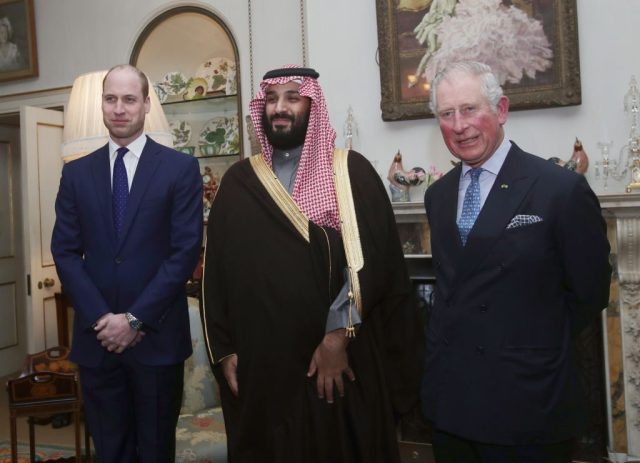
Do Britain’s interests align with the Saudi Kingdom? (Yui Mok-WPA Pool / Getty)





At a time when Buckingham Palace is trying to distance itself from the cascade of Epstein disclosures related to Andrew Mountbatten-Windsor, it might seem odd — to put it mildly — that the Prince of Wales should be on his way to Riyadh to meet Crown Prince Mohammed bin Salman, aka MBS, aka Mohammed the Bone Saw. Yet Prince William is in Saudi Arabia this week to cozy up to his counterpart, who acquired his gruesome sobriquet after overwhelming evidence emerged that he personally ordered the murder of Jamal Khashoggi, the well-known dissident journalist, in the Saudi consulate in Istanbul in October 2018.
The Saudis, backed by President Donald Trump, have of course denied that the murder was officially sanctioned, claiming that a rogue outfit was responsible after an argument got out of hand. However, the killing and dismemberment by the infamous bone saw were recorded in brutal detail by Turkish intelligence; and credible authorities, including senior intelligence officials such as Agnès Callamard, former UN special rapporteur on extra-judicial killings, have been unequivocal in their verdicts. Callamard’s report into the “execution” is damning: “Evidence points to the 15-person mission to execute Mr Khashoggi requiring significant government coordination, resources and finances… Every expert consulted finds it inconceivable that an operation of this scale could be implemented without the crown prince being aware, at a minimum, that some sort of mission of a criminal nature, directed at Mr Khashoggi, was being launched.” Just in case Prince William is in need of some small talk.
Of course, a visit by a senior member of the Royal Family is never just ceremonial. It is an act of diplomacy, and symbolism too. The moral endorsement of the British crown will be cherished by the Saudi regime, which likes to think of itself as “royal” in the grand tradition of the Western monarchies, despite its parvenu origins. But Prince William’s visit raises uncomfortable questions — not only about Middle Eastern realpolitik in an era of shifting alliances, but about the values that the United Kingdom claims to uphold.
These questions have become especially acute in the wake of a recent High Court judgment against the Kingdom of Saudi Arabia. It concerned Ghanem al-Masarir, a Saudi dissident living in Britain since 2003. Through his popular YouTube channel, The Ghanem Show, recorded in Wembley, al-Masarir uses satire to expose corruption and human rights abuses within Saudi Arabia. His reach is vast, amassing over 300 million views, primarily from audiences inside Saudi Arabia who seek alternatives to state-controlled narratives and pro-regime bots.
But the authorities are aware of him too. Al-Masarir has been under constant harassment since 2004. He claims that a large check was forged in an effort to break him financially; that his phones were infiltrated with Israeli-manufactured Pegasus spyware; that he was followed and assaulted in broad daylight; and that he received explicit death threats from individuals linked to the Saudi royal court. The most violent incident, al-Masarir says, occurred in August 2018 he was followed from a cafe and assaulted by two men near the Brompton Road entrance of Harrods. Al-Masarir alleged that during the beating, the attackers repeatedly shouted: “Who are you to talk about the family of al-Saud?” and “How dare you curse Prince Salman, we won’t allow it!” They called him a “slave of Qatar” and threatened to “teach him a lesson”. When an English friend who was with al-Masarir told them they were protected by the Queen and British police, the attackers retorted: “Fuck London — their queen is our slave and their police are our dogs.”
In 2010, al-Masarir was befriended by an individual claiming to be a Master’s student in the UK who repeatedly attempted to persuade him to travel to Italy or Egypt. He later discovered this man’s true identity: Rajeh al-Baqmi, the head of Saudi intelligence at the Saudi embassy in London. He also encountered Maher Mutreb, a Saudi intelligence officer at the embassy, who made an explicit warning that he should never leave the UK. This might have been a back-handed threat with a hint of protection, suggesting that unlike their Russian counterparts who were prepared to murder co-nationals in London or Salisbury, Saudi mafiosi are more comfortable conducting their nefarious operations outside the UK, in countries such as Turkey.
Mutreb is clearly not to be messed with. A brigadier general commanding the Saudi hit squad or “Rapid Intervention Force”, it was he who led the team charged with killing and dismembering Khashoggi, assisted by Dr Salah al-Tubaigy, a forensic pathologist who is thought to have wielded the bone saw. In the audio recordings revealed by Turkish intelligence — the Saudis had failed to sweep the consulate for bugs — it is Mutreb’s voice that dominates. “Keep pushing, don’t remove your hand!”, followed by: “It’s over, it’s over, it’s over,” with the sounds of plastic sheets and the whine of an electric saw. While there is no audio directly linking the Crown Prince to the Khashoggi murder, the circumstantial evidence is compelling. In a separate audio, leaked by the CIA, the phrase “tell your boss” occurs in a conversation between Mutreb and the Crown Prince’s de facto chief of staff, Saud al-Qahtani. As Bruce Riedel, a former CIA analyst, told The New York Times: “A phone call like that… is as close to a smoking gun as you’re going to get.”
The disclosures implicating MBS in the murder will certainly be ignored in the current White House — whose incumbents include the Crown Prince’s close friend, Jared Kushner, the President’s son-in-law. But is it really always necessary for the UK to toe the US line? At the very least, the High Court ruling in the Ghanem al-Masarir case should give the Palace — and the Foreign Office — pause for thought. Saudi Arabia initially attempted to claim immunity under the 1978 State Immunity Act. However, the court ruled in 2022 that the Kingdom was not immune to these claims. After the Saudi state failed to pay court costs and its appeal was struck out, the final judgment was delivered on 26 January. Judge Pushpinder Saini found that on the balance of probabilities the Kingdom had been responsible for the physical attack on al-Masarir and for hacking his phone: “The KSA had a clear interest and motivation to shut down the claimant’s public criticism of the Saudi government.”
In its ruling, the court awarded al-Masarir more than £3 million in compensation for the psychiatric harm caused by hacking his phone as well as the physical assault. This marks a significant benchmark in the defense of human rights — though, given its refusal to take part in the legal proceedings, there is no certainty that the Saudi government will actually pay.
Nevertheless, any concerns that the British state has about criminality are outweighed by realpolitik. As David Hearst, an astute Middle East observer, has argued, a profound realignment is underway in the Arab world. It is not driven by palace intrigues, tribal rivalries, or the usual contests between regional proxies. Nor is it about Iran or political Islam — the two habitual anxieties of Sunni Arab rulers. And unlike the Arab Spring, it has not emerged from popular uprisings or mass protests. Yet its consequences could be just as far-reaching.
What has changed, according to Hearst, is that the region’s most populous Arab states — above all Saudi Arabia and Algeria, and potentially Egypt — have begun to recognize the threat of a shared project of Israel and the United Arab Emirates to reshape the Middle East. Their fear is that Tel Aviv and Abu Dhabi intend to fragment Arab-majority or Arab-leaning states. This would enable the Israelis and Emiratis to control key maritime chokepoints, such as the Straits of Hormuz and the Bab el-Mandeb, and entrench military and economic dominance across the Red Sea, the Horn of Africa, and beyond.
This strategy is already explicit in Israel’s actions: in its efforts to create de facto enclaves in Syria protecting the Druzes and Kurds; in its recognition of Somaliland, which gives it a foothold in the Horn of Africa; and in its general efforts to weaken Arab polities where national unity tends to be problematic. For the UAE, fragmentation has been a long-running method of power projection. It’s visible in Libya, where the UAE has provided military support to General Khalifa Haftar against the UN-supported government in Tripoli; in Sudan, where the UAE backs the genocidal Rapid Support Forces against the central government; and in southern Yemen, where the UAE armed and empowered the Southern Transitional Council (STC) in pursuit of a separatist state aligned with Emirati interests and open to ties with Israel.
Indeed, Yemen is the decisive fault line in the plan for regional fragmentation. What began as a campaign against the Muslim Brotherhood-linked al-Islah movement evolved into a broader attempt to carve out an Emirati client state in the south, centered on the port of Aden and extending east into the Hadhramaut valley. The separatists’ attempt to take over the port of al Mukalla in the Hadhramaut region at the end of last year proved a turning point. Saudi Arabia, now encircled on its southern frontier, felt that Emirati ambitions were now threatening its security — and duly responded with force. Backing official Yemeni government troops, it bombed STC positions in Mukalla, reversing much of Abu Dhabi’s decade-long project in a matter of days. Almost simultaneously, Israel’s recognition of the separatist government of Somaliland (it is the only UN state to formally do so) confirmed Saudi fears that these were not isolated moves but elements of a coordinated strategy across both sides of the Bab el-Mandeb.
The rift between Mohammed bin Salman and his former mentor, the Emirati president Mohammed bin Zayed, was now gaping. The pair were once close partners in resisting the Muslim Brotherhood and allied movements. Now, Riyadh has not only confronted Emirati proxies militarily but also publicly reframed Abu Dhabi as a destabilizing actor. The Saudi media attacks on Mohammed bin Zayed have been blistering, depicting the UAE’s president as a disruptive force rather than the trusted ally of yore.
And the break reflects a deeper recalculation. Saudi Arabia understands that its strategic weight — in terms of population, territory, and oil power — far exceeds that of the UAE. Once you remove the expat community living in Dubai and Abu Dhabi, there are barely one million Emirati citizens. Abu Dhabi may specialize in covert action and proxy warfare, but it cannot prevail against Riyadh when vital Saudi interests are at stake.
Meanwhile, Washington under Donald Trump has intensified Saudi unease by treating global energy resources as prizes to be seized and threatening to depress oil prices, undermining the kingdom’s fiscal stability. Riyadh has concluded that US military power does not equate to responsible governance, and that American adventurism routinely generates chaos it cannot manage.
So the Saudi turn is not moral but strategic. By resisting Emirati-Israeli plans for regional fragmentation, Riyadh is positioning itself as an autonomous Arab power, potentially aligning more closely with Turkey, Egypt, Algeria — and perhaps, even long-term, with Iran. What it favors is a regional security order independent of Washington and Tel Aviv.
Given the emerging regional configurations, the British government — and the Palace — would be right in thinking that Britain’s interests align more closely with the Saudi Kingdom which, like it or not, is emerging as a leading player in the region and a potential source of stability rather than with the disruptive UAE. But does all this mean that the heir to the throne must cosy up to his murderous Saudi counterpart?
Prince William has cultivated an image as a thoughtful, socially conscious public figure — engaged with environmental issues, interfaith dialogue, and the responsibilities of leadership. It does not befit that persona for him to associate himself too closely with a regime implicated in surveillance, murderous violence, and repression. If William proceeds with the visit, he will need to find ways of expressing a certain distance from his hosts. He should certainly decline any invitations to inspect MBS’s yacht, Serena. According to the anonymous Saudi activist who goes by the name Mujtahid, Jamal Khashoggi’s fingers are kept on board as a trophy.