




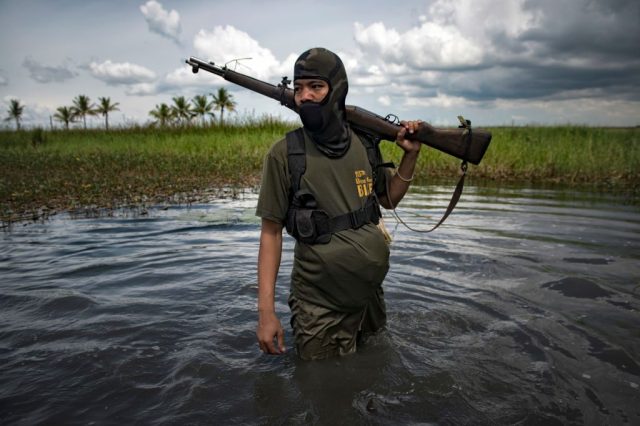
A Moro Islamic Liberation Front fighter in the Philippines in 2017. (Jes Aznar/Getty)





In early November, Sajid Akram, 50, and his bricklayer son Naveed, 24, traveled from Australia to the Philippines. Their destination was Davao, a city in Mindanao, the second-largest of the Philippines’ many thousands of islands — and a region in which the notorious terror organization Islamic State is regrouping. Here, the Akrams spent four weeks receiving military-style training.
When they returned to Australia, the pair perpetrated the worst terrorist massacre in the nation’s history — murdering 15 people at a Hanukkah celebration on Bondi Beach, turning what should have been a day of bright, joyful warmth into a day of horror. If it weren’t for the bravery of citizens in thwarting the attack, the death count would have been far higher.
Islamic State has not claimed responsibility for the atrocity — though it has of course delighted in the deaths of so many Jewish people as a “source of pride”. But the attack on Bondi Beach came right out of the Islamic State playbook, grimly familiar from the attack on music fans at the Bataclan, Paris in 2015 — or indeed two massacres at churches in the Philippines in recent years. This is a decentralized operation with no discernible command structure but a coordinated typology of violence. The sadism, the fact that the victims were celebrating, worshipping — all of this is intentional.
And Islamic State is an organization that exports its hateful ideology abroad, making significant inroads in Southeast Asia in recent years. If most Westerners think of this region at all, it is a holiday destination, a region of white sand beaches, chaotic cities, and vibrant food cultures. The Philippines’ majority-Muslim neighbors, Indonesia and Malaysia, are both often cited as examples of moderate Islam.
However, the attack signals some uncomfortable truths: militant Islamism is rising in a region that is home to more than 240 million Muslims — and Islamic State is exploiting the changing conditions in order to make a global comeback after years of languishing in relative obscurity. What Bondi Beach shows is that its instructions are not falling on deaf ears. Unless we make an effort to understand why and how this is happening, and the breadth and scope of the threat, then Bali, Bangkok or Bintan Island could be the next to suffer a deadly attack.
While the Philippines is a predominantly Christian country, it has long had a significant Muslim minority as well as a history of Islamist movements dating back to the early 20th century. The Muslim population is historically concentrated on Mindanao, a mountainous island straddled between three bodies of water — the Sulu Sea, the Celebes Sea and the Philippine Sea — meaning it is both geographically and culturally distinct from the rest of the Philippines.
When the Philippines achieved formal independence in 1946, a deluge of government-sponsored Christian migration swept Mindanao — causing resentment among many of the region’s Muslim farmers who now found themselves outnumbered by Christian settlers. By the early Seventies, Muslim separatists had formed a rebel group under the banner of the Moro National Liberation Front, or MNLF, which received financial support and military training from Malaysia and Libya. In 1972, a deadly conflict broke out between Muslim separatists and government forces under the command of President Marcos. It was one of the nastiest “small wars” of the era. For four years, the 30,000 strong MNLF forces succeeded in tying down four-fifths of the Philippine military, inflicting an average of 100 casualties each month.
In the decades since, at least 10 violent conflicts have flared in Mindanao. The MNLF has transmogrified into the awkwardly named Moro Islamic Liberation Front — MILF, for short — and several splinter groups have emerged, vying for ideological and military domination. These groups have often looked to the Middle East for inspiration and ideology. The Abu Sayyaf network founded in the late Eighties, took its cues from Al Qaeda. Dawlah Islamiyah, a coalition of different Islamist groups, tethered itself to the Islamic State in its era of prominence, between 2014 and 2015.
The long-term objectives of these groups are the same. They want to form a global Islamic caliphate. However, their methods differ. Al Qaeda and its offshoots adopt what’s known as a “far enemy” strategy, which means they like to strike enemy targets in far-flung parts of the world. Islamic State adopts a “near enemy” approach. The idea is to start locally, gaining control of territory and steadily consolidating and expanding its position until it can create a government operating under Islamic law.
The international nature of the threat makes it extremely hard to eradicate. But in 2017, it looked as though the struggle against Islamic State in the Philippines would finally reach its denouement — as President Rodrigo Duterte deployed his military to take on Islamic State-affiliated forces in Marawi, the capital city of the Lana Del Sur province in Mindanao. The urban war lasted five months — making it the longest urban warfare campaign in the Philippines since the Second World War.
Duterte’s forces prevailed, inflicting massive casualties on Islamic State. In 2019, the region became the Bangsamoro Autonomous Region in Muslim Mindanao (BARMM) and with Islamic State seemingly out of the way, it appeared for a brief period that the bitter and bloody struggle was coming to an end. A peace process was established. MILF (a rival with Islamic State for regional control) described the settlement as an “antidote to extremism”.
However, the optimism proved premature. As a Filipino army officer noted in the aftermath: “We have brought the number of insurgents to the lowest ever, but we never seem to quash the whole thing.” Any victory in the context of a battlefield will always remain temporary. Islamism’s ideological precepts never truly die — and despite suffering heavy losses to its most virulent adherents, a new coalition is emerging.
From 2019 until the beginning of 2024, Islamic State claimed credit for at least 18 attacks within Mindanao, which have claimed 162 lives — including 37 civilians. 13 of these attacks were conducted against military targets; two were against regional rivals, MILF; one was against critical national infrastructure — and two were on Christian worshippers. In January 2019, an Indonesian couple affiliated with Islamic State suicide-bombed a church on Jolo island in the Philippines. And in December 2023, Islamic State claimed responsibility for dropping an explosive device into a Catholic Mass in Marawi. Even in a state of retreat, Islamic State is capable of wreaking catastrophic levels of death and destruction.
The attacks on churchgoers are very much how Islamic State likes to operate. The terrorists chose deliberately soft targets; they targeted members of a different religious group; and they sought to optimize a sense of palpable horror in the broader population. The spectacular nature of the attack grabs attention. The desired effect is paralysis by fear.
If this sounds all too familiar, it’s because it’s precisely what played out on Bondi Beach earlier this month. “For twenty minutes, they were just shooting. I couldn’t hear anything, the shooting was just too loud,” said a survivor of the attack. “They were targeting everyone. Just anyone. Jews. They just shot. Doesn’t matter who. Just anyone.”
The attacks also have a lot in common with recent Islamist attacks on the West. Since Hamas’s October 7 attack on Israel, there has been an exponential rise in attacks on Jewish civilians or institutions — as Islamic State has leveraged opposition to the conflict in Gaza to foment a virulent form of antisemitism, combined with an unequivocal call to violence. “The conflict with the Jews is not about patriotism, but ideology. The battlefield is therefore everywhere,” said an Islamic State infographic from late October 2023.
Peter Neumann, a terrorism scholar based at King’s College London, encapsulated Islamic State’s motivations: “Jews [are] to be terrorized because they are Jews” and not necessarily “because they fought against Palestinians in Israeli uniform”. Drawing on statements made by Islamic State, Neumann explained the rationale: “unprotected crowds are better than hard targets, and places of worship are also particularly suitable for attacks.”
Meanwhile, in the Southeast Asian context, Islamic State’s revival is rising amid a rising Islamism. In Malaysia, an Islamist political party known as Parti Islam Se Malaysia, or PAS, is growing in popularity, winning 146 of 245 seats in the 2023 elections — making it the single largest party in the Malaysian parliament. Their agenda includes harsh punitive measures such as the amputation of limbs for theft, stoning to death for crimes such as adultery, and the public flogging of individuals caught in homosexual activities.
In Indonesia, the Prosperous Justice Party, or PKS, seeks to impose a strict version of Sharia — and is deeply hostile to concepts like gender equality or gay rights. It currently hold 50 seats in the Indonesian House of Representatives. Like Malaysia’s PAS, it is inspired by the Egyptian Muslim Brotherhood. Members have expressed support for Hamas, hold antisemitic views, and refer to adversaries as the “enemy” of Islam. This surely spells trouble for two countries that have often been touted as exemplars of moderate Islam.
If these trends go unchecked, a region known for verdant landscapes and pristine waters could rapidly turn into a global epicenter for Islamist terror. On a different day, what happened on the Australian coast could have happened on a beach overlooking the Andaman or the Java Seas. If Islamists have their way, it will.