




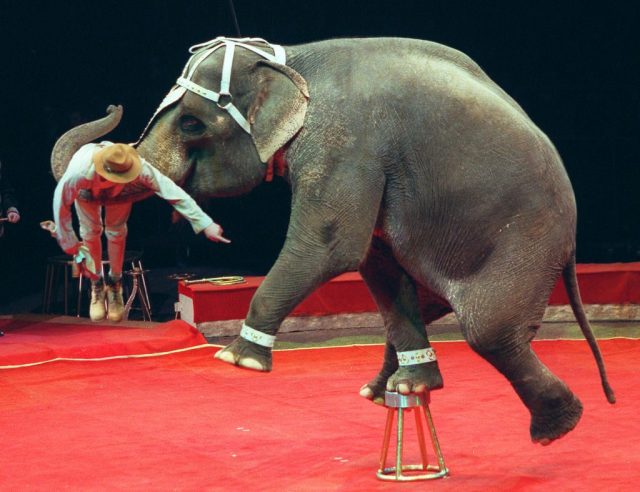
With it and for it. (Pierre Very/AFP/Getty)





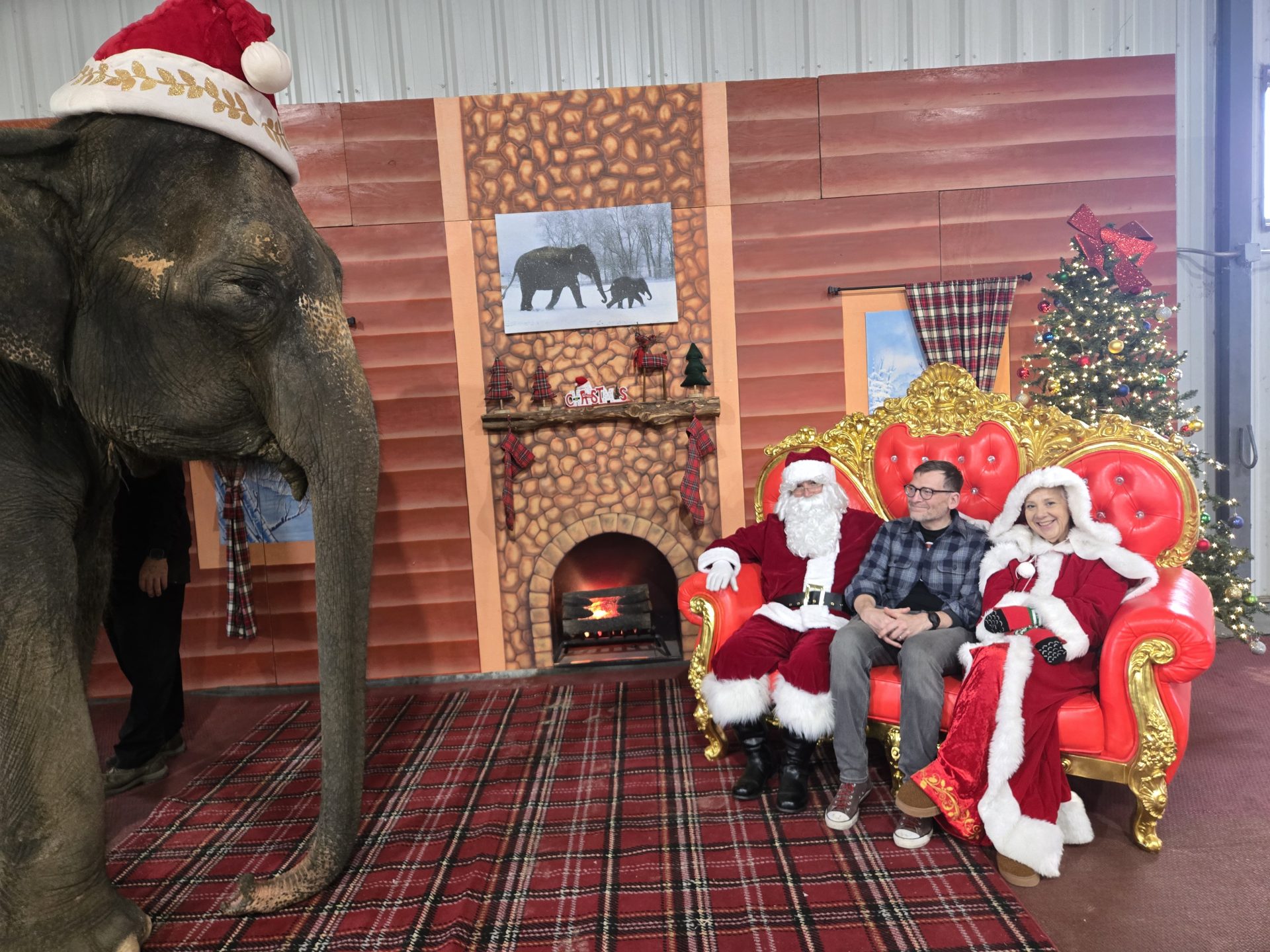
Lisa and Tracy are “with it and for it”. That’s circus speak for the show must go on — and it’s hard to disagree, especially at this time of year. It’s fortunate, then, that this pair of big-top lifers still know how to sense a crowd’s vibe. “No waits, no breaks, wham, bam, boom, boom” is how Jim Royal, a 77-year-old ringmaster, puts the secret to a well-paced act, or “read a lot” in slang. Lisa and Tracy offer all of this in droves, as they don their bobble hats, plié-relevé-sauté, and usher in Santa’s kingdom beneath the canvas.
At a combined 13,200 pounds, Lisa and Tracy make the wiry Royal seem like a Christmas pixie. But here in Hugo, such elephantine size is unsurprising. A windswept Oklahoma town, the jumbos come each winter, as much a festive tradition as the donkeys and the shepherds. With around 5,000 permanent residents, Hugo has long been known as “Circus City, USA”, and was once the Christmas home of nearly two-dozen circus troupes. These days, festive visitors are far less common. Yet like Lisa and Tracy, some old stalwarts endure, as much for family as business — even if there may be little to replace the elephants once they finally hang up their hats.
Hugo’s three-ring history dates back almost a century. In 1941, cheap land, warm winters, and a promise of free water attracted the Al G. Kelly and Miller Brothers Circus. Hugo’s own name, borrowed from the 19th-century novelist, may also have been a draw, lending a dash of Gallic sophistication to a corner of hardscrabble prairie. Soon enough, other groups arrived, with names like Famous Cole and Circus Chimera, and even today circus life is everywhere in Hugo. Statues of performing elephants decorate the streets. A section of the local cemetery — “Showmen’s Rest” — is dedicated to vanished circus greats. It acts, one grave marker reads, as “A Tribute to All Showmen Under God’s Big Top Home”.
These bonds have been strengthened by money. In small-town America, the circus is both entertainment and fundraiser. Schools and Rotary Clubs will co-sponsor a circus and push tickets in exchange for a cut of the gate. Through regular routes, a group will tour the same hamlets again and again, with philanthropy guaranteeing warm welcomes. What started off, for instance, as a one-time benefit for a blind child is now a permanent partnership between Culpepper & Merriwether Circus and the Visual Bucket List Foundation. Altogether, America’s circuses give millions to good causes, with Circus Smirkus, a youth non-profit, raising $2.7 million alone.
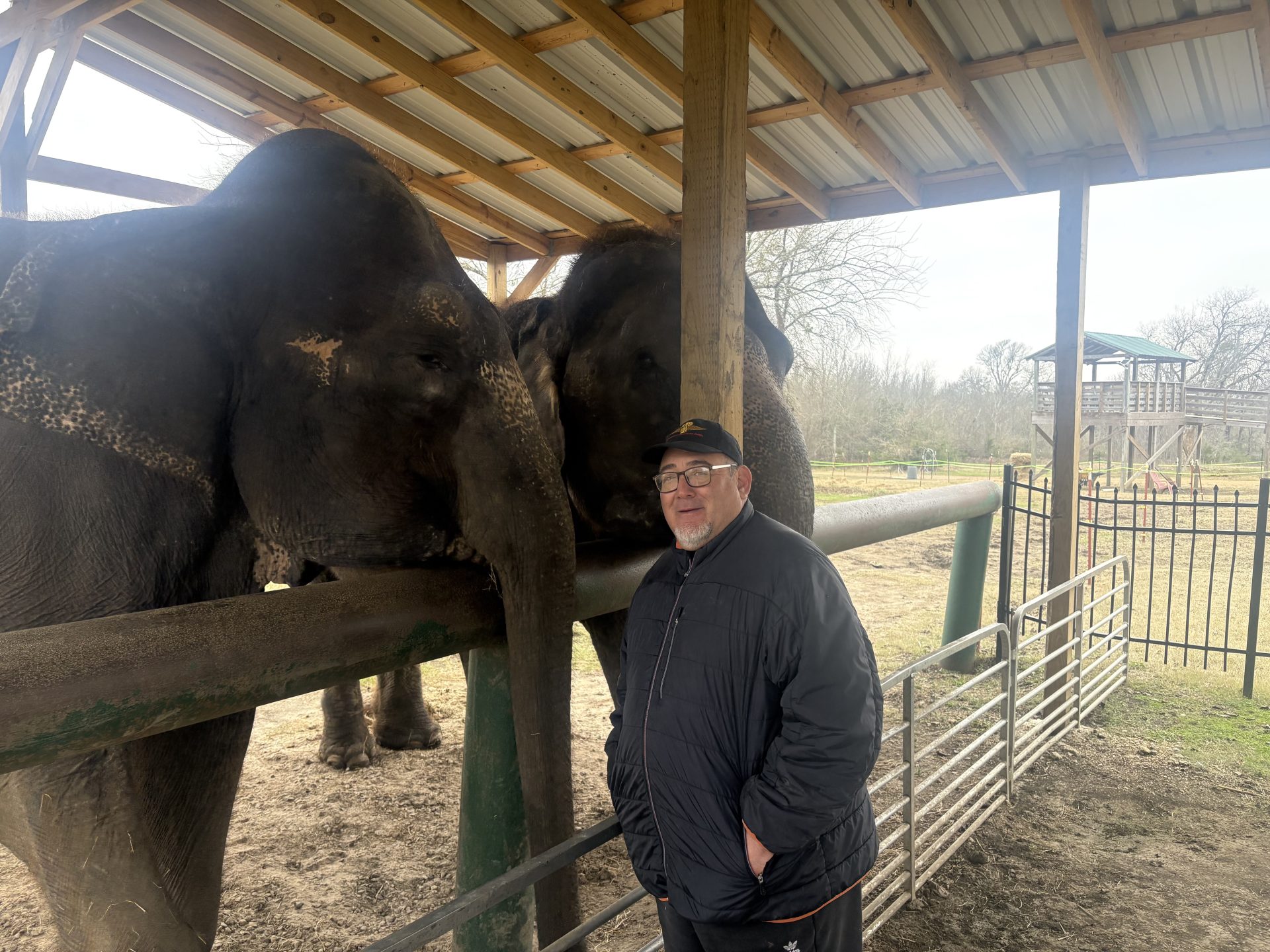
As for the punters themselves? All year round, but especially in Hugo at Christmas, they come for the elephants. A handful still winter in Hugo, while others, like Lisa and Tracy, now live here year-round. Semi-retired, the duo spend their golden years at the 270-acre Endangered Arc, a community for aging circus beasts. Not that they’ve lost any of their enthusiasm, swaying excitedly at the sight of a visitor. The bobbing and weaving is a disarming non-verbal plea: “pet me.” Sweet nothings and a stroke of their trunks elicit what’s best described as a purr. Kids, pogo-sticks of excitement, squeal. Parents swoon. But these circus cut-ups are professionals to the tips of their tusks. At the appointed moment, Lisa strikes her “blue steel” pose. In a Christmas snap with visitors, Santa and Mrs Claus alongside, she’s as still as a statue, her bobble hat symmetrical, her dignity intact.
Of course, Hugo’s magic is about more than its pachyderms. Take Armando Loyal, Lisa and Tracy’s minder. “They’ve provided entertainment and happiness for people all over the country, all over the world,” he says of his charges. “So, it’s their turn.” Listen to him speak, in fact, and they sound almost like family, with Loyal explaining how he cares for them on Christmas morning even before his own children.
That sense of the circus as something more than work is common here in Hugo. In Loyal’s case, it’s literally true. A ninth-generation showman, his grandparents were brought over from Italy by legendary impresario John Ringling. Some households make dentistry their lineage; for the Loyals, the “family staple”, as Armando puts it, is Roman equestrian riding, or standing atop two galloping draft horses while vaulting into a handstand. Tavana Luvas has lived a similar life. “I grew up with my family all day long,” says the fourth-generation trapeze artist, who learned her craft at her grandmother’s feet. Later, when Luvas had a husband and kids, she wondered how people could live like this.
It’s a question John Kennedy Kane, or “Eggroll” to his friends, has asked many times. Aging and balding, his career as “Canaan: the Human Volcano” feels like ancient history now. Yet his wry humor endures, as he describes the tensions of spending years on end with the same set of people. “You are with each other 24 hours a day,” Eggroll explains. “If you have an asshole that you work with, you only see them eight hours a day. I go back and his feet are hanging in my face because he’s on the upper bunk.”
But like all families, rowdy and rambunctious, circusers find a way — with every member vital to a show’s success. That means performers, yes, both four-legged and two, but also the backstage help. How could it be otherwise with such a grueling schedule? Consider a group like Culpepper & Merriwether, which over an eight-month season plays some 200 shows. The rhythm is relentless: arrive at dawn, bring down the house, then depart to do it all again tomorrow. And, in each new town, the big top must go up — without it, says Dave Williams, the Culpepper booker, “you don’t get to play”. Little wonder he reserves special praise for “the true stars of the show”: those tough folk who drive 120 stakes into the ground to hold and harness the tent.
For decades, this family effort, this “with it and for it”, paid off. Focusing on communities of less than 3,000 people, circuses like Culpepper brought out crowds — eager for some fun, but hinting again at the deep connections between big tops and small towns. “Nothing else goes there,” Williams says. “But the circus does. I think that’s part of it, another big part is that they are supporting their local group, whoever is bringing it to town. This is about civic pride.” When a circus came to Hugo in the old days, a pageant of animals and performers would parade down Broadway, the town’s main thoroughfare. Schools closed, businesses shuttered, and local celebrities rode elephants as part of the pomp.
Such festivities are getting rarer. A century ago, nearly 100 circuses and their menageries toured the nation. Today, there are 50, and that’s on a good day. Bad news for Hugo: winter retail has collapsed, and a once-bustling downtown, with its 11 department stores, now feels ominously still. Television and smart phones have doubtless played their parts here, but so too have changing mores toward the circus’s four-legged titans. “My God, protesters would be out there trying to stop us,” Eggroll says of animal-rights activists, with grand parades increasingly swapped for furtive night-time setups. “When did we become the bad guys?” Eggroll adds. “When did we become the villains?”
To be fair, there are genuine problems here, or anyway there used to be. In 2011, for instance, the Ringling Brothers circus was fined $270,000 after revelations that its elephants were chained, whipped and left in cages full of feces. By 2017, the iconic group had ended its 146-year run, though has since reopened with an animal-free show. Other challenges are harder to resolve. In September, a 37-year-old animal tamer, related to Loyal by marriage, was killed by his own tiger as his wife and daughter watched ringside.
On this second tragedy, Loyal is grimly philosophical. “We all know what we signed up for.” On the broader question of abuse, he concedes that “bad apples” will always exist: but emphasizes that throwing “everybody into one single pot” is wrong too. Turning to Lisa and Tracy, he shrugs and smiles. “Come and meet me. See how I take care of them. See how I love them.” Eggroll makes a similar point, suggesting that activism has actually changed the circus for the better. “We all saw animal treatment improved on shows because of the spotlight being on it,” he says. “Well, now — the elephants can roam free.”
The circus is modernizing in other ways too. Once upon a time, the big top was about clean-cut fun, all mimes and magic. Now, audiences craving some post-Covid liveliness go for something bawdier, with groups offering blue-humored clowns and strip teases. It may help, too, that the circus has remained gloriously apolitical, perfect for punters desperate to escape the bitterness of American politics. No wonder Royal the ringmaster describes his work as a “reply to our terrible times”.
Whether that’s enough to save Circus City, USA is another matter. With only three circuses now wintering in Hugo, it could soon become just another prairie town, with its rodeo team and its Walmart. Even so, circus lifers remain sure of their work. “Nobody’s farther away than about 40 feet from the ring,” Williams says. “So, you’re right on top of it. You can see them sweat. I think that’s the whole thing, and it’s the joy.” There are financial calculations here too. A ticket for four will set you back a mere $50, a godsend for people in places like Hugo, where 25% live below the poverty line and where per-capita income is less than $12,000.
Not that anyone really cares about the money. “You don’t go into show business wanting to get rich,” Williams says, who quit a stable job in accounting to book circus acts. “That’s not what it’s about. You either feel it in your heart, or you can’t do it.” Loyal is just as romantic, explaining how he can tell whether someone is a would-be circuser just by looking at them. You’re either the type to love “good trouble” — or you’re not. “Let me tell you,” Loyal says, “you can look in the crowd, and somebody that’s from the circus can tell. You can just look at people and know.” Being “with it and for it” means connection, a spiritual bond that’s invisible to most — but rainbow clear if you’re a member for life.
And, perhaps, for even for longer than that. When he dies, Jim Royal will be buried in Showmen’s Rest, and his plot will come with an inscription: “He knew how to read a lot.” Not that Royal, or the circus he so loves, is quite there yet. This, after all, is Hugo at Christmastime, a place where “with it and for it” is sung as loud as any carol. And so, for the moment, the festive parades go on, with their face paint, and floats, and a pickup truck pulling the Grinch on a flatbed. And, at the center of it all come Lisa and Tracy, swinging their trunks for all they’re worth, the Santas on their backs a sideshow for once. Oklahoma smiles a Christmas Day grin, and the circus family does too. “Look at where we are,” says Luvas. “We’re watching Santa on an elephant. Where are you going to see that? Just here.”
Jeff Bloodworth is a writer and professor of American political history at Gannon University
 jhueybloodworth