




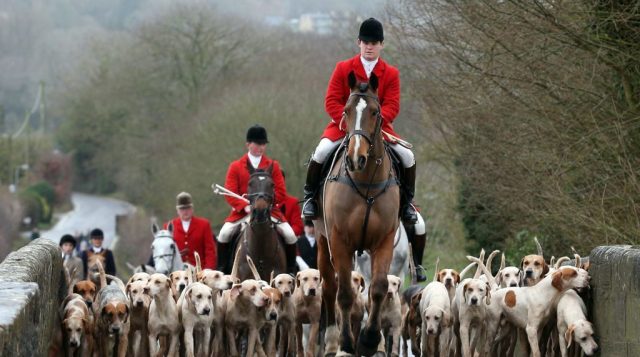
'Sponge’s travels allow Surtees to deploy battalions of venal, selfish, ludicrous and delusional characters.' (Matt Cardy/Getty)





This morning, hunts across England and Wales will gather for their last Boxing Day meet. Anxieties over the future of hunting are nothing new. In the 18th century, huntsmen worried that the expanding canal network, which effectively laid a series of un-jumpable barriers across the countryside, would put an end to the sport. The railway provoked similar fears a century later. But while hunts adapted to a changing landscape, a radically changing culture is another matter entirely. Twenty-one years after fox hunting was outlawed, Labour’s commitment to ban trail hunting seems absolute.
In 1924, the critic Charles Whibley wrote that a certain novelist would not be forgotten “until the hunting field, with all that it means and has meant to English life, is utterly abolished.” Perhaps he was right. The moment of abolition has arrived, and who but a small band of enthusiasts has heard of Robert Smith Surtees? His creations, displaying characteristic self-interest, have decamped to the works of better-known writers. Messrs Sponge and Jorrocks, his most celebrated offspring, are found in the pages of Virginia Woolf, Rudyard Kipling, Siegfried Sassoon, Evelyn Waugh and John Buchan.
None thought Surtees required any introduction. They assumed that his characters were as familiar as David Copperfield or Elizabeth Bennet. His best novels — Jorrocks’s Jaunts and Jollities, Handley Cross, Mr Sponge’s Sporting Tour, Mr Facey Romford’s Hounds — seemed to have secured a permanent place in the minds of British readers. They had also attracted foreign admirers. Teddy Roosevelt enthused over “the immortal Soapey Sponge”, while the French critic André Maurois described Jorrocks’s Jaunts and Jollities as nothing less than “le chef-d’oeuvre du roman anglais”.
Robert Smith Surtees was born five months before the Battle of Trafalgar. He died two months after the opening of Charing Cross railway station. The second son of County Durham gentry, he set up as a London lawyer, though quickly succumbed to journalism. In 1838, he inherited the family estate, Hamsterley Hall. He stayed there for the rest of his life, hunting, shooting and writing. His books are often described as “sporting novels” because they’re notionally about hunting. But foxes were never his real quarry. Surtees was far more interested in running his fellow men to earth.
Mr Sponge’s Sporting Tour (1852), the novel so loved by President Roosevelt, sees “Soapey” Sponge traveling around northern England. His goal is to hunt as much as possible without spending any money. In fact, he’d rather like to turn a profit. Sponge by name and nature, he secures tenuous invitations to country houses and then fails to leave. He eats, drinks, smokes and hunts. He tries to sell his troublesome horses, both handsome beasts with serious behavioral issues, for far more than they are worth. When not hunting, he spends hours scouring Mogg’s Ten Thousand Cab Fares, an exhaustive guide to London’s transport system. “It’s a book I never travel without,” Sponge explains. “It’s invaluable in town, and you may study it to great advantage in the country. With Mogg in my hand, I can almost fancy myself in both places at once.”
Sponge’s travels allow Surtees to deploy battalions of venal, selfish, ludicrous and delusional characters. Many are unforgettable. Mr Jawleyford, one of the first to get sponged, is a case in point. Free with invitations, though outraged when they are accepted, he fills the walls of Jawleyford Court with portraits of himself. Ingratiating with the rich and powerful, he serves corked port to everyone else, and only rides to hounds if there’s a chance to hobnob with county bigwigs. Such an attitude to hunting is typical of most characters in the novel. Consider Mr Waffles, an epicene swell who views hunting as an opportunity to host lavish dinners and wear exquisitely cut coats. Or Mr Puffington, who becomes master of the Hanby hounds “because he thought they would give him consequence.”
Surtees knew that there was much more to hunting than the chase itself. Writing about huntsmen also meant writing about ostlers and eligible young women, coaching inns and ball rooms, grocers and gentry, horse-traders and dandies. Jorrocks himself is no drawling squire, but a Cockney grocer made good, who hunts because he loves it. This all chimes with a point that defenders of trail hunting have made time and again: that it’s much more than an activity. It is a community, stretching back through time, that provides meaning and belonging to a much wider variety of people than is commonly acknowledged. The communal aspect of hunting was appreciated long ago. In a 1680 poem called “The Fox-Hunting”, an entire village comes out to watch the chase. Excited mothers throw down their children, farmers cheer, and even the vicar gets involved: “A clergy-man I understand / Unto this sport was hasted / Having a psalm-book in his hand / And at the fox he cast it.”
Still, Surtees was a clear-eyed sort with no illusions about human nature. As Rob Williams, chairman of the R. S. Surtees Society, told me: “Mr Sponge loves hunting and very little else, but the people he meets mainly pretend to love it – because they think it lends them social ton or will help them with finding a wife.” Reading Surtees for the hunting scenes is like reading Patrick O’Brian for the naval battles — yes, they occur, but less often than you might expect, and they aren’t really the point of the enterprise. Surtees lavishes far more attention on the foibles of his infuriating, delightful characters than on hunting. But the hunt is always his point of departure, his gateway into broader human comedy.
Take the moment that Mr Sponge and a friend write up the day’s chase for the local newspaper. Full of energy and enthusiasm, they sit down to compose their article. The procrastination begins at once. First, cigars are smoked. Next, dry ink is revived. Then they discover that the pens are “clotted up to the hocks with ink, or split all the way through”. Would you believe it, there’s no penknife either. After much discussion, a straight razor is found and used to achieve a writing point. Satisfied, the men sit down once more. Silence. How to begin? “‘Begin!’ replied Jack, ‘begin, oh, begin, just as you usually begin.’” The silence deepens. Eventually, a first sentence is dragged onto the page. But is it quite right? Was the pack splendid or stunning? And so it continues. “You don’t s’pose one’s pen goes of itself,” growls Soapey, a complaint familiar to anyone who has written anything longer than a tweet.
The real pleasure of Surtees is found in scenes like this. Small moments of human frustration, tightened into humor. There are many other reasons to read him. When Jorrocks rides down the Strand in full hunting rig, Surtees delivers the feel (and vanished Cockney accents) of early Victorian London by introducing a crowd of piss-taking newspaper boys: “My eyes, vot a swell! — vot a shocking bad hat! — vot shocking bad breeches!” This gift for atmosphere extends to the small struggles of daily life. Sponge and his acquaintances are on a constant quest for a warm room and good food. “Great was the noise of eating” is a typical Surtees line.
The writing is always clear. The plot, less so. No straight shots on the turnpike here, but stately tours along winding, tree-choked lanes, with the occasional need to jump a fence and hack across country. Surtees’s books are huge and meandering. Like Sponge’s horses, they set their own pace. Characters appear, have great attention lavished on their appearance and background, and then wander off for 200 pages. Some are never seen again. Storylines come and go, gleefully abandoned if it means time can be spent in Mr Jawleyford’s vulgar new gallery or plotting new job prospects with saucy grooms like Peter Leather. Surtees is made for dipping, each chapter offering a self-contained narrative and a return to a familiar, comforting fictional world.
When Charles Whibley wrote of the hunting field’s abolition, it was as a rhetorical flourish. A century later, both Surtees’s novels and long rural tradition have faded to the margins. When Labour’s ban on trail hunting goes ahead, England will become a little less lived in. For many, this will be good news. For others, it will be the end of a way of life. This is true of huntsmen themselves, but also the tailors and the hounds and the crowds that come out every Boxing Day. Any good anthropologist would include hunt saboteurs, too, who may find that they miss their own sense of purpose and community when the last horn sounds.
But Surtees would not approve of too much gloom. This is a good time of year to read him, especially if, like Mr Jorrocks, you require a period of quiet convalescence after “too much roast-beef and plum-pudding at Christmas, and prolonging the… festivities a little beyond the season allowed by Moore’s Almanack.” While it’s unlikely that he will ever be a household name again, the vanished England which Surtees wryly recorded and affectionately mocked remains an object of fascination for many. And, as Rob Williams points out, there will always be a market for “his relish in exposing cant and teasing the faux-pious.” The R.S. Surtees Society has kept his books in print, ready for another generation of readers. Like Mr Sponge, the novels of Surtees have proved adept at securing new, if tenuous, lodgings. Let’s hope the invitations never dry up.