




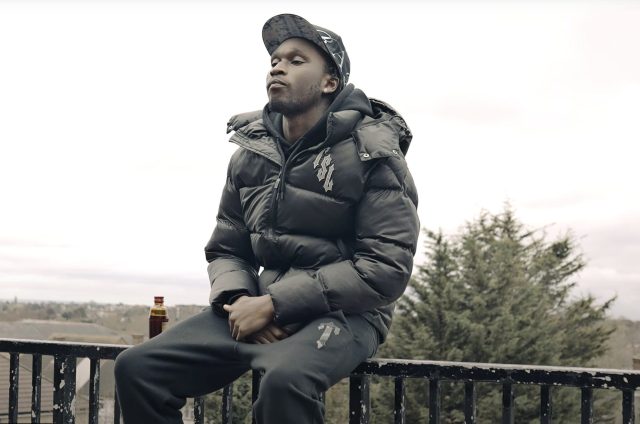
As the East London rapper Berna, pictured, put it: 'And the gang do crimes cause crime pay'. (YouTube)





Alibi, a bar in Altrincham, Cheshire, recently made the news for banning solo patrons after 9pm. But it’s worth noting what else the landlord frowns upon — or rather, who else. “No sportswear/trackies,” wrote the landlord, Carl Peters. “No Stone Island. No ripped/frayed jeans. No baseball caps. No roadman vibes.”
Roadman? To the uninitiated, the term generally refers to a young, working-class black Londoner wearing a black puffer jacket, a dark tracksuit, black Nike Air Maxes. The look fuses the casual with the athletic. He might be carrying a manbag and wearing a face covering of some sort. He mostly listens to grime and drill music and he speaks a kind of Multicultural London English (MLE), often sneered at as “roadman English”. Yes, that guy.
In the 2000s, the roadman had a negligible presence in the mainstream. He was very much associated with grime culture (Run the Road, a seminal early grime compilation, was released in 2005). Since the 2010s, however, the figure has stepped into the mainstream, thanks to films and TV shows like Anuvahood and Top Boy, and the rise to prominence of drill music. Michael Dappah’s caricature of a roadman in his satirical 2017 song “Mans Not Hot” was a turning point. It turned the figure of the roadman into a meme, made him loveable even, pushing many signature phrases into everyday speech and opening the door to TikTok trends like the “roadman parliament” and “roadman translation“. Luxury fashion brands, always keen to make money from black-originated trends, have put out streetwear inspired by roadman chic. So what was once a niche, underground, street identity and sub-culture associated with inner-city black youth has morphed into a mainstreamed, commercialized aesthetic and memeified trope.
Take, for instance, Stormzy’s McDonald’s advert from earlier this year. The advert encouraged people to “order like Stormzy”: to march up to the counter and use his distinct roadman English lingo: “mandem”, “ting”, “fam” and so on. The joke, of course, was that white English people, especially those who don’t live in London, don’t talk like that, perhaps even aren’t supposed to. I wonder how it would go down if Harriet from Oxfordshire strolled into her local McDonald’s and tried speaking like this.
But the roadman — or as British-Nigerian comedian Nabil Abdulrashid’s referred to him in a skit, “the gentleman of the road” — is an authentic British figure, part of a subculture that grew within a much wider multicultural urban milieu. The term derives from Jamaican patois — to “run di road” is to be in control of a particular area — signifying its origins within black Caribbean culture. His ancestors are the “rudeboy” and the Yardie, who were for a time the bogeymen of black criminality in British society. The rudeboy, forged in the street-gang-infested shanty towns of Kingston, symbolized the rebellious culture of Jamaica’s post-independence youth, who crossed the Atlantic into Britain in the Sixties and Seventies through the post-Windrush immigration wave. Known for their sharp suits and pork-pie hats, and immortalized in the ska and rocksteady music of the era, the rudeboy archetype soon became at the center of sensationalized discourse around mugging. In the Eighties and Nineties, the Yardie, likewise a product of the Jamaican diaspora, became the evolution of the stereotype, encapsulating all the fears white British society harbored about black British youth. For the writer Jeffrey Boakye, the Yardies were seen as “ostentatious gunmen obsessed with cars and jewelry, speaking in broken English from a former colony and completely unconcerned with the safety of the majority white public.”
More specifically, and as its etymology implies, to be a roadman is to be someone who is “on road” — the British equivalent of being “hood”. This means that the roadman operates in the mean streets of the post-industrial urban metropolis. To “do road” may mean to sell drugs, to be involved in petty street crime, to play drill music loudly in public, and to keep an eye out for the “opps” — gangs of rival roadmen. The roadman’s calling is not a glamorous one. “Doing road” means struggling and hustling to survive in an unforgiving world by any means necessary, which will take its toll. The rapper Berna, who was raised in an East London council estate, put it this way: “And the gang do crimes cause crime pay / Can’t wait for the day we don’t have to / But if one don’t die it’s a nice day / So I always gotta watch how I move”. The roadman knows his life is a vulnerable one, that he always has to look over his shoulder: but he knows he cannot admit weakness.
In this sense, being a roadman is both an accusation and an achievement. Yet he is also a figure of parody, derision and pity. The roadman exists within a hierarchy within the criminal underworld — alas, for him, he is at the bottom of it. He is just entry level. A few echelons above him in his social ecology is the badman, who lives by his own code. Being called a badman is an accolade. The badman is tough, fearless and dangerous. His reputation for violence and dominance earns him respect on the road. He is discreet, but everyone knows not to mess with him. It’s like being an alpha: something you can call someone else, but never yourself.
Plenty of roadmen talk a good game and think they’re a badman; that is until they meet a real badman. In Guy Ritchie’s film The Gentlemen, there’s a scene where one of the main protagonists, played by Charlie Hunnam, confronts a bunch of machete-wielding roadmen who have a phone containing crucial information. They refuse to give Raymond back the phone, even as he offers money for it. With some bravado, they warn him to go away or they’ll cut him up — until he pulls out a compact sub-machine gun to demonstrate who really is the apex predator. The scene has spawned a small internet subgenre of “roadmen meet real gangsters” compilations.
Still, due to social media and general cultural commodification, the roadman “look” and the roadman lifestyle have somewhat become divorced from each other. Many young people, and not just in the main cities, adopt the roadman aesthetic, speak a multicultural English dialect, and listen to grime and drill without being a part of that life.
And if London was the social laboratory where the roadman was born, the phenomenon is no longer contained to the capital. The roadmen of Birmingham will speak “Multicultural Birmingham English” (MBE); similar to its London equivalent but adapted to a Brummie context. The chav subculture of the 2000s (racially coded as white and out of London) has largely been subsumed by roadmanism. You even have white poshos from the Home Counties who cosplay as roadmen to appear more “authentic”. Indeed, the racial imagination has always been fascinated with blackness as a source of Dionysian vitality: from minstrel performers to Sacha Baron Cohen’s Ali G. To connect with “blackness” is supposedly to connect with one’s elemental impulses — a momentary means of escape and rebellion from a repressed white, Protestant, bourgeois mode of existence.
It’s tempting to reassess the roadman in this light. Given that “integration” is a consistent if vexed topic in our national discourse, it has been argued that roadman-ism might be one of the few (sub-) cultures within Britain that can easily integrate, or rather assimilate, newcomers. For one, it has a low barrier of entry. It’s genuinely inclusive and open to new influences. To be a roadman doesn’t mean assimilating into blackness. It is really a pan-ethnic subculture, in many ways the default youth culture of the super-diverse cities that immigrants and their children encounter. For second- and third-generation immigrants who are alienated from both the mainstream national culture and the native culture of their parents, being a roadman offers an identity, a surrogate tribe (a mandem), something to “belong” to. Perhaps, then, roadmanism is the closest thing there is to a British melting pot.
But I’m not sure this is a model of integration that should be championed. The roadman is also a champion of ignorance, parochialism and shallow machismo. Newly minted roadmen who plunge deeper into that life will aspire to be a badman, often laboring under the delusion that doing “badness” is how you express just how masculine you are — and that you become “someone” through inflicting damage on the “opps”. That inevitably will lead to bloodshed and devastate communities. Crime and urban violence is a young man’s game and it is young men who are its biggest loser: 83% of teen victims of homicide were killed by stabbing in 2024; young men (aged 18-24) were eight times more likely to be killed by stabbing compared to young women.
The function of roadmanism, as Mark Fisher once wrote of hip-hop, is to operate as an “anti-mythical myth”. The Weltanschauung of the roadman has no room for sentimental idealism. It reveals life for what it supposedly really is: a social Darwinist struggle where only the fittest survive. Why was Henry Hill so enthralled by the gangster life in Goodfellas? It wasn’t just the money and flashy goods. It was a sense of freedom and excitement — of no longer being a non-player character in a dead-beat job.
And so the roadman “vibes” have transcended their working class black British origins to become the cosmopolitanism of the lumpenproletariat. The best remedy for it is a dynamic civil society that inspires young people to reject this nihilism. To translate their talent and graft into society’s gain. To realize that they can be free in society rather than acting against it. To discover meaning and purpose. Until such a thing exists, the roadman life will be the life that purposeless young men fall into. White middle-class people may laugh at the memes — but out on the road, baleful consequences will follow.
Ralph Leonard is a British-Nigerian writer on international politics, religion, culture and humanism.
 buffsoldier_96