




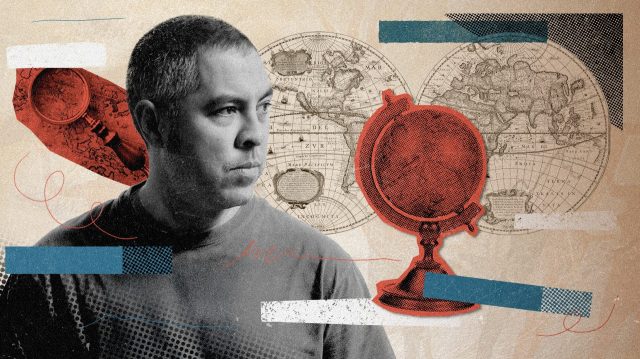
Star academic Jason De León represents a change in the field. Credit: UnHerd





The keynote speaker, a well-known American anthropologist in his 50s, wearing a tight T-shirt that showed off his tattooed arms, stood on stage in front of a packed ballroom at the annual conference of the American Anthropological Association, the most elite social-science gathering of its kind in the United States. “To quote the taxi driver who drove me from the airport,” he said, pausing for one theatrical beat, “ ‘fuck ICE!’ ”
The audience — from gray-haired professors at the top of their game to undergraduates, there to present a poster — whooped, cheered, and clapped enthusiastically.
We were five minutes in, and I, an ethnographer with a doctorate in anthropology and 30 years’ experience, already felt not-at-home. The speaker, Jason De León, an academic star who has won every major award the academy can bestow, began his talk by recounting how he’d “remained silent” during an event he attended at which colleagues offered public condolences for the recently murdered Charlie Kirk. He’d been disturbed by the sympathy, he said, because “Charlie Kirk was a peddler of hate speech.” However, his silence had “inhibited” him, and his speech for that prior event was mediocre, he told us, because he had not been “true to himself.”
Next, he issued a trigger warning before diving into a tale of his traumatic childhood, his identity as a man of color, his emotional numbness, his therapist, his need for danger, and his fieldwork among human traffickers. He showed us childhood photographs. He wept. He said he’d told the traffickers that he was “fucked up, too.” They were “damaged, fearful, angry men,” he said: “so am I.”
De León is not an outlier. He represents a new academic persona of Therapeutic Scholar-Hero, whose ascendancy spells nothing less than the death of the university: not the first time this death has been predicted, to be sure, but the first time it feels earned. This persona claims its authority not from intellectual credibility or scholarly rigor, but the capacity for emoting. The narcissism of the Therapeutic-Scholar Hero isn’t a bug, but a feature.
Over the next three days, I witnessed similar behavior at numerous symposia and presentations. At the symposium on “feminist ethics,” organizers handed out a book list that featured exclusively “disabled scholars.” The first presenter announced her pronouns as “she/they,” and told us that her disability had “flared,” ahead of the conference, preventing her from preparing. She’d also been sidetracked by “urgent” campus activism: “I almost didn’t come, but I needed to publicize my book!” The audience loudly cheered.
This was rank self-promotion, disguised as vulnerability. Her talk, unsurprisingly, was thin, disorganized, and derivative. She ended with a call to resist the “fascist state” because “ICE is coming to this town next.” More rapturous applause.
Or take the symposium on autoethnography, a subfield of anthropology in which researchers use their own lives — their emotions, relationships, and personal histories — as data. The room was full long before the talk began, with several high-profile scholars in attendance. One after another, the speakers shared personal or familial stories adorned with ethnographic commentary. One presenter suggested that the dust that had settled near a nuclear test site during her grandmother’s youth caused her grandmother’s early death. This was autoethnographic evidence of the American war machine — and an instance of “missing kin” and “intergenerational trauma.”
In each case, the ethnography merely served to illuminate the personal narrative, rather than to advance a theory. The insights were predictably underwhelming. Although each speaker insisted that story was more accessible than theory, and was more likely to resonate with the “public,” none addressed the central problems of this method: what distinguishes self-expression from scholarship? What are the limits of subjectivity as data? What about distortion, selective seeing, the dangers of solipsism?
The speakers were apparently unbothered by these elementary concerns, preempting scrutiny or critique by deploying the concept of “positionality.” To acknowledge “positionality” is to explore how one’s own biography shapes the questions one asks, and informs both the things one sees and doesn’t see. To speak from a particular position or identity can yield insights, though it also makes blind spots inevitable. The concept was never intended to confer automatic authority or serve as a replacement for analysis.
One speaker concluded by asking, “What does it mean when the story truly leads the way, and arguments emerge out of stories, rather than the other way round?” This question was intended rhetorically, but I can answer it: if the story leads, the story sets the terms. An argument that “emerges” from a story is not an argument, but a statement of feeling. And when emotional revelation is framed as expertise, and scholars are rewarded for being rather than knowing, the university mission becomes therapeutic narrative rather than scholarship. Once who you are is treated as epistemic authority in itself, feeling replaces analysis, and identity displaces argument.
“Being rather than knowing” was on particularly vivid display among the early-career academics at the conference. Young men wore berets, soft floral shirts, and scrunchies on their ponytails. Young women were in army jackets, boots, and elaborate earrings. The clothes were deceptively expensive; the attitude reminded me of 1990s gay clubs, where knowledge of the dress code determined entry. Attendees paired the aesthetic with an aggressively casual decorum: arriving late, eating noisily, putting socked feet on chairs. The message was clear: I reject hierarchy; my comfort is political.
Such conduct provoked in me a sensation I’ve recently grown familiar with: being subtly rebuked — a quick glance, a sidelong smile — by young colleagues. If scholarship is now confessional and moralizing, if identity confers sacred authority, then early-career researchers, even students, can be just as “insightful” as their elders, perhaps more so.
At one panel, a young scholar responded to a methodological question with a short speech about rent and “precarity,” ending with the extraordinary line: “I’ll let you sit with that.” It wasn’t the point that startled me, but the tone: a novice addressing senior scholars in the therapeutic register, as if counseling them. In that small flourish, the collapse of hierarchy revealed itself perfectly.
These younger colleagues are bold in a way unimaginable in my early years, when I was acutely aware of how little I knew and how much I had to prove. I trained under Godfrey Lienhardt, an exquisitely sensitive ethnographer and master of the discipline, whose magnum opus came much later than his doctorate. He believed in form, structure, and the metaphysical stakes of ethnography. His lineage did cosmology, mapping a community’s entire worldview and belief system. The new cohort does identity. And only identity.
But this inversion is not the fault of the youth; academia no longer allows people to ripen. PhDs are time-limited, rewarding speed, compliance, quick conclusions, and ideologically safe frameworks. The old apprenticeship model, in which seriousness and self-knowledge matured slowly, has vanished. The death of the university is, in part, the death of spaces where maturity matters.
Nor are all senior scholars resisting this shift. At the conference, many older professors were fully aligned in tone, performance, and politicized moralism. There were still serious thinkers doing rigorous work, of course, and I attended some of their sessions. But they no longer set the atmosphere of the discipline — the language, incentives, and epistemic norms. And they no longer shape its future.
Nowhere is the decline of analytic clarity more visible than in the university’s treatment of sex. As a category, it has collapsed entirely into “gender,” sliding from the empirical and material into pure subjectivity. At the conference, this was reflected in the pronoun badges we were encouraged to wear. (After several attempts, I managed to delete mine online and print a badge with only my name and university.)
It also appeared in presentations featuring the all-too-familiar patois of gender ideology: “female-identified bodies,” “womxn,” and pregnancy as something that happens to “people.” One paper described “pleasurable violence” within a Central American trans-feminist community as “healing” when consensual, collapsing harm and care into the same category. Another uncritically mapped contemporary Western “nonbinary” gender categories onto non-Western cultures, regardless of the local realities, in the name of decolonization. It was jarring to confront scholars unable to distinguish vastly different cultures and civilizations, and committed to romanticizing pre-colonial systems.
The slide from empirical clarity into therapeutic reassurance wasn’t confined to the panels. Some of the same conceptual moves on display here have already appeared in high-ranking journals: a reminder that these tendencies are not fringe aberrations, but are increasingly institutionalized as “scholarship.” In the book hall, Princeton University Press was prominently displaying Sex Is a Spectrum, the establishment’s polished argument that biological sex can be dissolved into gradations and feelings — a theme reinforced by the book’s author, who was ubiquitous at the conference. Here was another face of the Therapeutic Scholar-Hero: more philosophical than performative, but still committed to dissolving material categories in favor of subjectivity.
I have had a front-row seat at this unraveling, across many disciplines and arenas. The American Anthropological Association conference was hardly unique; but what I saw there was the distillation of the trend into its clearest form. The tragedy is not that universities have become ideological; it is that they have become unserious. A culture that once prized discipline, depth, and rigor now rewards emotional display, political conformity, and autobiographical performance.
The university has forgotten what it was for: to preserve and extend knowledge across generations. That requires hierarchy, apprenticeship, discipline, shared categories, and a recognition of material reality. When these collapse — when reality becomes optional, subject to feeling and “lived experience” — there can be no transmission of knowledge, only performance and self-display.
The old university was often cruel; brilliant older scholars could crush young ones, intentionally or not. I experienced this myself. For this reason, and others, it took me years to find my voice, and more time still to mature into having something worth saying. But the old university also met the world with humility, patience, and an understanding that social science is, at heart, an encounter with the other, not a stage for the self. It was a craft that taught me to pay attention to the world before attending to myself, to question before confessing. That formation shaped my intellectual life, and what I learned then is simply no longer being handed on.
The university once existed to clarify reality. Today, it obscures the real. Everything else follows.