




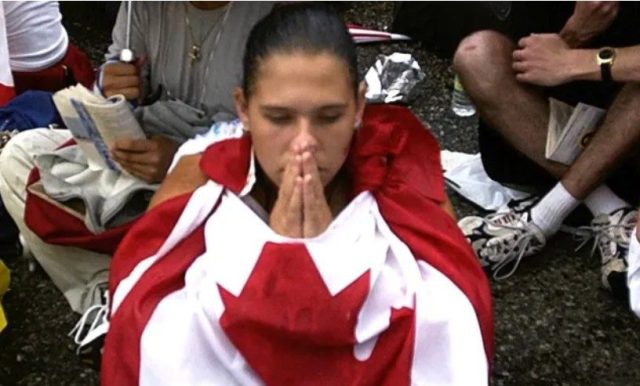
Quebec is set to ban prayer in public, with a fine of over C£1000 for those who dare invoke the deity outside. Marcos Townsend/AFP via Getty.





Quebec is set to ban prayer in public — with a fine of over C$1,000 for those who dare invoke the deity outside. This strengthens an existing ban on public officials like teachers from wearing the kippah or turbans at work, and follows a number of pro-Palestine events that included Islamic prayers as a part of the demonstrations. Opponents of the bill argue that this will make the Canadian province one of the most hostile places for religion anywhere in the world, especially when it comes to Muslim women. Supporters, for their part, argue that freedom of religion is maintained insofar as everyone is allowed to practice their religion, just not in public.
But “religion” is a surprisingly tricky term: and not just for Your Party who offended their Muslim members by signing off their recently chaotic Liverpool Conference with John Lennon’s “Imagine” (“and no religion too”). In our Western post-secular world, we tend to think of it as the kind of thing that goes on in specific spaces — churches, mosques — where it is appropriate to speak of God. Religion thus understood is a kind of specialist pursuit that religious people are into, like a hobby you do on the weekend. Sport is an obvious comparison here. Max Weber coined the term “specialization” when talking about the changes brought about by modernity. Different social activities — whether football or faith — did their own thing, established their own rules and institutions, and existed in a semi-detached way to other activities in life. And just as it is possible to live without knowing how Chelsea got on, so one can live, for the most part, without knowing or caring that we are now in the season of advent.
Before, let’s say, 1500, this wasn’t really the case. And it isn’t really the case for faith traditions that developed outside of the West and specifically outside the orbit of the Protestant revolution that came to govern how we think about that term “religion”. What confuses so many beyond the modern West, and non-Christian minorities within it, is that they cannot conceive of religion as simply being the theological equivalent of buying a ticket at Stamford Bridge. A roll call of places that vex us politically — Russia, Israel, much of the Islamic world — all boast a very different religious “DNA”, one where the boundaries of God’s presence in the world are set in totally different ways.
Take Judaism. It sounds like a pretty straightforward term, one used to describe a religion, like Christianity or Buddhism. But that’s a very modern understanding, one many Jews would not accept, and one that historically would scarcely have been recognized. Even the word “Jew” is a misleading translation of a word like the Hebrew term “Yehudi”. Before the second century, that would have been understood as more like “Judean” — a person from a particular place called Judah. “Jew”, then, is originally an ethnic-geographical term, not a religious one.
Of course, the people from that corner of the Levant had various practices linked to their understanding of God. But to call these practices “Judaism”, and to gather them together as “religion”, misplaces the role that God played in the life of a Jewish person. The great Talmudic scholar Rabbi Daniel Boyarin argues that “Judaism” is a Christian term designed to fit Jewishness into a very Christian template. Tom Holland agrees. After the French Revolution, Jews were told that they had freedom of religion, and were to be French citizens who were able to practice something called Judaism. But as Holland rightly notes, “Jews didn’t have religion”. After all, “religion” as a discreet activity, to be done occasionally and in private, was a totally alien idea to a people for whom identity and faith were indivisible.
To put it differently, then, the very idea of “religion” is arguably a secular one, even as it stems from the deep history of Christianity itself. Certainly, Christianity was the very first to detach its relationship with God from any ethnic or geographical rootedness. You could be a Greek a Jew or a Roman — and still be a Christian. What mattered was what you believed. And through Christianity, belief became the central defining feature of being religious.
This association of religion and belief is further intensified after 1500: thanks to the Protestant Reformation. The Canadian philosopher and sociologist Charles Taylor is particularly illuminating here. The Protestant attack on maypoles and relics, on Christianity as a way of life marked by a panoply of everyday popular practices, reduced religion to something that went on in your heart or your head. This, for the reformers, was where the battle for salvation took place. Yet again, then, religion was about what you believed. And when you gathered in church, it was with other like-minded people.
Back to the Canada secularization bill. If you think of religion as I have just outlined it, then it makes perfect sense to deal with the sort of conflict that can come about by having different world views rubbing up against one another by defining the public sphere as one safely free of religion. After all, religion understood as private belief can be practiced freely in specialist religious spaces. This liberal answer to the religious clash of worldviews is a tidy way of both respecting people’s right to their own faith — and maintaining good public order. Yet this liberal answer to the challenge of a multicultural society only works if Jews, Christians and Muslims all accept that they indeed are a religion in the Western sense of the word.
This is by no means certain. For Muslims, after all, the term “religion” is a kind of trap. Like the trap sprung for Jews by the French Revolution, it is a know-your-place kind of word, one that seeks to fillet what it is to be Muslim. And very few Muslim could accept that. But by that same token, this idea of religion is also a trap somewhere like Israel. The idea of Israel as a majority Jewish state, where Jews are free to behave as Jews, is premised on the idea that there is no such thing as “Judaism” as a religion in the narrowly Protestant sense: but rather that being Jewish is an entire way of life. Indeed, it is perfectly possible to be a Jew in Israel without believing in God or going to synagogue — because being a Jew is a combination of ethnic identity and involvement in various public and family practices that don’t necessarily require that Protestant emphasis on belief. A Jewish atheist isn’t an oxymoron in a way that a Christian atheist is.
A word in Arabic that appeals many times in the Quran and is often translated as “religion” is the word “deen”. But a better translation is something like “way of life”, or “way of life that should be followed”. A word with the same root appears in Hebrew, and occurs, for instance, in the “Beth Din”, the “House of Judgment” or religious courts. Deen, then, is far more all-encompassing than the Western term “religion”, one relegated in Quebec and elsewhere to mere private belief. It includes public life, government, food, clothing, law, art, everything. This is why Muslims and Jews who are promised freedom of religion by secular Western states are bound to feel confused.
Of course, none of this is to say that the secular answer to maintaining fairness in the public realm is necessarily wrong. Even so, the very different idea of religion as deen, doesn’t, if I can put it this way, travel very well. You could almost say that Christianity was, right from the start, designed to be portable. All those maps of St Paul’s journeys around the Mediterranean, which they used to have in Bibles, was an indication of an understanding of religion that could uproot and replant itself in different cultures. We should not expect that other religious traditions will find it so easy.
