




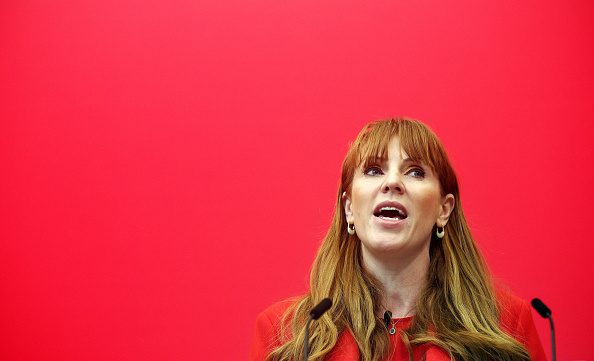
Prescott in a pantsuit. (Credit: Eddie Keogh / Getty Images)





Once upon a time, Keir Starmer’s dullness was paraded as a virtue. After years of Conservative scandal and infighting, the Labour leader’s dependability was meant to be a tonic. Yet, like his Tory predecessors, the Prime Minister has stumbled from disaster to disaster, not least of which is the fallout from his appointment of Peter Mandelson as US ambassador. Starmer withstood the initial revolt — albeit at the cost of his chief of staff, Morgan McSweeney — and remains in situ. This week’s parliamentary recess will be a welcome pause for the embattled Prime Minister.
But the next setback might be the one that ends Starmer’s leadership. As for his successor, the Westminster gossip mill continues to turn. Who will step up? Given the dissatisfaction with Starmer’s roboticism, there is a sense in the party that what is required is a leader with personality: someone Labour can lean into, liking, rather than begrudgingly supporting. Andy Burnham fits the bill, what with his Fred-Perry-and-an-accent embodiment of the professional Northerner. But Burnham’s hope of running in the Gorton and Denton by-election was thwarted by Labour’s National Executive Committee, a decision that will keep him out of Parliament for the time being. Meanwhile, Wes Streeting is too close to Mandelson, and too disliked in the party, for his obvious ambitions to be realized. Ed Miliband, though popular within the party, has ruled himself out. That leaves just one credible candidate, someone rarely accused of roboticism.
Angela Rayner, the former Deputy Prime Minister, has her own political struggles. She is still under investigation for her tax affairs, for instance. Even before she lost her job over the matter, she was unpopular with much of the public. But we live in an era of bloc politics. The old duopoly is broken. Left and Right are not fighting over voters in the middle; instead, Reform and the Conservatives are competing to be the main party of the Right, while Labour faces competition from Greens, independents and Your Party for the votes of the left. In the chaos, apparently divisive characters can take advantage by uniting their bloc — if not the country.
Could Rayner take such a path? So far, she has ably navigated Labour’s modern factionalism, promoted by both Corbyn, of whom she was later critical, and Starmer. She has praised Blair yet earned the plaudits of John McDonnell. As such, she is well placed for a crack at the leadership, and is said to have attracted lots of donor cash. Her polarizing nature would normally be a weakness, but now it might offer the Labour Party something that it currently lacks: a sense of identity. Rayner has a strong accent, a blunt way of speaking, and an eye-catching sense of style. Unafraid to be pictured with a fag and a pint, she can be to Labour stereotypes what Ken Clarke’s cigars and whisky was to the Tories. Rayner once dubbed herself “John Prescott in a skirt” — embracing the idea of herself as a union bruiser and standard-bearer of the old Left. When Starmer eventually falls, she could be the one who fires up the enthusiasm of the Labour base.
It is, after all, hard to think of a character more explicitly Labour than Rayner. She left school as a pregnant 16-year-old, yet would one day reach the top table of British politics. It is a mythos that delights Labour Party members, and one that is entwined with the party’s history. Rayner credits the Tony Blair government with the state help — childcare and training — that got her into work and enabled her to support herself and her children. From there, she moved into the unions, rising through the ranks as she established her political career. In a party where aspiring candidates talk of their grandparents’ factory jobs in their attempts to project authenticity, Angela Rayner is the real thing. That authenticity is both her chief asset and one of her biggest liabilities. Allies see her as forthright; her opponents dismiss her as “chippy” and “uppity”. Rayner herself has dismissed Tories as “scum”, a comment she took a month to apologize for.
It is a jibe that could help Rayner in a leadership contest rather than hinder her. In such a contest, she would be appealing first for the support of MPs, who whittle down the candidates, and then for the votes of members — who tend to be to the left of the Parliamentary Labour Party. It will be in Rayner’s favor that she has generally shied away from ideological and intellectual fights within the Labour Party. Instead, she has portrayed herself as a pragmatist. Internal purity tests come second. As she put it in 2017: “Ideology never put food on my table.”
Still, it has been half a century since Labour held a contested leadership election while in power, and it is difficult to predict how the party will behave. Pragmatism suggests swinging behind the most electable candidate, but there is always a chance that members will pull behind someone who flatters their own prejudices and can’t actually govern. The Tories’ experiment with Liz Truss should serve as a warning to Labour.
If Labour members can bring themselves to think of electability as well as Left-wing appeal, they will have to countenance the possibility that Rayner might turn out to be a hindrance. Under her leadership, Labour are likely to lose moderate voters who perceive her as radical, even as those on the Right turn out in strength against her. In a polity where median voters matter, that is a fatal dynamic.
But for Labour, the dilemma is that we are arguably no longer in that political zone. With the days of the Labour-Conservative duopoly apparently over, winning might now entail a new strategy. First, you have to unite your side behind you, competing with popular parties on your own side, then you have to outnumber the other bloc. That strategy would appear to call for a divisive candidate.
After all, this is the age of divisive politicians. Boris Johnson had many detractors, but the vigor he brought to the Tory party helped them reach voters they had not reached before. Nigel Farage is leading in the polls despite negative favorability ratings, even worse than Rayner’s. Across the Atlantic, Donald Trump is the epitome of decisiveness, inspiring devotion and hatred — with the former enough to win elections. Having a lot of the population dislike you doesn’t preclude political success, provided your side is enthusiastic enough. Rayner might fit the same mold. Tough-talking, unafraid of a scrap and uninterested in cross-party coziness, she could invigorate the base at the cost of the middle.
The proposal for Rayner’s leadership bid is becoming clearer: she is the high-risk option. While her politics might be pragmatic and hard to discern, her image is not. If Labour were to choose her, it could consolidate the Left-wing bloc by emphasizing her class credentials and presenting a platform that delivers victories for the people she cares about. In that respect, a Rayner premiership could be the antidote to Starmer’s emptiness, offering a more straightforward, principled politics that offends many but seeks to win back the disillusioned left. Voters tell pollsters they see Starmer as a “jellyfish” and a “doormat”. Few would say that about Ange. In power, she would be reviled by the Right, and would relish winding them up.
But the most important question remains whether Rayner can govern. Starmer has been hampered by his lack of personality, but has also struggled to address the multiple crises that Britain currently faces. It is unclear what Rayner would actually do differently, beyond having a bit more spirit. Her time as Housing Secretary was underwhelming, with the government struggling to make inroads on the housing crisis. She has no real record on economic policy — the most pressing challenge for the government — or foreign affairs. Her union background could easily lead to more policies that protect workers, but it could also make it harder and more costly to hire people in the first place. Above all, Rayner has had barely a year’s experience as a minister. There is every chance that, in the top job, she would simply be out of her depth. A highly partisan program could easily implode, especially if it swings towards rapid tax rises on a stuttering economy.
There is also a chance that she could be a Lefty Thatcher: striking, principled, and loved — by her side, at least — for her pugnacity. But the last time a party went looking for a Maggie, they ended up with a Truss. A proudly partisan Rayner could hit the same trajectory: beloved by her base, but badly exposed in the highest office.
John Oxley is a corporate strategist and political commentator. His Substack is Joxley Writes.
 Mr_John_Oxley