




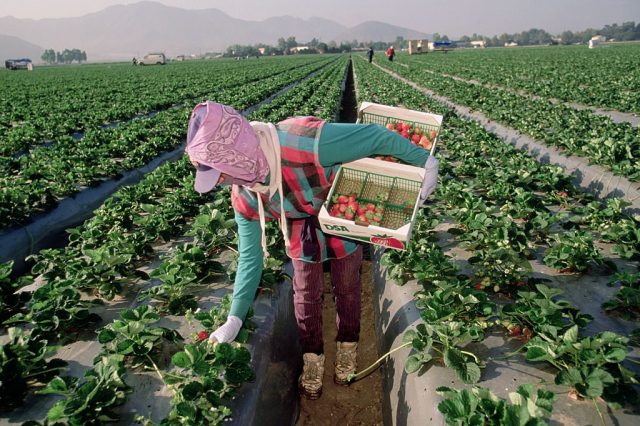
A migrant worker in California. (David Butow/Corbis/ Getty)





Imagine if President Joe Biden had announced that he’d massively boost the number of foreign guest workers that big business could import into the homeland. The American Right, and much of organized labor, would have erupted in fury. Exploitative guest-worker programs function much like offshoring — taking advantage of the desperation of workers in the developing world to undercut the jobs, wages, and bargaining power of US workers. The only difference is that instead of sending the job overseas, these programs bring the foreign worker to America. They call it “labor arbitrage.”
Today, just this scenario is unfolding under President Trump. After sustained lobbying by business interests, the Trump administration is doubling the number of H2B seasonal guest-worker visas it is granting in 2026. This will allow major industries — including hospitality, landscaping, and construction — to import an additional 65,000 foreign workers this year, on top of the 66,000 visas already granted by statute.
The decision comes on the heels of the Trump administration arbitrarily lowering the wages for workers in the H2A agricultural guest-worker program, which allows employers to import seasonal farm workers primarily from Mexico, Jamaica, and Central America, and does not even have a statutory visa cap. Even before Trump’s wage cuts, the H2A program has septupled in size since 2005, and is now bringing in nearly 400,000 seasonal guest workers a year. (The union I work for, the United Farm Workers, is suing to reverse the new wage cut in federal court.)
The Trump administration’s immigration crackdown has generated significant controversy. For the Left, the ICE raids and the agency’s notorious “performative cruelty” — often afflicting long-time residents with close US citizen relatives and without criminal records — have provoked grief, anger, even rebellion. For much of the Right, the images of migrants being detained stoke vindication and triumphalism.
Yet far from headlines and social-media feeds, the Trump administration is quietly replacing one group of cheap foreign workers with another. By its own estimates, the population of the H2A agricultural guest-worker program will grow by as many as 120,000 additional workers a year following the H2A wage cuts — far exceeding the number of farm workers who have been deported. Similarly, by doubling the H2B program, the number of foreign workers in construction, landscaping, and hospitality will ultimately increase, not decrease. After deindustrialization, such jobs are often the only ones available to US workers without college degrees. And now, by Trump policy design, they have to compete with a foreign reserve army willing to work for even less. This, despite the “Americanism” slop the US Department of Labor’s social-media interns like to post, is not putting American workers first.
Indeed, what’s coming into being now is worse than simply maintaining the status quo. While migrant workers excluded from citizenship weaken US workers’ bargaining power, the expansion of guest-worker programs is that problem on steroids. Whereas undocumented workers can at least change jobs and often join unions, guest-worker visas tie employees to the specific employer who is sponsoring their visa. With seasonal visas like H2B and H2A, employers also decide whether or not to bring guest workers back each year. This makes the prospect of organizing a union or negotiating a higher wage significantly harder.
Taken as a whole, the Trump administration’s immigration policy amounts to a system that can best be described as American Kafala. “Kafala” is the infamous migrant-labor system of the Persian Gulf sheikhdoms. Foreign workers live and work in countries like Qatar, Kuwait, Bahrain, Oman, Saudi Arabia, and the United Arab Emirates but remain completely excluded from citizenship and bound to their employers.
Such a lopsided power dynamic between employers and workers has led to horrendous cases of abuse and exploitation. Much was made of Kafala’s abuses in the lead-up to the 2022 World Cup in Qatar. Yet equally abhorrent abuses have already occurred in the similar US guest-worker programs like H2A and H2B, including rape, human trafficking, and forced labor. Expanding guest-worker programs now will lead to more such cases.
Trump, like many rich and powerful people, admires the societies of the Gulf. While corruption may well have played its part in Trump’s close relations with various Gulf rulers — a decked-out Qatari Air Force One is a nice toy, indeed — much of the US president’s admiration for these Kafala-fueled societies seems genuine. Trump notably visited Saudi Arabia, Qatar, and the UAE for the first major foreign trip of his second term as president. During that trip, Stephen Miller, the architect of Trump’s deportation policies, praised an Emirati palace as costing less than what Democrats spent housing migrants. Yet like everything else in the Gulf, the palace was likely built by hyper-exploited, near-slave-like migrant workers.
More recently, Miller laid out some of his most explicit thinking yet on the relationship between labor, migration, and citizenship. It is worth quoting in full. “Plenty of countries in history have experimented with importing a foreign labor class,” Miller tweeted. “The West is the first and only civilization to import a foreign labor class that is granted full political rights, including welfare [and] the right to vote. All visas are a bridge to citizenship.” This is, of course, not true: the West has long denied rights to its imported labor classes. Even excluding the trans-Atlantic slave trade, various gästarbeiter (“guest worker,” from the German) programs have been a feature of the Western world since World War II. And the H2A and H2B in the United States, as well as similar visa programs in Australia, Canada, and the United Kingdom, all function to bring cheap foreign labor into the country without extending the workers an opportunity to become citizens.
Yet for all its historical illiteracy, it was a revealing comment by Miller. He takes no issue with the existence of a foreign workforce per se. One might point out that this is effectively what our huge migrant underclass already amounts to. Yet Trump and Miller are now going even further, expanding guest-worker programs to create not just a foreign labor class excluded from citizenship, but one legally tied to specific employers. If not quite slavery — due only to the fact that foreign workers willingly pursue these visas, even bribing corrupt labor recruiters to obtain them — guest-worker programs are at least a form of indentured servitude, but with no promise of citizenship at the end of decades of hard labor.
There is real bigotry inherent in this position. Miller views foreign workers as less worthy of protections than citizen workers. But the logic is not an ethno-nationalist one, bent on creating the white utopia of liberal nightmares and Groyper dreams. It is an exploitive logic bent on creating a permanent underclass beholden to a global elite of the kind you’d find in Dubai as well as Mar-a-Lago. Miller’s goals, in other words, align perfectly with those of international corporate capital. Indeed, Trump’s moves on guest-worker programs are a reminder of the one constant of the Republican coalition: the interests of Big Business will always prevail. Certainly, there is no reason to expect Trump, whose own businesses have long relied on both H2A and H2B guest-worker programs, to behave any differently.
Immigration restrictionists have been made useful idiots for the Kafala agenda of Big Business. Deportation raids harm a small minority of undocumented workers, while intimidating the far larger group that remains — and will remain, by design. The raids serve two simultaneous purposes for business interests. First, they render the remaining foreign workers more docile than ever. Second, the raids have been cynically used to justify expanding guest-worker programs by citing fear of a deportation-induced labor shortage. This, even as Team Trump has made clear that it will never permit a shortage of cheap foreign labor to hinder the arbitrage game.
To their credit, some restrictionists are clear-eyed about what is happening. Yet they have been either unwilling or unable to get the administration to change course on expanding exploitative guest-worker programs. President Trump’s 2024 election was in no small part a mandate to reduce the number of foreigners arriving in the United States and competing for jobs, housing, and other resources. Certainly among Latino voters, a feeling of competition with recent border crossers was a major factor behind their shift to Trump. Affluent liberals, for whom open borders mean only a cheaper supply of landscapers, delivery drivers, nannies, and handymen, failed to understand the economic stress that many working-class people, especially other immigrants, felt as their bargaining power was undercut by newer arrivals.
Yet the Trump administration is doing the opposite of addressing those concerns. Indeed, Latino voters who may have once supported Trump have clearly begun to turn against him. Meanwhile, the Trump administration is creating an even worse version of open borders: legalizing big business’s ability to bring in workers on demand — without rights. This American Kafala strategy amounts to legally codifying the exploitative relationship between big business and immigrant labor, ensuring that borders remain open to service capital’s cheap-labor needs.
It would be far better for American workers to simply legalize the undocumented foreign workforce we already have, allowing them to compete on a level playing field and organize for higher wages and better working conditions, rather than deporting and replacing it with another foreign workforce permanently trapped in legalized exploitation.
Antonio De Loera-Brust is the communications director for the United Farm Workers. Previously, he served as a special assistant to US Secretary of State Antony Blinken.
 @AntonioDeLoeraB