




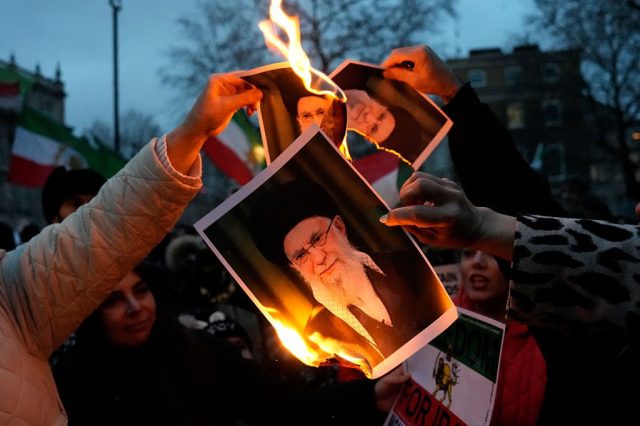
'The Islamic Republic is unlikely to survive.' (Carlos Jasso / AFP / Getty)





As America’s advanced warplanes and ships arrive within striking distance of Iran, Donald Trump has promised attacks “far worse” than those of last June, when Iran’s nuclear sites and air defenses were attacked and several of its military leaders assassinated. In response, the Islamic Republic has signaled readiness to return to the negotiations that Trump’s 12-day war with Israel against Iran had interrupted. Parley between Steve Witkoff, the American envoy, and Abbas Araghchi, the Iranian foreign minister, is to resume on Friday in Istanbul.
It is unlikely, however, that Iran will accept Israel’s demands that it relinquish uranium-enrichment, dismantle its ballistic missile program and desist from reconstituting its network of regional proxies: effectively, the unconditional surrender that the Supreme Leader, Ayatollah Ali Khamenei, has consistently refused to entertain. His inflexibility has come at the price of an unremitting Western hostility that has, along with endemic corruption and mismanagement, crashed the economy and provoked the huge protests, revolutionary in character, which erupted across the country last month. The most plausible explanation for Khamenei’s preparedness to talk, then, is that he is playing for time and hoping that, if the worst comes to the worst, he will be saved by Trump’s aversion to wars which last more than a few hours.
On 1 February, the Supreme Leader warned that American aggression would precipitate a “regional” war, by which he meant Iranian attacks on tankers in the Persian Gulf and civilians in Israel. A few days earlier, Admiral Ali Shamkhani, an adviser of the Supreme Leader — who had a narrow escape when his apartment was targeted by an Israeli airstrike last summer — promised an “immediate, comprehensive, and unprecedented” response, “directed at the aggressor, at the heart of Tel Aviv, and at all who support the aggressor”. But Iran, we now know, is a spent military force and cannot carry out such threats.
Some 1,200 Iranians were killed in the 12-day war, compared with 28 Israelis and not a single American, while enemy aircraft bossed Iranian airspace. Around 90% of the missiles that Iran fired in response towards Israel were intercepted; a mere handful of its 500 or so drones made it into Israeli territory, the rest meeting a similar fate to that of the Iranian drone that flew close to the US aircraft carrier Abraham Lincoln on Tuesday, and was shot down by one of the carrier’s jets. For all Iran’s bluster, the imbalance between a belt-and-braces autarky and the world’s most advanced militaries is as stark as that between the Mahdist army and the British at the Battle of Omdurman in 1898, when thousands of Sudanese tribesmen were mowed down by Maxim guns to the loss of 47 British lives; or between the Mamluks and Napoleon’s Armée d’Orient a century earlier, when a medieval cavalry was put to flight by modern infantry squares spitting grapeshot.
No, it isn’t chaos in the Gulf nor brimstone over Tel Aviv that need concern us should the negotiations fail. It is the possibility of mass slaughter of unarmed civilians in the Islamic Republic itself.
For an ominous pattern of botched outside intervention and the implacable exercise of monopolized force, look no further than last month’s unrest and its suppression. Having begun as street protests by an “army of the hungry”, in the words of Hatam Ghaderi, perhaps Iran’s most perceptive political analyst, the movement took on a radical character after Reza Pahlavi, the exiled son of the last Shah, asked ordinary Iranians to go out and topple the regime on 9 January. The millions heeding his call were further galvanized by Trump’s promise, made a few days earlier, that if Iran “violently kills peaceful protesters… the United States of America will come to their rescue”.
In the event, thousands were mown down, Omdurman-style, on the streets of Tehran and dozens of other cities by Revolutionary Guardsmen firing Dushkas and AK-47s. We don’t yet know exactly how many people died, though the death toll certainly exceeds by thousands the nugatory figure of 2,985 conceded by the government — dwarfing also the 3,164 people killed by the Shah’s forces over the 16 years of sporadic revolutionary activity culminating in the monarch’s flight in 1979. As for the help promised by Trump, it never came.
The bloodiest episode of civil strife that Iran has seen for at least two centuries could have been avoided had the 86-year-old Khamenei bowed to longstanding demands and stepped aside. This would have paved the way for elections to an assembly to draw up a new constitution — a relatively bloodless transition, involving members of the current regime untainted by the worst excesses of corruption and cruelty, might have been possible. By refusing such a transition and turning his stormtroopers on mostly unarmed crowds — amid reports of the Revolutionary Guards’ snipers shooting bystanders in the head and of knife thrusts aimed deliberately at the genitals — Khamenei has cleared the field of potential unifiers, in the process condemning the Islamic Republic and its internal opponents to a fight to the finish.
A former British official with close connections to Western policy-makers told me this week that the thinking among Western countries, including Britain, is that the regime is out of puff and that a collapse as rapid and as straightforward as that of Syria’s Bashar al-Assad is likely. But in 30 years of reporting on the Middle East, I have learned never to be surprised by the ignorance and complacency of our policymakers. Iran resists such a reassuring prognosis; a messier denouement awaits.
Do not be fooled by the worldliness of Iran’s artistic and literary culture or the prosperity and accomplishments of its diaspora. For much of its post-Islamic history, Iran has contained a minority of fanatics; the difference is that today’s fanatics have guns in their hands and their backs to the wall. This is what Hatam Ghaderi refers to as the revolutionary “hard core” which has gathered around Khamenei, and is composed of Revolutionary Guardsmen, hardline clerics and members of the Basij militia.
They learned their trade fighting small, dirty wars in Iraq, Syria and Yemen; their worldview formed in prayer halls and barracks where a hatred of the godless West is propagated alongside a deep yearning for the return of the 12th Shia imam, who disappeared from view 10 centuries ago and will emerge to inaugurate an epoch of justice and peace. Religious meetings are conducted by men who sing of martyrdom and purity; they regard the killing of godless “rioters” acting at the behest of Israel as a virtuous act. With blood already on their hands, they have no way back into general acceptability, and nowhere to go but further and further into their own fantasies of martyrdom, all the while nurturing fond expectations of divine intervention. There is no reason to exclude Ali Khamenei from their number.
Whatever happens in Istanbul on Friday, and during the weeks to come, the Islamic Republic is unlikely to survive. Its people hate it too much. But its fall will not be the simple event that is seemingly contemplated in Washington and Jerusalem. The correct analogy is not with the kleptocracy that melted away with the fall of Assad but with those members of the Waffen-SS who carried on fighting even after Hitler’s death in 1945, exhibiting the same unappeasable contempt for death and hatred of their enemies that they did when he was alive.
When Reza Pahlavi was asked whether he took responsibility for the slaughter on the streets of his homeland, he replied coldly, “this is a war, and war has casualties”. That words have consequences means something tangible in a world of bullets and flesh and the destiny of a people. Many Iranians have entered a war with their regime that must end with the elimination of one or the other. Trump should think hard before he next promises Iranians his help, and mean it if he does, or he too will have blood on his hands.