




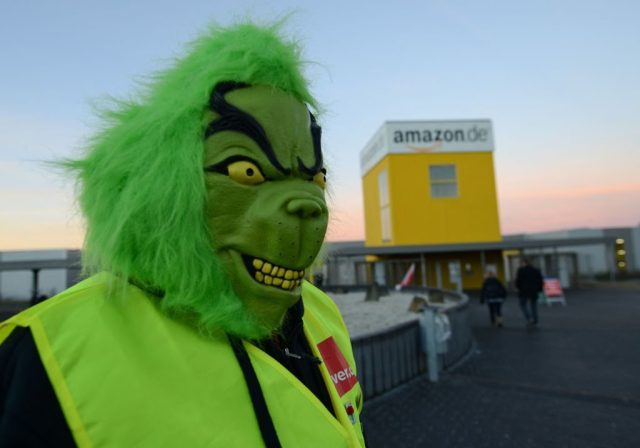
He wouldn't be welcome at Beales. AFP/DPA/UWE Zucchi/Germany Out via Getty.





The ebbing fortunes of Bournemouth aren’t unusual. They echo those of seaside towns across Britain: Victorian origins and Edwardian glamour, followed by the jet-age, foreign holidays and decline. While Blackpool is the epitome of this shift, Bournemouth has fared marginally better. That’s because, unlike other ailing beachside behemoths, the Dorset town once boasted a unique selling point: department stores. Until a few decades ago, half a dozen still lined its streets — and Beales used to be its proudest.
From the moment it opened, in 1881, Beales was at the vibrant heart of my hometown. Called the “Fancy Fair and Oriental House”, it was more palace than department store — feeding the then appetite for Japanese wares, as well as selling photo albums for beach-going visitors. And back then, the Hampshire beach resort wasn’t about vulgar postcards. It was in vogue. The same year Beales opened its fancy doors, John Galsworthy had his protagonist, Soames, meet Irene in Bournemouth in the Forsyte Saga. Not long after, Robert Louis Stevenson moved to the town to enjoy the sea air. Bournemouth had arrived.
Christmas was always central to the Beales appeal. Some declare that the Bournemouth flagship welcomed the world’s first ever real-life Father Christmas: a now all-pervasive yuletide tradition that it allegedly started in 1885, five years before Edgar’s department store in Massachusetts claims to have invented it. And not content with a solo Santa, the company even devised a massive annual Christmas parade which entertained the town for decades.
Christmas at Beales is stitched into my childhood memories. My mother and I lived in a flat a few hundred meters away, right in the thick of things, and I was five or six when I was first taken to meet Father Christmas. Bournemouth was only a modest seaside town back then, and the parade long gone, but between Hollywood films and these sparkling halls of consumption, it still felt like you had been granted access to a larger, almost cosmopolitan culture of shared affluence. When I watched a VHS of Kevin in Home Alone 2, as he wandered around Macy’s, it wasn’t completely incongruous with what activists would now refer to as my “lived experience”. The wealthy and the poor might have bought different things, but they did so in broadly the same spaces.
Not anymore.
Today, almost all this is gone. Beales finally shuttered its Bournemouth store in 2020, a fate shared by all but one of the town’s department stores. Earlier this year, Cas Paton, the CEO of OnBuy, chose to relocate his business to London citing Bournemouth’s “deserted high streets”, and high drug use. While John Betjeman may have once described the place as a “garden with houses in it”, these days, you wonder what he would make of the empty shops and rough sleepers. Behind the boarded-up Beales site is the grave of Mary Shelley; in front are “Trident casino slots” housed in a building that used to be a bank.
None of this is new, of course. Britain’s department stores began to shutter up in 2008, hit by the twin hurricane of the global financial crisis and a collapse in consumer spending, as well as the widespread adoption of online shopping. The role of the latter, though, with Big Tech playing an ultimately decisive role, is hard to exaggerate.
And as it devastated offline retail, Silicon Valley didn’t just kill the high street. It also did its best to ruin Christmas too. Before 2008, business reporters would gleefully assert how, with each passing December, record amounts were being spent by frenzied shoppers. For some, the increasingly commercial nature of the season was an outrage — but looking back, with people actually sharing space and time, those days feel almost wholesome. Bournemouth clung on for longer than most, but those scenes from my childhood, watching crowds of people coming together — even if it was to buy Buzz Lightyear toys and laugh at Santa’s fake belly — are now only memories. If our grandparents made gifts, and our parents bought them down Beales, today, we simply press “buy now” in a frictionless act of real time logistics.
The general response to the escalation in rough sleeping, empty shop fronts and shattered sense of place is to say that this is the price of progress. Convenience has trumped ritual and community because people prefer it that way. But I’m not convinced. Why do some places feel just as convivial as they did 30 years ago? Why does somewhere like Winchester, or Godalming, boast so few empty shopfronts compared with Bournemouth? And if people don’t care about the experience of Christmas shopping, then why is Liberty fit to bursting, and why does Regent Street’s LED extravaganza burn brighter than 10,000 Lumie SAD lamps? We clearly still yearn for spectacle and congregation. It’s just that now, with our economic model, only the more affluent can enjoy such a luxury.
These might sound like the whining ruminations of a man who refuses to accept the inevitable. Perhaps. But it’s also true that the rules today are rigged to suit Big Tech. We are gleefully, in the words of Cory Doctorow, enshittifying our culture, Christmas included. In It’s a Wonderful Life, George, the film’s protagonist, is rescued by his local community, including a panoply of small businesses he had previously championed. Yes, it’s a somewhat confected vision of an idealized America, but let’s imagine the analog today: the staff at the local William Hill? Deliveroo drivers and the lads behind the till at the vape shop? For many places, that’s all that survives.
All of this is built by design. Consider Amazon’s “most favored nation” policy. This means that merchants who sell products on the platform must offer their lowest price there. Failure to comply results in sanctions ranging from being demoted in search rankings, to being completely unlisted. In other words, it is impossible for the likes of Tesco or Asda — let alone a local shop — to sell the same product at a lower price than the $2-trillion online giant. The official line is that the company’s bargain prices are a result of its hyper-efficient logistics. But if that is the case, then why are such anti-competition policies necessary? Not only does this kill competition and shutter beloved shops, but the survivors end up increasing their prices. Only the wealthy can afford to visit the stores that remain.
Amazon’s search rankings are similarly sinister. When you look for an item on the site, the products it displays aren’t there because they are the highest quality, the most purchased, or even the best reviewed. No, the results you see are the consequence of sellers paying to skew them. De-optimizing customer search is a lucrative side hustle, making around $38 billion dollars for Amazon last year — a figure which has now reputedly risen to over $58 billion. That is more than the total revenue of British corporate giants such as AstraZeneca and GlaxoSmithKline, something to remember the next time you see a string of empty shopfronts.
Not content with decimating our high streets, though, big tech is also eviscerating our cultural rituals. Once, Christmas blockbusters were released to take advantage of holiday audiences. Like It’s a Wonderful Life, Home Alone was not only set during the festive season, but released then as well. Elf, Love, Actually, Die Hard…they were the definition of holiday viewing. I remember when we queued every year to watch the latest Lord of the Rings — not particularly Christmassy, but still a seasonal ritual.
Of course, some people still visit the cinema in December. But the shift to online streaming means that we’ll be watching this year’s big release, the finale of Stranger Things, on our smaller screens. It’s quite the cultural statement that Netflix is releasing three episodes of this story about interdimensional demonic creatures on Christmas Day. Where British audiences once indulged in homemade comedy after the annual belly-buster, from Only Fools and Horses to Some Mothers Do ‘Ave ‘Em, today we tap into a globalized, increasingly Americanized media culture.
It’s ironic that this same culture seeks to channel a sense of nostalgia for the recent past — Stranger Things, after all, is set in the Eighties, Perhaps the explanation is all too simple. For whatever reason — a near-infinite archive of digital images; fewer young people; lower economic growth — our culture is simply much less vital than before. The rise of streaming isn’t just an expression of that paucity, it’s a contributing factor, and the same applies to the demise of your local high street.
Cassandras have long warned that we are losing the true meaning of Christmas. But my point here isn’t theological or moral, it’s something profoundly prosaic. In his 2006 novel Spook Country, William Gibson writes how “cyberspace is everting”. No longer is it a distinct, separate reality which we plug into. Rather, it is colonizing the physical world. The collapsed high streets of countless towns and cities are the result of digitally coordinated logistics. Christmas is just one more victim of that: the magic of the season replaced by the distraction economy and next-day delivery.
Is this trajectory fixed? Could we tame the beast of multi-trillion-dollar US companies swallowing our country? Could we edge towards a post-American internet? Shifting direction won’t be quick, or easy. After all, our payments systems, business tools, means of communication — and even the web servers of the country’s security services — run on American software. It is impossible to disentangle that reality, and our shriveled industrial and technological base, from our wider, deeper cultural malaise.
Perhaps the starting point, then, is to simply agree that what went before was better than what we have now. That busy streets, with colorful shops, and children running amok, is good in itself. An intellectually honest Left might concede that while many things have improved, something far more important has been lost. And faced with technological and cultural vassalage to the United States, a politics animated by nostalgia need not necessarily be conservative.
Who knows, maybe Bournemouth could set things in motion by bringing that parade back.
Aaron Bastani is the co-founder of Novara Media, and the author of Fully Automated Luxury Communism.
 AaronBastani