




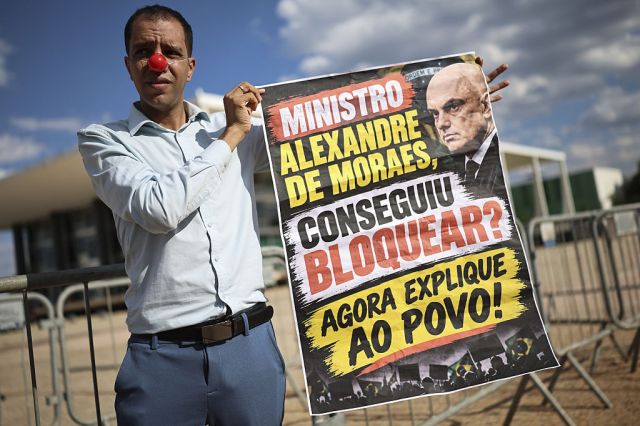
Brazil’s electoral season has been marked by a mass outcry over public officials, such as Justice Alexandre de Moraes. Credit: Getty





At a seaside villa, a Who’s Who of political, business, and judicial elites mingled with dozens of scantily clad women flown in from Eastern Europe. The host’s own travel company handled logistics, bringing in the women by the busload. The walls, it was later revealed, featured a hidden camera system with capture points recording sexual encounters in every room. The financier and his associates even referred to the luxury abode as a “cinema.”
No, not Jeffrey Epstein. The financier in question is Daniel Vorcaro, the now-jailed evangelical banker who was on the mind of many voters as they headed to the polls in this Sunday’s congressional and presidential elections in Brazil. In a surprise result, Right-wing senator Flávio Bolsonaro and son of the jailed former president, Jair Bolsonaro, won 47% of the vote over incumbent Leftist Lula Da Silva’s 45 percent; the pair will face a run-off on October 25. But despite the apparent backlash against Lula’s Workers’ Party (PT), the case of Vorcaro reveals something deeply rotten about Brazil’s establishment, both Left and Right.
A native of Belo Horizonte, Daniel Vorcaro’s father, Henrique, headed a real-estate empire in the state of Minas Gerais. For decades, the Vorcaros were prominent financial backers of the Lagoinha Baptist Church — one of the country’s most influential evangelical churches, headed by the televangelist Márcio Valadão and his son, André. (Since the turn of the century, the evangelical share of Brazil’s population has ballooned to around a third.) Accordingly, the younger Vorcaro was inculcated at an early age in the evangelical excess of Lagoinha; at one point, Daniel himself hosted a musical program on the church’s television channel. His sister, Natália, also married Fabiano Zettel, a Lagoinha pastor, lawyer, and wellness influencer (and Daniel’s future business partner).
By 2004, Daniel Vorcaro inherited the bulk of his father’s real-estate empire. Then, in 2018, he assumed control of what was then called Banco Máxima, now Banco Master. Practically overnight, the bank changed from a sleepy, small-time lender into a major player in Brazilian finance. The bank’s modus operandi consisted of offering investment securities with promises of large returns. This, despite the bank lacking the necessary collateral. By the start of the 2020s, Banco Master’s asset base swelled to more than $1 billion, including around $400 million in public pension funds across 14 states. And Vorcaro himself became a fixture of São Paulo’s Faria Lima, Brazil’s equivalent of Wall Street.
In truth, Banco Master’s business model was effectively a pyramid scheme. Fraudulent credit was sold to cover older obligations and subsequently laundered through a series of investment funds. The bank evidently went as far as to also launder money from the Primeiro Comando da Capital, Brazil’s most powerful crime syndicate.
The evangelical banker also had a peculiar sense of “Christian charity.” Banco Master paid $4 million from its fraudulent funds to Lagoinha’s temple; messages between Vorcaro and his brother-in-law Zettel showed the latter protesting that construction would stall without further funds. Head pastor André Valadão at Lagoinha has denied wrongdoing, referring to related accusations of irregular payments as “religious persecution.”
By 2024, irregularities within Banco Master drew the attention of Brazil’s central bank, leading Vorcaro to attempt multiple failed sales of the bank; former President Michel Temer and former Supreme Court justice Ricardo Lewandowski were recruited as paid consultants for an eventual sale. Finally, on Nov. 17, 2025, a consortium of Emirati investors and the Brazilian conglomerate Grupo Fictor purchased Master for an undisclosed sum. The next day, the central bank announced the immediate liquidation of the lender, citing widespread fraud — the largest of its kind in Brazilian history. Vorcaro was subsequently arrested while trying to board a private jet out of the country. He now awaits trial in detention.
The fallout from Banco Master has reverberated across every corner of Brazil. His extravagant parties, held in and outside the country, were evidently used as an “insurance policy” in order to coerce protection from attendants. The evangelical banker reportedly hired foreign escorts precisely so they couldn’t understand sensitive conversations in Portuguese. And his alleged private militia, used to intimidate journalists and coerce contacts, at one point reportedly reached out to the PCC, the crime syndicate, for protection. One member of his militia committed suicide while in custody.
Much like Epstein, the upstart Vorcaro displayed an uncanny ability to ingratiate himself with the highest echelons of Brazil’s political elite, easily sliding past partisan boundaries.
Ibaneis Rocha, a former center-Right governor of Brasília, directed the state-owned Bank of Brasília (BSB) to buy Master assets and attempt an acquisition of the lender that was ultimately blocked by the Central Bank. When I arrived in Brasília last week, on my way from the airport, a banner referring to Rocha’s vice governor and her successor Celina Leão read: “Where are they Celina? Where are the BSB funds?”
But among the largest direct transfers of fraudulent funds from the Vorcaro empire was to none other than Flávio Bolsonaro, the former president’s son, who is himself running for the same office. (The presidential race, pitting Flávio against the incumbent President Inácio Lula da Silva from the Left, will head to a runoff.)
In the years before the banker’s detention, Flávio wined and dined with Vorcaro and flew in his private jet, maintaining close contact practically until the moment of the financier’s arrest. Just days before his failed getaway, the financier received a message from Bolsonaro stating: “brother, I am and will always be with you.” Flávio, it turns out, solicited around $26 million from Vorcaro for a biopic about his ex-president father, titled Dark Horse. What would have been the most expensive film in Brazilian history was never made, and instead, might have funded Flávio’s brother’s lobbying efforts in Washington and Mar-a-Lago.
But the Left is implicated, too. Jacques Wagner, the Workers’ Party, or PT, leader in the Senate, reportedly defended Master’s interests in the upper chamber. The former finance minister during Lula’s first term, Guido Mantega, was reportedly paid around $200,000 a month from Master-linked entities. Rui Costa, a former PT governor for Bahia and Lula’s current chief of staff, privatized and sold the payroll-loan firm CREDCESTA to a Banco Master partner.
But the scandal’s real center of gravity lies within Brazil’s judiciary. In recent years, the Supreme Court, and especially Justice Alexandre de Moraes, have been heralded inside and outside Brazil for their roles in opposing the autocratic aims of Bolsonarismo. (Ironically, the court was previously instrumental in Lula’s 2018 conviction, which effectively handed Bolsonaro the presidency; and Moraes was once reviled by the Left for convicting Lula on dubious charges of passive corruption.)
Fast forward four years later, and the justices annulled all charges against Lula, who narrowly defeated Jair Bolsonaro in the 2022 election. Prior, during, and following his loss, the far-Right firebrand made multiple cartoonish attempts at remaining in office past his term — some of which involved trying to assassinate Lula and even a failed military coup. The court rightly sentenced Bolsonaro to 27 years in prison for these crimes, with Moraes presiding over the trial; in response, President Trump imposed 50% tariffs on Brazil in 2025.
The Supreme Court and Moraes have also employed at times heavy-handed tactics, such as installing a harsh censorship regime against conservatives and critics of judicial power in order to “defend democracy.” Behind these actions against the Right — however justified or not — lies something even more troubling, however: Moraes and others on the courts are, themselves, also implicated in the Vorcaro scandal.
Moraes’s wife received payments worth $15 million out of a $25 million legal-services agreement with Banco Master. In exchange, Moraes reportedly offered Vorcaro forewarning of investigations into Master. Justice Dias Toffoli received around $7 million from the jailed banker via a family resort fund. Meanwhile, on the court’s Right flank, a Vorcaro associate donated around $1 million to Bolsonaro appointee André Mendonça’s think tank. Further, associates of Bolsonaro appointee Kássio Nunes Marques, including his son, seemingly negotiated millionaire contracts with Banco Master; Justice Marques reportedly slept with a prostitute hired by the evangelical banker.
Game of Thrones-esque intrigue has since ensued on the 11-member court between competing factions headed by Moraes and Mendonça. Justices loyal to either Lula or the Bolsonaros have each sought to selectively reveal or suppress their respective ties to Vorcaro with the ultimate aim of aiding the campaigns of their political patrons.
Judicial corruption in Brazil is obvious, and Lula has pledged to establish an independent council to nominate justices and impose fixed terms on the court (justices currently serve indefinitely until the age of 75). For his part, Flávio Bolsonaro has promised to limit the court to constitutional decisions, end decisions by individual justices, and clamp down on nepotism. It remains an open question which, if any, of these reforms will be enacted should either candidate win the presidency.
The reality is that the victor is virtually certain to opt for continued protection of allies in and outside of the court who are implicated with Vorcaro or face reprisals from opposing justices. Regardless, the stakes are high given that the next president will fill one vacancy and appoint replacements for four justices who will be forced to retire due to age limits.
The truth is that, unlike Bolsonaro and his family, Lula is not directly implicated in the Banco Master scandal. (Up until recently, it was Bolsonaro who saw his poll numbers tank due to his close ties with Vorcaro.) But because the president has chosen to protect Moraes via his loyalists on the court, many Brazilians have gravitated to Bolsonaro under the auspices that the Right-wing populist offers a more credible alternative for reform.
One voter told me he was voting for Bolsonaro in order to end lawfare and censorship against conservatives. (On the other hand, Mendonça’s recent conduct suggests that opponents are right to fear a novel censorship regime against progressive views, particularly over Israel.)
Finally, beyond the judiciary, a Flávio Bolsonaro presidency, like that of his father, would be devastating for Brazilian labor. And the family has lobbied the White House for sanctions, tariffs and terror designations against their own country. The 80-year-old Lula, on the other hand, effectively represents the status quo; his party has governed Brazil for 17 of the past 24 years. Poverty has fallen, but wages have remained largely stagnant, and Brazilians are deeply in debt. Reforms such as debt relief and a provisional ban on gambling have come far too late, and only under electoral pressure.
Prior to the first round of elections, one street vendor in Brasília told me he was tired of the country’s political class and was voting for libertarian populist Renan Santos; a service worker at a nearby museum likewise told me she would vote for neighboring Goiás Governor Ronaldo Caiado. In the end, however, it seems both may have opted to instead punish Lula and vote for Bolsonaro. Come what may in Brazil, the reality is that the country’s institutions will likely remain in thrall to the ever-present, and increasingly evangelical, oligarchs like Vorcaro.
