




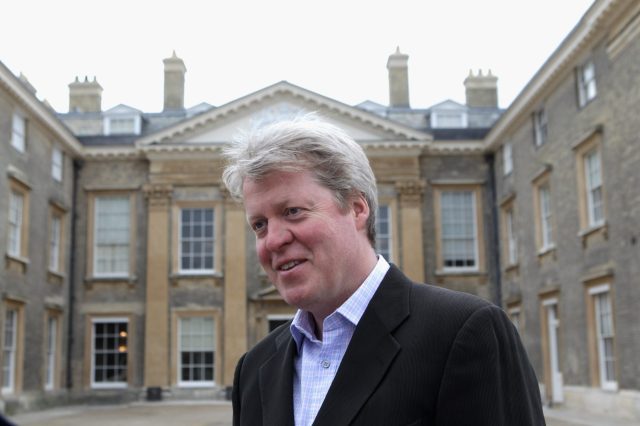
Charles Spencer: hopelessly decadent. (David Rogers/Getty)





Ever since the death of Diana, the decadence of Britain’s ruling class has grown ever more impossible to ignore. A class created by and for the British Empire has turned onanistically inward, while their erstwhile virtues have grown pathological in idleness. No one illustrates this more vividly than Diana’s younger brother, the historian, earl, and serial shagger Charles Spencer, who has popped up to offer his own front-row take on Britain’s Aposhcalypse Now in a new memoir, Swan Song.
The most sensational allegations are already well-rehearsed. Charles seemed “giddily elated” after Diana’s death; that Diana said the now-King was “in love with his valet”, and that His Maj said after her death that “we’ll forget her soon enough”. Wasn’t it a bit dodgy to make all these un-falsifiable claims so long after the fact? Laura Kuenssberg asked ever so mildly, in a BBC interview on Sunday. Shouldn’t the good earl consider Harry and Wills before raking it all over?
Spencer’s retort cuts to the heart of Britain’s posho pathology. No, he insisted, it’s all a true account of what he remembers. Charles was always on about duty, he said, but Diana also had a strong sense of duty. And as “a witness to history”, the Earl intoned, he has a “duty” to tell his sister’s story.
But what exactly do we mean here, by duty? Duty to whom, or to what? Over Britain’s high imperial era, this idea of “duty” always pulled in two directions. One half of the ruling-class culture that emerged in that age was a Spartan toughness and (at times) cold-blooded single-mindedness, that built institutions and infrastructure, and also extracted wealth or massacred recalcitrant natives. Institutionalized and reproduced in Britain’s chilly, disciplinarian public schools, this sense of “duty” supplied the former Empire’s stoical, institutional-building team spirit and capacity to set personal feelings aside in pursuit of larger goals.
The other half was a genuinely idealistic moral universalism. Born in industrial-age Britain’s Protestant predilection for social reform, and always more female-coded, this supplied a core of righteous zeal that animated the Empire’s missionaries and “civilizers”. Perhaps the most historically notable fusion of these two senses of “duty” is the point where (admittedly after a lot of campaigning) abolishing chattel slavery became imperial policy, realized through an immense expenditure of blood and treasure.
The British Empire’s legacy is immense and ambivalent, meriting both the acclaim of its nostalgists and also the critique of its post-colonial revisionists. And since its end, no subset of Britons has been left more lost, and less capable of reckoning with that legacy, than the upper class — especially the constitutional monarchy — whose purpose evaporated with its collapse.
It was not always thus. In the high imperial 19th century, our monarchs did their duty, just as they expected citizens to do the same. Prince Albert turned his abilities to diplomacy and or institution-building in areas such as museums, scientific societies, and military schools. Queen Victoria, for her part, espoused moral causes such as animal welfare, social reform, and injured veterans. Some monarchs and a whole empire later, even Charles’s mother was able to squeeze a lifetime’s “duty” from presiding over the Empire’s dismemberment while pretending everything was fine. But there was nothing left on that carcass by the time Her Maj died. So with little useful to occupy them, our upper crust has turned the twin moral turbine of their imperial upbringing loose on themselves, and all of us, to disastrous effect.
Nowhere did this appear in more vivid tableau vivant, than throughout the miserable marriage of Charles and Diana. Victoria’s and Albert’s instincts are discernible in, for example, Charles’s interest in youth education and Diana’s in landmine victims. Charles tried to personify “duty” in the sense of willingness to inhabit given roles, rules, and obligations, irrespective of personal feelings. And Diana personified “duty” in the sense of obligation to pursue a deeply felt moral mission wherever it led.
But unlike Victoria and Albert, Charles and Diana had only a Potemkin empire in which to play out their inherited roles: the “Commonwealth”. This entity, confected to save face as the real Empire imploded, was always an awkward hybrid of friendly-ish settler states such as Australia, plus former colonies whose disposition toward the Crown runs from ambivalent to openly and extractively hostile.
With only an at best ambivalent reception to enjoy, while doing the rounds in the “Commonwealth”, Charles’s and Diana’s institution-building and moral-reform instincts went in search of a canvas at sufficient scale. Alas: they found themselves reborn as warring emotional camps, in an America-led, globalized 24-hour TV entertainment cycle. In this frenzied setting, a sensibility that once ruled the world degraded into an ugly divorce battle, between “duty” in Charles’s sense of subsuming your feelings for the greater good, and Diana’s of pursuing personal truth, no matter what the cost.
This resonated more widely than just the Windsors, because the battle was also raging throughout our erstwhile imperial class. Long before Diana died, her combination of idealism and selfishness was a sufficiently common cultural hangover of the Sixties to have been vividly satirized in the Nineties sitcom Absolutely Fabulous.
The show’s two central characters, Patsy and Eddie, capture the hedonism and sentimental, self-righteous attitude this produced — while casting a sharp eye at Britain’s fraying upper class. Only Patsy is genuinely “posh”, but she also has no money: she lives a parasitic life in nouveau riche Eddie’s house, where she guzzles Eddie’s champagne, makes use of her chauffeur, and bullies her staid daughter, while weeping crocodile tears whenever challenged.
The year after Ab Fab stopped broadcasting, Diana’s sudden death declared her self-involved version of “duty” the winner in the media battle, as it were by martyrdom and canonization. As Tony Blair solemnly declared at the time, she was the “People’s Princess”. From there on in, the Patsy and Eddie version of “authenticity” was to be the new normal for Modern Britain. Small wonder, perhaps, that therapeutic navel-gazing plus globalized wokeness has since become the dominant moral registers for what’s left of Britain’s poshos, as typified by figures such as Kirstie Alsopp and indeed Diana’s son, Harry.
Watching Earl Spencer justify his latest salvos against King Charles to Laura Kuenssberg, I don’t doubt his assertion that if he really wanted to spill the tea, there are spicier truth-bombs he could drop. But clearly he doesn’t just want to screw King Charles. He wants us to understand how discreet he’s being and how utterly lovely his life is, and to be sympathetic about his (self-diagnosed) “ADHD” and “rejection-sensitive dysphoria”. Like Patsy and Eddie, he wants to destroy his enemies and not be made to feel guilty and still have everyone agree that he’s a really nice person.
What of the other side, meanwhile? If Britain’s posho moral-reform instincts have long since resiled into wokeness, philandering, and crybully emotional terrorism, the proponents of emotionally detached team spirit are just as gravely adrift. Shorn of an empire in which to act globally, and obviously reluctant to contract their field of vision to “little Britain”, this group has instead directed its energies either to renting out social cachet à la Patsy, selling off the family silver, or alternatively chasing a dream of universal institution-building, often at the expense of those whose interests they ought to protect.
Here, for example, we find hereditary products of Britain’s erstwhile imperial class such as Boris Johnson, opening Britain’s borders to the “Boriswave”. We find Jacob Rees-Mogg enjoining British plebs (presumably excluding himself) to “do their duty” and enlist to defend their nation, even as those plebs witness government after government refusing to defend Britain’s own coastline in the name of “international law”. And, indeed, we find the recent, cold-blooded assertion by Rory Stewart that the mass rape of British girls by Pakistani-heritage clan mafia networks is a trivial issue compared to real problems, such as the future of AI governance. We also find King Charles hiding in grand thoughts about our technological future: his reaction to Earl Spencer’s revelations was to attend a conference on AI. An aide retorted, in response to press enquiries, that “The King was rather more concerned about the future of mankind than the unkind claims of one man picking at the scars of the past.”
These two poles represent, between them, the spread of ways a decadent upper class can absolve itself of responsibility. On the one side, by resiling into Patsy and Eddie emotivism, and saying, of anything inconvenient or guilt-inducing: “It wasn’t my fault because I’m nice and a victim.” On the other, by fixating on “the future of mankind” rather than of a particular people, and offloading responsibility to assorted forms of technocracy, from institutions, to international laws, and – now – the dream of a “machine intelligence” that might finally liberate them from decisions and accountability.
A fish rots from the head down. Ordinary Brits are still demonstrably capable of self-organizing in a crisis, for the common good, at a pragmatic scale. If our country is in a bad way, ultimate responsibility lies with our leadership class, which long since committed itself to a general stance of “it’s not my fault”, or “we need to make things even more neutral”. Whether the supposed culprit is personal trauma, institutional racism, Donald Trump, International Law, or AI Swarm Gods, we’re stuck with this ghastly tranche of wet-eyed cry-bullies and cold-blooded universalists, none of whom shows the slightest interest in the one thing they’re supposed to do: lead and serve, in the interests of their own nation.
By contrast with the normal Brits who still cheerfully rally in a crisis, they should all feel ashamed of their own cowardice and crapulence. But they won’t. Shame implies choice, which signals responsibility. And the inability of the class that produces characters such as Earl Spencer, Boris Johnson, and Rory Stewart to feel shame, let alone take responsibility, is precisely the problem we need to confront, if we’re ever to climb out of our current morass.
It’s not really possible to do without an elite. But we really could do without one whose sole unifying refrain is “It’s not my fault”. So my fervent wish, at this point, is that “swan song” refers not just to Earl Spencer, or Diana, or even King Charles (A)III, but all of them: their whole class, generation, and hopelessly decadent worldview.
