









In February, after Morgan McSweeney was forced to resign in the wake of the Mandelson-Epstein scandal, effusive tributes began pouring into a WhatsApp group for Downing Street staff. “There wouldn’t be a Labour government without you Morgan”, messaged one colleague. “Thank you for not only being a leader of this team and a confidante for so many of us”, said another emotional staffer, “but for everything you did over so many years to bring the party back from the brink of destruction”. Another chimed in to thank McSweeney for his “political genius”.
The No. 10 aide had fallen on his sword, sacrificing himself on the altar of Keir Starmer’s continued reign of error. The press, the public, and even the Parliamentary Labour Party, with one eye on its dismal polling, demanded someone’s head on a plate — and it certainly wouldn’t be the man who was ultimately responsible for the decision to appoint the thrice-disgraced friend of a convicted paedophile as US ambassador. Advisors advise and ministers decide, yes. But who in their right mind would want to see an otherwise successful PM, delivering essential reforms, resign over such a trifling matter?
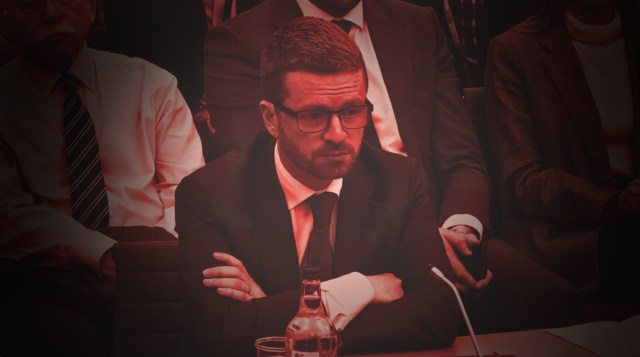
The feeling was by no means universal. One aide told me that they wanted to reply with “[waving emoji] Off ya fuck”. That aide will be pleased that McSweeney is being hauled over the coals for his alleged role in pressurizing Foreign Office officials to expedite Peter Mandelson’s appointment, with or without due process. To the McSweeney skeptic, yesterday’s pitiful Foreign Affairs Select Committee performance would have been no surprise. Here sat a man whose image, as a Malcolm Tucker-esque fixer, had for years been carefully cultivated, not least by his allies’ incessant briefing to journalists. By this telling, “Morgan” was the real power behind the throne, a latter-day Thomas Cromwell steering the government while Sir Keir was plonked obliviously at “the front of the DLR”.
But who among us isn’t tempted to believe in an enigmatic Rasputin, the political éminence grise to which we have recently become so accustomed? Bumbling Boris lacked political consistency, but Dominic Cummings would provide operational rigor, as well as an overarching vision: a lean state, shorn of the constraints of European law and recalcitrant bureaucracy, using science and technology to facilitate post-Brexit growth.
McSweeney was supposed to be cut from similar cloth — the consummate political fixer and wily operator on whom the PM relied for his organizational, political and ideological moorings. But in the cold light of Emily Thornberry’s camp, incredulous questioning, he wilted. Here was a diminutive, shy Cork man whose answers to the committee were anodyne deflections and polite, sometimes flustered, denials. He began with a profuse apology for recommending Mandelson as ambassador. At one point in the proceedings he had to correct himself after initially seeming to claim that he had always doubted the Prince of Darkness’s answers to questions posed in his vetting. “In September I realized I didn’t get the truth back”, said McSweeney. “At the time I thought I got the truth back. I might have mumbled my words. I got the answers back to him. I thought he was telling the truth. I thought he answered truthfully”. Clear as day.
On display was none of the panache, the charm or even the quiet menace that we might have associated with an ultra-effective operator, Labour’s backroom svengali. That isn’t to say that the dark arts of political skulduggery and intense factionalism haven’t taken place on McSweeney’s watch and at his behest. They have. The Irishman’s rise to the top is a story of furtive dinners, calculated untruths, strategic sleights of hand and discreet inner-party campaigns whose funding broke electoral law. But it’s all been done in a way that mirrors the political project that he and Starmer personify. The essence of that project is inner-party, internecine factional warfare carried out by people without any idea of their ultimate political purpose, without any conception of their ideal Britain.
With Cummings, there was an ethos behind the mythos. Whatever one thought of the Vote Leave guru, he had a theory of change, and a set of coherent, radical proposals that he had concluded would work in the national interest. His was a move-fast-and-break-things approach, to be delivered by small, accountable teams full of “weirdos and misfits” and Leninist fervor, committed to a Whitehall package reversing the influential reforms of Northcote-Trevelyan report. In contrast, McSweeney’s philosophy seems to have lacked substantive weight. What were his efforts in service of? Five ditched missions that nobody vaguely normal can recite? Or was it the six milestones, or three foundations?
Perhaps the paucity of ideas reflects McSweeney’s familial politics in the mother country. The McSweeneys are a Macroom clan of Fine Gael supporters. His aunt was Fine Gael councillor, and his cousin has been an advisor to two recent Fine Gael Taoiseachs. This kind of grounding in the anti-revolutionary, pro-Treaty traditions of one of Ireland’s conservative parties lends itself not to grand narrative or transformative agendas, but to quiet pragmatism in the service of established institutions. From rural Ireland to London, McSweeney is the college dropout who found purpose in Labour’s backroom. There, around the turn of the millennium, he punched information on New Labour’s political enemies into a primitive database, “Excalibur”, for use in Mandelson’s own Blair-era machinations. It was then that McSweeney learned the tricks of the trade, under the tutelage of the epoch’s factional enforcers.
But his emphasis on discipline outmatched anything that came before him. McSweeney oversaw a Stalinist approach to party management. He purged political rivals and suspected malcontents; he was all too willing to remove the party whip from recalcitrant MPs. But this is Stalinism without the five-year plans. It’s authoritarianism for authority’s sake. Dirty tricks must be employed, power must be exercised and maintained, simply to stop the Corbynites, to “rescue the party” from all the parasitic tendencies of the loony Left. But there was no vision for the country. Pure means, with no ends, beyond sinecures for your allies, what Thornberry called “jobs for the boys”.
In Starmer’s image, a new Parliamentary Labour Party has been created. Out of the 403, not a single one of them represents a plausible alternative Prime Minister. This is the only thing that keeps Starmer in place, in spite of his unprecedented unpopularity, itself about to collide with a coming recession and inflationary spiral. McSweeneyism, in pursuit of political professionalization, has produced a Labour-dominated House of Commons packed with legislators whose chief achievements center not around representing workers, rising through the ranks of trade unions in a variety of sectors, and sit still less upon building organizations or creating successful institutions with national impact. Instead, it is a hollowed-out parliament of junior managers armed with humanities degrees, specializing in internal slideshows for corporate public affairs departments or the third sector. Gone are the organizers, the rabble-rousers, the barnstorming autodidacts, and in are the dull young things, delivering speeches in the manner of weekly updates on Microsoft Teams. Once it was a party of labour; today it is a party of LinkedIn.
And now, languishing in the polls, mired in scandal, hit by economic crises, and about to lose Wales and much of London to insurgent parties, even the LinkedIn PLP is restive. The putative footsoldiers of Starmerism are unmoved by claims that they owe their jobs to the Irishman. A No. 10 insider texts to say that “everyone says he’s a genius” but that McSweeney was “just a kinda sensible pair of hands… no real narrative, just data-driven.” The insider concludes: “That’s fine for winning but not for leading the country”. McSweeney’s construction of a historic majority rests on the thinnest of margins of support. This was the shallowest of victories — winning by appearing as a default option, as simply “not Tories” after the years of Partygate, Trussonomics and stagnant living standards. For all the clever vote-to-seat efficiency, it’s likely that any leader of the Labour party, a team of monkeys in red rosettes, would have fought a hard campaign against a hapless Rishi Sunak. McSweeney and Starmer’s efforts in 2024 garnered fewer votes than a Hamas and IRA-adjacent old hippy-dippy Leftist could muster in Labour’s 2019 wipeout, and significantly less than the same bearded radical won in 2017.
Without McSweeney, Starmer is less anchored. He has burned through all his goodwill and political capital. There will be no recovery. A timetable for his exit, imposed on the Prime Minister by his own Cabinet, is not out of the question. In January, Starmer blocked Andy Burnham from contesting a Denton and Gorton by-election; this time, the Prime Minister will be too weak to repeat the trick. If Starmer is given an exit timetable, Burnham will have time to gain a seat and to launch a challenge in time for party conferences in September. Among many MPs who previously gave Starmer the benefit of the doubt, the general feeling that the PM is a good man doing a bad job has given way to near-universal contempt for him on a personal level. He has shifted blame and thrown colleagues under the bus rather than take responsibility. Operation Save Keir could yet claim more scalps.
For all the fawning goodbyes crediting McSweeney’s “genius” with saving Labour “from the brink of destruction”, it may all be too late in any case. If trends continue, his legacy won’t be saving Labour, but overseeing its slow self-destruction. He may have proved adept at conquering a party machine, but far less capable of maintaining the political coalition that the machine was meant to serve — an electoral bloc currently being torn apart by competing populisms of Left and Right. McSweeneyism treated power as the destination rather than the instrument, and a party and a Prime Minister that forgets the difference rarely survives for long.
Jonny Ball is a Contributing Editor at UnHerd. He formerly wrote under the name Despotic Inroad.
 DespoticInroad