




US Vice President J.D. Vance and Hungarian PM Viktor Orban at an election campaign rally on April 7, 2026. (Janos Kummer/Getty)




Last Tuesday, JD Vance appeared beside Viktor Orbán at two glossy events in Budapest to lend the Trump administration’s weight behind Fidesz’s hard-pressed election campaign. For a small and marginal country, Hungary’s election has elicited unprecedented interest — and competing claims of interference — from both Orbán’s international allies, supportive of his experiment in post-liberal governance, and an EU mainstream keen to rid themselves of a years-long thorn in Brussels’ side. But for Hungarian voters, the value of a Trump endorsement may not be what it once was. Certainly Tibor, the shaven-headed taxi driver who took me back from the second Vance event, was not impressed. “America and Russia, they’re working together in this election,” he told me. “We need change, it has been too long. I have two daughters and I want them to stay in Hungary, not have to go to Austria or Germany for work.” After 16 uninterrupted years in power, the longest term in office of any Western leader, this Sunday’s election marks the gravest challenge yet to Orbán’s rule.
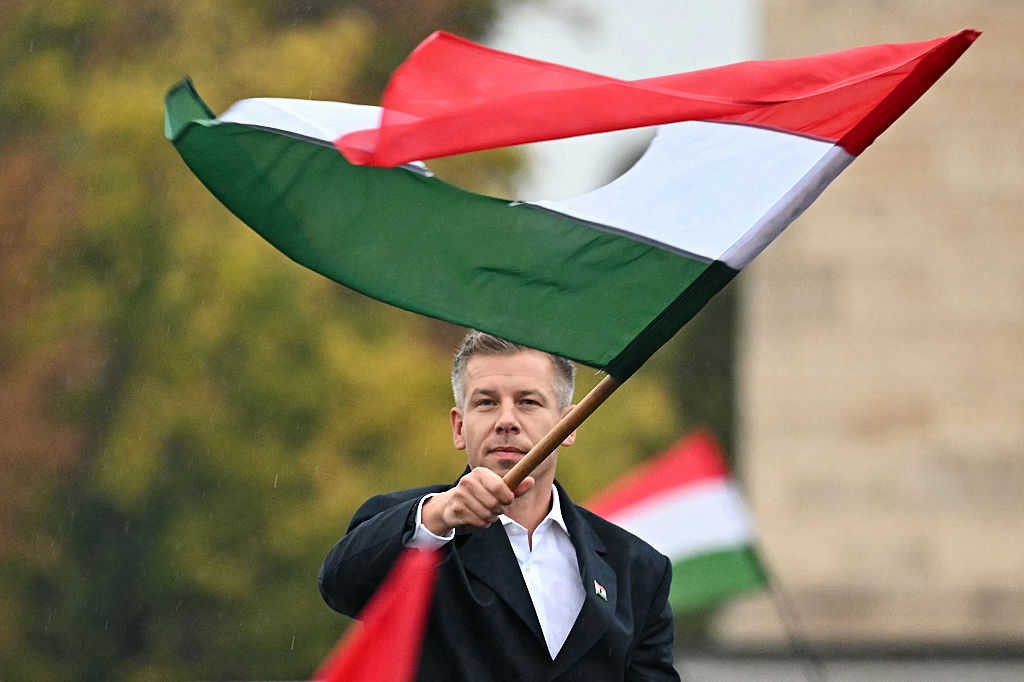
Presenting itself as less a liberal opposition to Fidesz than a reformist movement from within it, the Tisza party, built around the charismatic authority of its leader, the former Fidesz insider Péter Magyar, has developed a commanding lead in most polls. Magyar’s adoption of nationalist imagery and eschewing of support for progressive social causes has won inroads into Hungary’s electorate far outstripping the previously lacklustre opposition. His party sells itself, one government sympathiser told me, as “Fidesz without the corruption”. His entry into opposition politics came after a very public breach with his ex-wife, former Justice Minister and Fidesz high-flyer Judit Varga, who resigned from public life following revelations she had pardoned a well-connected paedophile. Fidesz loyalists, describing Magyar as a “third-tier apparatchik” gone rogue, are happy to gossip darkly about the alleged character flaws displayed by their former colleague. (Tisza, pursuing a tightly-controlled media strategy which may hint at a successful Magyar’s governing style, did not agree to an interview for this piece.) But in liberal Budapest at least, almost anyone you speak to who is not connected to the government transpires to be a Tisza voter.
On a riverboat in the Danube converted into a restaurant, I met Balázs Sarkadi, bassist and vocalist in the punk band Bankrupt. I had met young Bankrupt fans protesting at Orbán’s national day rally a few days earlier, one of whom was dressed as a zebra in an ironic nod to opposition claims that the prime minister keeps the exotic animals at his family’s country estate. Bankrupt’s songs, with titles like “Viktorland” and “Illiberal Holiday”, channel the frustration of a younger generation who have never known a different government. “It is definitely a generation gap between Fidesz supporters, who tend to be like old people or uneducated people, but all the young people are against them. They all want this Tisza party to win,” Sarkadi told me. After years of opposition failure, “This guy appeared, and he was competent. People were like, yeah, he came from Fidesz, but if he’s the one who can defeat Orbán, then let him beat them, because he came from Fidesz, he knows how they work, so he has the knowhow to compete against them.”

Yet a Tisza victory is far from certain. Pollsters close to the opposition present Tisza with a commanding popular lead; pollsters close to the government show Fidesz winning most electoral districts. In a country whose journalism is largely inextricable from political activism, whether for or against the government, the results of the election are genuinely difficult to predict. In Hungary’s last election, the polls seemed to predict a slender opposition victory: the result was a Fidesz landslide. “It’s going to be tight,” Pál Daniél Rényi, an investigative journalist with the opposition-leaning 444.hu website, told me. “But I can’t even say that, because the system favours the winner so much that you can win and you win easily. But it’s difficult to see Orbán winning so clearly as he has been doing for the last four times.”
Still, figures close to Fidesz point out that even after all this time, Orbán can boast personal approval ratings greatly ahead of any Western leader. In liberal Budapest, it is easy to get the impression that everyone supports Tisza, but Orbán can depend on a bedrock of loyal support, particularly in the countryside and among the Hungarian minorities in neighbouring countries, that may yet be enough to swing the election. “Budapest is 70, 80% for Magyar,” András, the softly-spoken middle-aged owner of a cafe in the gentrifying VIII district, told me, “but outside in the villages, I don’t know, Orbán pays poor people for votes. I hope it will be Magyar — I don’t like Orbán, I don’t like Putin, I don’t like Trump, I don’t like populism and corruption. But it is very difficult. I hope it is Magyar.”
At the national day march, loyal supporters carried banners and placards bearing the names of their towns and villages — Nagycenk, Fertőd, Törökszentmiklós — Hungary’s conservative countryside gathered in the heart of opposition Budapest. One pensioner I spoke to, in traditional folk dress, was an ethnic Szekler from neighbouring Romania’s Hungarian minority, among whom, he told me, “90 or 95% of Transylvanians support Orbán”. In its split between liberal cities and conservative provinces, Hungary replicates the familiar pattern seen across much of Europe, only more so. “In most countries, the capital rules the countryside,” one member of the foreign post-liberal diaspora in Budapest told me. “But in Hungary the countryside rules the capital.”
After Orbán’s big speech, I chatted with Buda, a 22-year-old Fidesz-supporting law student in a quarter zip. “I believe Hungary is the last bastion of the old Europe, and that has to be preserved,” he told me. “If you look at the West, with all the crime and sexual assaults that come from migration, you see the EU leadership have an idealised ideology of how things should be that just doesn’t work in real life.” Many, perhaps most, voters in Western Europe would agree, a fact not lost on Fidesz in its long-running war against Brussels. For many Western conservatives, Hungary presents an attractive vision of post-liberal governance, not only in its strict border management but in its extensive support to young families, pro-natalist subsidies and vision of a rightly-ordered conservative society. On immigration, the source of Orbán’s original rupture with Brussels, Hungary has won the argument; the EU may yet, in the aftermath of the Iran war, come around to an energy rapprochement with Russia, too. It is certainly striking that the Tisza opposition is not offering any dramatic ruptures on the questions dividing Budapest from other European capitals. But perhaps, given the dire relationship with Brussels the past decade’s battles have wrought, Fidesz can no longer extract political capital from having been right too early.
“My feeling is that all the big, important decisions which we made after rational calculations based on the national interest, it turned out that these were good decisions,” Viktor Orbán’s strategic advisor Balázs Orbán (no relation to the Prime Minister) told me. We were meeting in his office in the Karmelita, a converted 18th-century monastery that is now Hungary’s seat of government, overlooking the city high up in Buda’s castle district, from where he was running a Fidesz election campaign for the first time. “And probably that’s the reason why we are still the most popular governing party in Europe. If you look at the polls, there is no other governing party which has this popularity rate and this chance to win the election.”
Yet outside the gleaming, expensively restored streets of central Budapest, where MAGA influencers are wont to take nocturnal selfies by the Danube marvelling at how safe they feel, the capital sometimes doesn’t feel that different to Western Europe at all. In the VIII District, an inner suburb of grand 18th- and 19th-century palaces and apartment blocks, once notorious for crime and prostitution but now heavily if unevenly gentrified — and visibly reshaped by mass migration — the expensive cafes and bakeries patronised by middle-class, opposition-supporting young families are punctuated by the same halal takeaways, African hair salons, phone repair shops and Middle Eastern barbers as London. Returning to Budapest for the first time since the 2022 election, I find it striking how many more rough sleepers there now are, and how numerous and visible street drinkers and beggars have become. It is often pointed out by the government’s post-liberal advocates that Budapest is a liberal bubble in a conservative country: it is hard to avoid the suspicion that the post-liberal utopia is also something of a bubble of its own.
“The economy is not good now,” Gábor Győri, a political analyst with the progressive Policy Solutions think tank, told me, as we chatted at a pavement cafe. “And you have what is catching up to the government, is that for many public services, they haven’t done anything in 16 years, or whatever they have done has made it worse. So, the Hungarian public, and we have done surveys about this, has a very devastating opinion of public services in Hungary, and when it comes to healthcare, for instance, even a significant minority of Fidesz [supporters] agree that it’s not good.”
While Fidesz presided over an economic boom in the earlier part of its reign, the Hungarian economy has suffered in recent years, particularly since the outbreak of the Ukraine War, with growth trailing that of the country’s Central European neighbours. Since 2021, research reveals, the Hungarian upper middle class has almost halved in number, while the poorest class in society has grown from 31% to 43% of the country’s population. Prices, in shops and cafes and restaurants, are now not markedly lower than in Britain, but wages have not risen accordingly. Government officials stress that the Ukraine War is an external shock beyond their control, and that without the continued access to cheap Russian energy maintained by Orbán, the cost of living for Hungarian voters would be even more crushing.
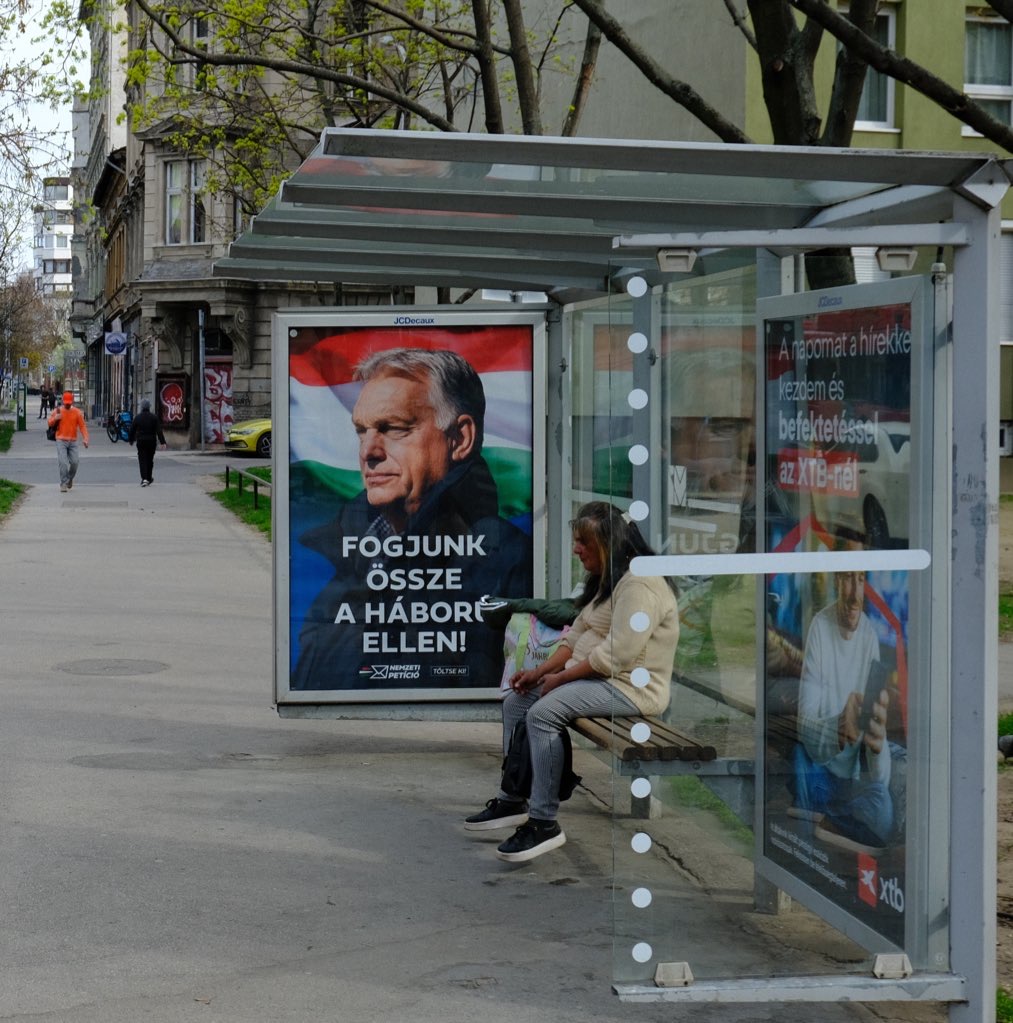
Yet with the dire state of the country’s hospitals a recurrent theme among the opposition, even Fidesz loyalists privately concede that more should have been spent on healthcare over their generation in office, on raising ordinary state employees’ salaries and on spreading wealth beyond the party’s innermost circle. While the government campaigns on foreign policy, centring the Ukraine war and Orbán’s close relationship with the Trump administration in its messaging, Tisza is running on bread-and-butter domestic issues: in many ways, it is now Magyar running a populist campaign against what he pits as an out-of-touch establishment.
“The difficulty in terms of running this campaign,” Balász Hidvéghi, State Secretary of the Prime Minister’s Cabinet Office, told me, “is that there is a foreign affairs, um, dominance in our message, you know? Whereas we’ve done a lot in Hungary that we can be proud of. We have a lot of results, economic results. We’ve increased wages, we’ve given a lot of tax cuts and other advantages to families, to young mothers, to young people. So there are lots to talk about, as positive… But of course, even I feel, when I finish a speech or an exchange with voters, that perhaps I talk too much about the international order, you know, the war, the strategy, and not enough about what we’ve done here in Hungary and what would be good for the community.”
Rényi, a long-term observer of Fidesz’s inner workings, believes that this time round, Orbán is losing his once-sure touch for the public mood. “He has a very close circle, and he started to make mistakes,” he told me. “That’s the feeling. You know, they just try to create content and dominate the daily discussions on politics, and it’s just not really working, to be honest.” The old style of Fidesz campaigning, pitting the country as fighting a valiant, lonely battle against internal and external enemies, is losing its appeal, he believes. “I think there’s some sort of an exhaustion in the system,” Rényi told me, “the whole way of doing politics, actually playing on people’s existential fear. I think this is something that just people got somehow fed up with. People are exhausted being all afraid all the time.”
In his office in a Baroque building in Buda’s castle district, a Make Europe Great Again baseball cap prominent on his desk, I met Zoltán Kovács, Hungary’s Secretary of State for Public Diplomacy. An often combative presence on social media, he was relaxed and affable in the flesh, leaning back into his armchair as he defended the government’s record in office. “Most of those criticisms can simply be refuted by the facts,” he told me. Over the past 10 years, the government had spent more on healthcare than ever before, he added, and wages were rising, even in an era of pan-European stagnation. “So as a matter of fact, [how] people feel about the economy is completely different to how people in reality are having that opportunity to actually consume, how their wages are changing. So that’s the reality on the ground.” As for the state of the healthcare system, “We can have an argument about it, but there comes the fact that actually the European resources that could be used for renovation are being withheld for political reasons.” With just a few more days of campaigning before the election, Kovács exuded confidence in the final result. “I believe there’s a huge surprise going to come on Sunday, especially for the international press. And I’m going to tell you that all the push polls you see, especially for the past couple of days, are completely nonsense.”
At least publicly, both sides are going into the election expressing certainty in their victory. Speaking on background, it is more common to hear doubt and uncertainty creep in. Independent observers, too, stress the unpredictability of the final result. “I think that maybe the odds are in favour of Tisza,” Győri told me, “because the polls, the independent polls, [show] such a strong lead.” Yet even still, the polls have been wrong before, understating the extent of Fidesz’s shy voters, and the party’s ability to turn out the wavering and undecided at the last moment. “So, if it weren’t for that,” he adds, “then I would say yes, Tisza are certainly going to win, because all the independent polls would give them a healthy margin. But still, I don’t know.”
Whoever wins the election will inherit a polarised country, and perhaps a pyrrhic victory. In its creation of a post-liberal counter-elite, Fidesz has enmeshed itself within the inner workings of the state. Without winning a supermajority, an unlikely outcome, Tisza will find its ability to govern effectively hemmed in by a state bureaucracy reshaped in Orbán’s image. Even in opposition, Fidesz will remain a tried and tested political machine, while Tisza — derided as a “virtual party” by Kovács — may struggle to hold together a disparate electoral coalition formed solely to unseat Orbán. On the other hand, a slender political victory for Fidesz, and perhaps even a coalition government, should the electoral arithmetic require it, with the radical Right-wing Mi Hazánk party, whose policy positions are far to the right of Fidesz, and who express quixotic foreign policy stances at which Orbán’s Trumpist allies would look askance, would also hamper Orbán’s ability to govern effectively for the first time in many years. The government’s hope, and a dominating theme in its campaigning, is that the uncertainty inherent in a new government formed by an untested party will, in the end, be too much of a gamble for Hungary’s voters. “They know him,” Balázs Orbán insisted of the Prime Minister, “They understand who he is, they understand where he is coming from, they know the bad and the good things. And in these times of uncertainty, you do not choose any risky candidate, and the guy itself [Magyar] is a risky candidate.”
One “interesting scenario”, cautions Győri, would be Tisza winning the popular vote but not, due to the intricacies of Hungary’s electoral system, winning a parliamentary majority. “That would be, technically speaking, a legitimate victory,” he notes, “but it would dispute the legitimacy of the election, because it would show that more people would have preferred Tisza.” In such a scenario, protests are not out of the question, notes Rényi, given the high expectations held by opposition voters. “They believe that this is the moment and that the regime is going to be over. So I think this is the first time when I had this feeling that when the opposition would lose, they would be less willing to accept it than the government. I mean, if the opposition loses, Budapest is going to be, I don’t know, something’s going to happen.” According to one recent poll, 71% of Tisza voters would not now accept a Fidesz victory as legitimate.
Whoever wins the election will require a commanding majority not just to govern effectively, but, perhaps, merely to convincingly take power. In an election that has seen previously unimaginable foreign interference, both for and against the government, and with such a polarised political and media landscape, a slim or even contested victory for either side would present great challenges for political stability over the next few years, and make the country a target for even more overt external meddling. Yet for all the foreign interventions so far, and the projected hopes and fears of foreign liberals and post-liberals alike, Hungarians seem set to go to the polls tomorrow centring domestic Hungarian concerns. The central Fidesz pitch, that after a generation’s rule, Orbán represents tried and tested leadership in an uncertain world, is the precise inversion of Tisza’s message that Fidesz has ruled for too long, and the country desperately needs change. In weighing up the merits of these opposing arguments on Sunday, in an election perhaps more finely balanced than domestic and foreign coverage would make it seem, it is in the country’s interest that whatever Hungary’s voters decide, they are seen to do so decisively.
