




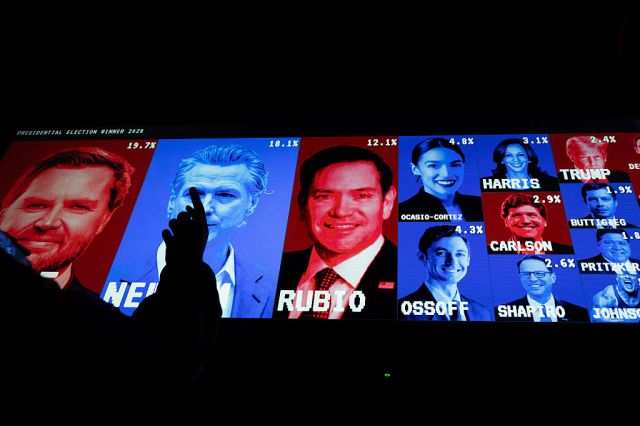
Betting has never been easier. Neville Elder/Corbis/Getty Images




When the fog of war envelops us, we too often focus our attention on those events with clear short-term consequences, even as we allow events with profound long-term ramifications to pass beneath our notice.
A clear example of this took place last month, when Times of Israel reporter Emanuel Fabian published a first-person account headlined: “Gamblers trying to win a bet on Polymarket are vowing to kill me if I don’t rewrite an Iran missile story.” In the American press, the article rated only a quick mention, nestled between updates on ships stranded in the Strait of Hormuz and the Pentagon’s comments on US strategy.
But when this latest chapter of America’s military struggle with Iran is a distant memory, Americans will still be wrestling with the matters raised by Fabian’s article. His account is the proverbial canary in the coalmine, warning us to get a handle on the power of online prediction markets before they hijack our political process.
Here are the basic contours of Fabian’s story. On 11 March, he wrote a Times of Israel blog post, reporting that an Iranian missile had struck Israeli territory. The missile, he wrote, had hit a wooded area and caused no injuries. After publishing this seemingly unremarkable news update, he began receiving emails, and then text messages, from people he did not know. The senders urged him to correct an “error” in his reporting and clarify that the area had been hit by shrapnel rather than by an entire missile. Fabian, believing his reporting to be correct, declined to make the change. But the messages continued, becoming more urgent, and then a bit sinister, and then overtly threatening. One read: “If you do not correct this by 01:00 Israel time today, March 15, you are bringing upon yourself damage you have never imagined you would suffer.” Only after Fabian went to the police with these messages did the threats stop.
By this time, Fabian had figured out that the source of the writers’ obsession with an otherwise insignificant missile attack was that it was the subject of a bet on the blockchain-powered prediction site Polymarket. The bet was on whether Iran would strike Israel on a certain date. The precise terms stipulated that Iran would have “struck” Israel only if Israeli territory were hit by a full missile rather than by fragments of an intercepted one. The pool at stake was $14 million. (Polymarket has since denounced the threats directed at Fabian, stressing its compliance with the law and its commitment to national security.)
When I read Fabian’s article, I was reminded of a scene in George Orwell’s 1984, in which protagonist Winston Smith, a record keeper in the “Ministry of Truth”, is asked by his bosses to change an “error” in the historical record. His specific assignment is to change the official history — which claims that his nation of Oceania has always been at war with the nation of Eastasia — into the claim that Oceania has instead always been at war with the nation of Eurasia. This “error,” of course, is not an error at all. His bosses’ demand simply reflects the government’s wish to maintain continuity in its propaganda, thus justifying its current military engagement with Eurasia. Smith duly complies, consigning the outdated history to the Memory Hole and writing the lie into truth.
Over recent decades, we have frequently been warned of the potential for biased journalists, powerful politicians, or moneyed special interests to instill false consciousness in the public to serve their own ends. But we have paid far less attention to the potential for gambling on politics or geopolitics to accomplish the same ends by means more impactful, more pernicious, and less traceable. The type of pressure that Polymarket’s bettors applied to Fabian over a relatively unimportant event — pressure to which a less courageous journalist might easily have succumbed — not only stands to undermine the integrity of journalistic reporting (the shared basis of facts on which democracies make decisions) but the integrity of decision-making itself. Indeed, it is hard to imagine that it isn’t doing so already.
Gambling is an ancient industry, but real-time prediction markets on topics other than games and sports are far newer. At the scale we observe on leading prediction market sites like Polymarket (founded in 2020) and Kalshi (founded in 2018), where bets on events from election results to military interventions frequently attract pools of tens or hundreds of millions of dollars, the industry is practically newborn.
On Polymarket, trading volumes approach $500 million in a day. The company earns a commission off users’ bets, and payouts can be massive. To bettors, using Polymarket feels like placing bets on sports book sites like FanDuel or DraftKings. But its customers are not betting on horse races or soccer matches; they’re betting on the most impactful events in the world.
The industry of sports betting has never been able to effectively neutralize the risk that gambling might cause some outcomes to become fixed. Horse racing has always had fixers ready to slip a certain horse a syringeful of drugs to speed it up or slow it down. Just this year, 20 college basketball players were indicted for their involvement in fixing games. Do we really think that when we subject politics and world events (and public information about them) to the same set of incentives, with betting pools running into the hundreds of millions, we’ll get a different result?
Currently, the only federal regulator of sites like Polymarket and Kalshi is the Commodity Futures Trading Commission (CFTC), originally formed in 1975 to regulate the trading of futures for commodities like corn and oil. In the absence of other regulators, CFTC has transitioned into regulating prediction markets. Initially, CFTC resisted Polymarket’s entry into the American market on the grounds that it lacked registration with the agency, but in 2025 Polymarket acquired a company that was already registered, making the point moot. The only CFTC enforcement action against Kalshi so far, which challenged the presence of US election prediction markets on the site, ended in a court ruling that the CFTC ban was inappropriate.
CFTC enforcement is hamstrung by the fact that the only major law governing the topics listable by online betting markets is a rather vague provision of the Commodity Exchange Act allowing CFTC to ban contracts that are “contrary to the public interest” if they involve “activity that is unlawful under any Federal or State law, terrorism, assassination, [or] war”. So, when six senators decided to send CFTC Chairman Michael Selig a letter in February asking him to increase enforcement against Polymarket, they were reduced to portentously asking whether he really thought that contracts like “Maduro out by…” or “Will Russia capture Myrnohad by…” were “in the public interest”. Presumably they meant the interests of the public in the US, not that of Ukraine or Venezuela. (Polymarket has updated its rules to clarify that insider trading is banned; Kalshi has said it is working with a compliance firm to identify “bad actors”.)
Government action against political betting sites has thus far taken on a partisan complexion, with Democratic legislators pushing regulations to limit insider trading by (Republican) members of the executive branch. All six senators who signed on to the letter to Selig were Democrats. Most pending legislation in Congress respecting political betting markets deals with insider trading by knowledgeable politicians, and the issue has become lumped in with efforts to regulate stock trading, like Congress’s recent investigation of Defense Secretary Pete Hegseth over his purchase of defense stocks just before the launch of US military action in Iran.
It is unsurprising that Congressional Democrats have zeroed in on government officials’ betting on politics and geopolitics while a Republican administration occupies the White House and has outsized access to sensitive information. The issue is a valuable political cudgel. They will likely lose that interest as soon as a Democratic administration enters the White House. (The whiplash of Democrats’ sudden deep interest in the Jeffrey Epstein scandal after a decade of indifference suggests just how quickly.) More importantly, this partisan approach all but ensures that no meaningful reforms will ever become law — if Congress ever passes them, the president won’t sign them.
But even if Congress were to pass any of the bills currently under consideration, the risks of insider trading are merely the tip of the iceberg. Far harder to regulate are influence campaigns like those Fabian experienced — whether directed at newsmen or at decision-makers themselves. If we’re already concerned about the influence of the wealthy and powerful on political decision-makers, how much more should we worry when those same individuals are making wagers on the outcomes of policymaking?
Let’s run a thought experiment. By the standards of Polymarket, the pool that ensnared Fabian was quite small. A larger pool, with $79 million wagered as of Tuesday, asks who will be leading Venezuela at the end of 2026. Current President Delcy Rodríguez is heavily favored with 64% odds, with deposed President Nicolás Maduro at 15%. Clearly, anyone who bets on Maduro stands to make quite a lot of money if he returns to power.
Let’s suppose a top executive at a semiconductor manufacturer, who is weighing whether to sign on to a proposed new export restriction, bets on Maduro’s return. While meeting with Commerce Department officials, he mentions his deep desire to see Maduro reinstalled. Then, on 1 December, President Trump announces that Maduro has learned his lesson from his year of incarceration. Trump releases him to Venezuelan custody, and he’s back as president. A few months later, new semiconductor export regulations are announced, to little fanfare.
Would that be illegal? Of course, in all kinds of ways. But would criminality be extremely difficult to prove, and the political event itself almost impossible to stop through the legal process? Also, yes. Scanning the leading markets on the Polymarket homepage, it takes but an ounce of creativity to imagine 10, 20, even 100 such scenarios.
It’s more than enough to convince yourself of two facts: first, that it’s inevitable that prediction markets will very soon exert significant influence on political decision-making, if they aren’t already; the money is simply too good. And second, that cracking down on “insider trading”, no easy task in itself, would be woefully insufficient to solve the problem.
For one thing, in a democracy where everyone has a vote, everyone is (to some degree) an “insider”. What’s to stop a voter, just as a sports fan bets against his favorite team to win a bet, from voting against his political interests for the same reason? Then there are the many powerful people who can exert political influence in oblique ways, but would not, by any legal definition, be considered “insiders”.
And if betting markets can so profoundly influence the political process, how much more could they influence news, think tanks, and policy institutes — industries where most workers make little money and might stand to get a big payday by tweaking reality just a little bit? For some, the temptation will simply be too great. (Readers may recall one such example from the think tank world last November, when a subsequently fired employee at the Institute for the Study of War altered the think tank’s publicly available map of Russian-held territory in the Ukraine at the eleventh hour to reflect a territorial gain that did not happen. By the time the map was changed, the gain was considered so unlikely that Polymarket bettors stood to earn returns of 33,000% on their investment if it occurred.)
It’s fortunate for Americans that there is a potential solution to the online prediction market problem that is as elegant and complete as the problem itself is multifaceted and complex. That is: limiting online betting to sports and games only. Case law is clear that the Constitution’s Commerce Clause gives Congress the power to regulate online gambling (up to and including banning it). Congress should use this power to ban political prediction markets, and do so quickly.
Some such prediction markets might remain in casinos or local betting parlors. But the experience of the last few years shows conclusively that it is only the engine of the internet that has enabled political and geopolitical prediction markets to become as large and as consequential as they have. If they are not allowed online, there will be little risk of American policymakers or news reporters being bullied, cajoled, or bribed into changing the facts to help someone win a bet.
One likely reason that the political class has thus far been slow to regulate prediction markets is that in only a few short years, it has come to rely upon them for information. Studies have shown that prediction markets like Kalshi and Polymarket can be more accurate at predicting election results than traditional polling. Prediction markets also offer predictions on events in areas like war and diplomacy that are not usually polled, and they do so (at least as far as the voyeuristic political class is concerned) for free. But they will need to learn to live without them. Our quality of governance and our national wellbeing are more important than the convenience of pundits, policy analysts, and campaign managers.
If Congress bans online political betting, it will head off a major destabilizing influence on our republic. Forging a path forward for our fractured country — a path that integrates the genuine diverse interests, desires, and passions of all Americans — is hard enough. With voters, businesspeople, and policymakers betting on those decisions, forging that path will be impossible.
Join the discussion
Join like minded readers that support our journalism by becoming a paid subscriber
To join the discussion in the comments, become a paid subscriber.
Join like minded readers that support our journalism, read unlimited articles and enjoy other subscriber-only benefits.
Subscribe