




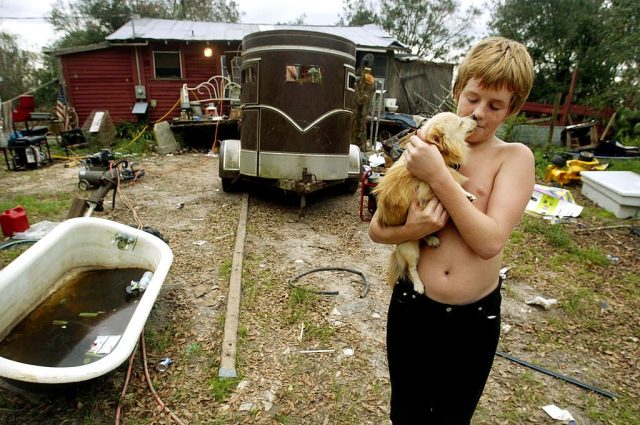
‘If you deduct debt from growth to come up with a true picture of the economy’s dynamism, the country would have already started going backwards.’ (Mario Tama/Getty)




What happens when the money runs out but you still have promises to keep? Take the Reform Party’s recent suggestion that it will join the political consensus to preserve the triple lock on pensions. Here we have a policy designed to keep a share of the British population in the style to which it’s grown accustomed, or even better, and whose price tag is growing faster than the economy meant to fund it. That widening gap forces spending cuts elsewhere — in basic services, investment or spending on higher education — all of which inhibit future economic growth.
In short, we get a policy that will over time make the UK poorer in a quest to keep it rich. Yet as damaging as it is to the country’s long-term economic prospects, nobody can bring themselves to end it. And so, logically, amid economic stagnation or reversal, if some groups can maintain or even grow their wealth and income, as is the case with the triple lock, others must experience falls in their living standards and life opportunities. So even amid tepid growth, degrowth has started for some — namely, those whose livelihoods depend on income from labour rather than proceeds from capital.
Mind you, this revived class struggle now brings a novel twist: the owners include not just the uber-rich but people with comparatively modest incomes, such as pensioners whose capital is tied up in the funds that are today among some of the world’s biggest investors. Nevertheless, their livelihoods require preserving asset values no matter how sluggish the growth. The inevitable outcome is that workers get squeezed, both directly and indirectly: directly through higher taxes on labour — out with free tuition, in with the triple lock — and indirectly through fiscal and monetary policies that ensure asset values rise faster than the economy.
At the heart of this deepening political rift between capital and labour, driving a resurgence of anti-systemic populism on both the Left and Right and a turn against democracy by young people, is a reality that few whatever their politics want to confront. The rapid economic growth rates of the postwar period, which made possible the expansion of the welfare state and promises of future benefits that presumed an endlessly rising supply of resources, are not returning — because, as with the pursuit of the triple lock, we’re now trapped in a cycle where the pursuit of growth produces degrowth.
Western economies have been slowing for decades, and a handful of rich countries have crossed the threshold between growth to degrowth in per-capita terms: while gross domestic product has kept rising in Germany and Canada, real per-capita income has begun declining. Almost everywhere else in the developed world, including Britain, growth has been close to stagnant since before the pandemic. And even the supposed star performer of developed economies, the US, whose real per-capita income has continued rising steadily, hasn’t escaped this trend towards deceleration, because its added growth results from added debt. If you deduct debt from growth to come up with a true picture of the economy’s dynamism, the country would have already started going backwards.
This partly has to do with profound shifts in the world economy, and in particular the relative decline of the West compared to the rising global periphery. But increasingly, there’s evidence of endogenous forces which act to inhibit growth — something I refer to as the “Icarus effect”. Simply put, as an economy grows richer, its growth rate slows, because it encounters forms of natural resistance that slow and eventually reverse growth.
The growth-retarding effect of Covid-19, the first truly global pandemic in history, has been obvious, but the bigger threat will come from climate change, whose deleterious effects are already creeping up on us. With the average annual number of extreme weather events having so far increased sevenfold since the Sixties, not only will capital be depleted but inflation will remain permanently higher due to the rising costs of production (the recent Mediterranean storms being just the latest event likely to jolt food prices this winter).
Yet while such feedback loops inhibit growth for the whole world, there also appear to be changes which specifically affect the countries where growth has advanced the furthest: the rich ones. Because in addition to external pressures, we’re now starting to better understand changes which occur in the internal environment — which is to say, within us, as individuals and societies. As a society grows richer, it undergoes social, political and cultural changes which reduce dynamism, raise vulnerabilities and diminish resilience, all while increasing the cost of preserving wealth.
To begin with, fertility declines, which raises a society’s average age. From there, the economically productive share of the population declines. As a proportion of total economic output, consumption therefore rises and investment declines. Meanwhile, the investment which does occur shifts in character, becoming more focused on dividends rather than long-term growth (which favours legacy industries). It also becomes more risk-averse, one manifestation of which is a shift towards real-estate investment: and real estate, of course, produces nothing. Consider Canada, Germany and Italy, all which have been among the slowest performers, even as real estate now accounts for a third of fixed capital formation.
Adding to this, fiscal and monetary policies become increasingly oriented towards preserving asset values, through such measures as Nimbyism and the shoring up of asset values after market corrections with bailouts and easy money — real interest rates were kept near or below zero for years after the financial crisis — since any fall in asset values would hurt the growing share of the population which lives off them. The anti-growth measures which follow are thus more a symptom than a cause of the Icarus effect, but the consequent rising cost of capital makes it harder for new businesses to form, reducing dynamism in the economy.
In addition to these changes, vulnerability to external shocks rises as a society grows richer. For starters, the more capital you have, the more there is to be destroyed in natural disasters, and while mitigation measures can reduce risks, they further increase the price of wealth preservation. But just as importantly, and in contrast to the prevailing assumption that “rich is resilient” — the assumption being that wealth provides you with the resources needed to adapt to and bounce back from exogenous shocks — there’s compelling evidence that the reverse may be the case.
The first hints of this came during the Covid pandemic, when it was widely expected that poor countries would do far worse than rich ones. The latter, so the theory went, could not only care for their sick but pay people to stay home and reduce transmission. In fact, on balance, poor countries emerged no worse from the pandemic than rich ones, and in many cases actually did better, all at a fraction of the cost borne by rich countries. For every dollar spent per capita in a developing country fighting the pandemic, developed countries spent 12; for all that money, the average death rate in the rich countries was only marginally better than in poor ones, while many of the poorest nations on Earth — especially in Africa — were star performers.
This probably shouldn’t surprise us. There’s a growing body of research in public health which suggests that regular exposure to disease prompts stronger immune response. Known as the hygiene hypothesis, this theory suggests that frequent exposure to natural shocks, from storms to floods, forces people to be adaptable and flexible. This research has been widened to look at societal resilience and finds exposure to shocks makes societies more resilient — in part because the weak states of poor countries make for strong societies, providing individuals with adaptive support through stressful times. Anyone who has lived in a developing country will be familiar with the community groups that form in neighbourhoods or at churches, mosques and temples, and which provide everything from basic welfare and storm preparedness to watch groups in under-policed areas.
The upshot is that the mix of declining economic dynamism and resilience with rising vulnerability will mean rich countries take bigger economic hits from ecological feedback loops. Given their already slowing growth, moreover, this means they’re especially at risk of getting knocked backwards — when a country’s annual economic growth rate is around 1%, a shock like a pandemic or severe flooding can quickly tip it into recession.
Degrowth isn’t inevitable, but two things could make it so. The first is if Western countries try to carry on as we always have in the expectation growth will somehow return to past levels. That would only hasten the degrowth that has begun. The second is if we neglect the externalities of growth, especially climate change, in a quest to prioritise growth. That will produce the perverse outcome of accelerating our decline.
***
Icarus Economics: Why Rich Economies Are Struggling – and How to Fix Them (Atlantic Books) is out now.
John Rapley is an author and academic who divides his time between London, Johannesburg and Ottawa. His books include Why Empires Fall: Rome, America and the Future of the West (with Peter Heather, Penguin, 2023) and Twilight of the Money Gods: Economics as a Religion (Simon & Schuster, 2017).
 jarapley
Join the discussion
Join like minded readers that support our journalism by becoming a paid subscriber
To join the discussion in the comments, become a paid subscriber.
Join like minded readers that support our journalism, read unlimited articles and enjoy other subscriber-only benefits.
Subscribe