




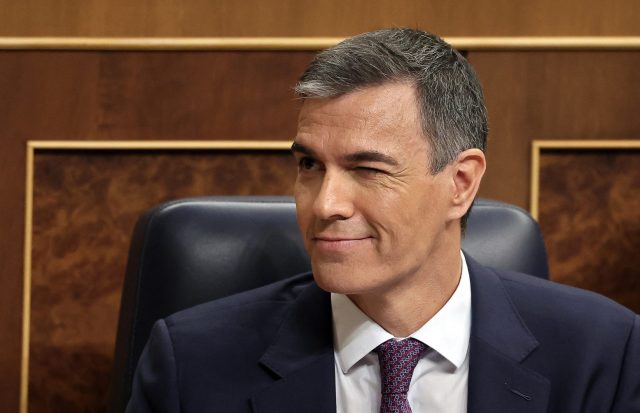
In recent weeks, the Left has gushed over Pedro Sanchez. (Credit: Thomas Coez / Getty Images)




The progressive world is having a Pedro Sánchez moment. Like an Iberian Hugh Grant in Love Actually, the Spanish Prime Minister told Donald Trump where to stick it on Iran — and left liberals swooning. The New Statesman profiled him as a “Left-wing icon”. Susan Sarandon gushed in approval. Mark Ruffalo was so impressed he even said Sánchez should be “leading the EU”.
But if he’s a hero abroad, Sánchez is more often cast as a villain at home — an opportunist who has clung to power at the expense of Spain’s national interest. Sánchez has been the Secretary-General of the Spanish Socialist Workers’ Party (PSOE) since July 2014 and in office since June 2018. In that time, he’s survived Covid, the economic shock that followed, and the rise of the hard Right. Britain in the same period has churned through five prime ministers — including one who lasted just 49 days — and the economy has stagnated alongside its sewage-filled rivers.
What makes this period of stability even more surprising is that for the majority of Sánchez’s time as PM, he has governed in coalition. Since his re-election in 2023, he has presided over what sections of the Spanish press term a “Frankenstein government”. Whether it’s truly monstrous depends on your political affiliation — and perhaps your appetite for the gothic — but stitched together it certainly is. To pass laws, PSOE has been forced into a coalition with a Left-wing alliance of smaller parties called Sumar, a verb which means “to add up”, though “make up the numbers” might be more apt. But even with their support, Sánchez falls short of a majority. So he must also go cap in hand for votes from separatist parties in the Basque Country and Catalonia that want independence from Madrid. It’s the alliance with these groups that’s proved particularly controversial. Unpopular concessions to the separatists have followed, including, most bitterly of all, an amnesty for the organisers of the illegal 2017 referendum on Catalan independence. Outside Catalonia and the Basque Country, support for independence is tiny and the subject provokes anger, even from liberals. Try saying “let them decide” in a Madrid bar and watch how the mood changes.
So, many predicted this hodgepodge government couldn’t last. Yet it has, and Sánchez is winning admirers for the striking clarity of his values. So how on earth has he done it?
For one thing, the Spanish system makes it hard to remove prime ministers. A government can only be toppled through a “constructive vote of no confidence”. That means opponents must agree on a replacement before they can bring the leader down.
Sánchez is also being helped by the fear of the hard Right, according to Pablo Simón, a political scientist at Carlos III University of Madrid. “Many parties back Sánchez not because they want his policies, but because they want to prevent the alternative,” says Simón. He’s referring to the emergence of the hard-Right party Vox, which has reshaped Spanish politics and coarsened the discourse, especially around immigration. In recent election campaigns, you occasionally hear the line Si te gusta el jamón, vota Vox — if you like ham, vote Vox — a charming refrain that left many wondering whether they really liked ham after all. The prospect of a coalition between Vox and the centre-Right Partido Popular (PP) also helps explain Sánchez’s staying power.
But part of the answer lies in something that is almost alien to British politics, with its entrenched two-party structure, but which seems increasingly likely to define Britain’s next election: the politics of the bloc. Until recently, Spain looked very much like the UK — dominated for decades by just two political forces, PSOE on the Left and PP on the Right. That system cracked open after the 2008 financial crisis and fractured further with the rise of Vox. Sánchez has proved remarkably adept at navigating this new, uneven terrain. He cannily framed the 2023 election as a simple choice: vote for him, or get Vox. And for all the anger over his Faustian pact with the Catalan separatists, he has avoided giving them what they really want: a legal independence referendum.
The question for Britain is whether something similar may be happening at home. The recent Gorton and Denton by-election offered one of the clearest signs yet of the fragmentation of the two-party system. Together, Labour and the Greens took more than two-thirds of the vote, suggesting that in parts of the country a progressive bloc already outweighs the conservative one — music to the ears of those hoping a progressive alliance may finally be taking shape.
A recent More in Common survey asked which parties voters would tactically block, and found that 38% of Britons would vote against Reform. Green voters were the most likely to say they would vote tactically against Reform, a view also shared by Labour and Liberal Democrat supporters. Britain’s electoral system may make formal coalitions less likely than in Spain, but informal dealmaking may already be beginning to take shape to prevent the alternative. Although progressive voters appear warm to the idea of cooperation between Labour, the Greens and the Liberal Democrats, the party machines are, for now, dead against it. Starmer’s sharp criticism of the Greens’ “sectarian” campaigning in Gorton and Denton hardly suggests he’s looking to them as a future bedfellow. And given the amount of energy he’s spent stamping out any whiff of association with the Corbyn-era Left, an alliance with the Greens of Zack Polanski would, surely, feel like the end of days.
Nevertheless, the comparison runs deeper than just voting patterns. Spain, like Britain, is a union state where the tensions pulling it apart feel familiar to anyone versed in Scottish or Welsh politics. A couple of years ago I invited my delightful Basque neighbours over for a drink. When I asked about their politics, they said they’d rather not say. It just “divides people”. As the penny dropped, I wondered briefly if this amiable couple were really cut out to be separatists. We changed the subject — Gibraltar, if I remember correctly — and got on with the rest of a pleasant evening. But in a very real way, it’s this ability to accommodate such differences that makes Sánchez’s coalition so striking: it forces the separatists to engage with the practicalities of governing, rather than just heckling from the sidelines.
“Sánchez has a remarkable political instinct,” says Simón. “His leadership style is extremely flexible and adapts quickly to changing circumstances.” Sánchez once ruled out an alliance with the separatists — until it became politically necessary. That flexibility can make him seem like a cynical operator, disguised as the handsome new doctor in a telenovela. But while the bloc holds, it also allows him to assert its values with apparent conviction. Sánchez excels at giving his base the signals it wants to hear. Time and again, he uses his power to claim the political banners that define his bloc: feminist legislation, defence of migrants, and forthright criticism of Israel’s military action in Gaza.
And now his four-word rebuttal to Donald Trump. No a la guerra is not only a masterclass in clear communication, but a calculated callback to the Spanish Left’s opposition to the Iraq War. That conflict left a deep scar in Spain and brought down José María Aznar’s Right-wing PP government. Days before an election, ministers blamed the Basque separatists ETA for deadly train bombings, rather than the actual culprits, Al-Qaeda.
Sánchez understands that in a multi-party system you can’t afford to be Diet Coke — you have to appear to be the real thing. Meanwhile, Keir Starmer is so preoccupied trying to prevent the drift of Labour voters to Reform that he struggles to communicate his values at all. On Iran, he seemed to plant the exact flag that progressives, still wounded by Britain’s own bitter experience in Iraq, so desperately wanted to see. But then he hoiked it from the ground like a caddy at Mar-a-Lago, leaving everyone to wonder if a flag had been planted at all. Still, he says, “we will not be drawn into the wider war.”
To be fair, Sánchez is on safer ground with his anti-war stance. A recent poll showed more than two thirds of Spaniards are against the war in Iran. In the UK, opinion is foggier — a YouGov poll found 49% opposed and 28% in favour, with the rest unsure. But Sánchez made his call at the outset of the war, before any polling had been published. Why? Because he doesn’t need to hedge his bets. He knows exactly what his bloc wants to hear.
Perhaps we shouldn’t be surprised that Sánchez is more adept at dealing with the reality of multi-party politics. Spain’s two-party system started to fracture long before Britain’s. During the protests that hit the country following the 2008 crash, pork products again entered the political arena as the public branded politicians chorizos, todos, or “a bunch of crooks”. From the anger emerged the new parties, Podemos and Ciudadanos, that shattered the old duopoly of PSOE and PP.
The Right derided Podemos’s unconventional pony-tailed leader Pablo Iglesias as a “perroflauta” — a brilliantly compressed insult for the Spanish breed of crusty found on town square benches with a dog (perro) and a recorder (flauta), and a repertoire consisting mainly of Manu Chao. But among Spanish progressives, excitement was through the roof. Many — including a friend of mine with three houses — joined the cause. A new energy swept through the Left, anticipating the early days of Jeremy Corbyn in the UK or Bernie Sanders in the US. Long-dismissed socialist ideas suddenly felt fresh, especially to a younger generation that had never heard them from the mouths of mainstream politicians. Within a few years of its creation, Podemos had won millions of votes and dozens of seats.
Like Ciudadanos, Podemos has now faded. However, the blocs these parties helped create remain, and it’s between these sides that the political battle is now being fought. On the one side, you have Sánchez’s socialists and their regional allies; on the other, the conservative parties of PP and Vox.
Of course, the comparison of Spain and the UK has its limits, not least the different electoral systems. And bloc politics is far from ideal. As Simón points out, it has some big drawbacks: increased polarisation and making national agreements far harder to reach.
But both Spain and Great Britain are dealing with fragmented politics and Sánchez is the master of the bloc. Far from being unstable, his coalition has proved more durable than Britain’s recent majority governments and forces him to take clear positions that resonate with his base. Across Europe, politics is now reorganising around competing visions of migration, identity and the state. For a country where a night out rarely begins until midnight, Spain has arrived uncharacteristically early to the bloc party. British politicians may soon discover that survival depends less on commanding a majority than on mastering Sánchez’s delicate art of holding the bloc together.
For Starmer in particular, if he can’t find a way to appeal to his own base, he risks looking less like Hugh Grant’s PM and more like a lonely teenager on a big stage clutching a sign that reads “Vote for Pedro”.
Join the discussion
Join like minded readers that support our journalism by becoming a paid subscriber
To join the discussion in the comments, become a paid subscriber.
Join like minded readers that support our journalism, read unlimited articles and enjoy other subscriber-only benefits.
Subscribe