




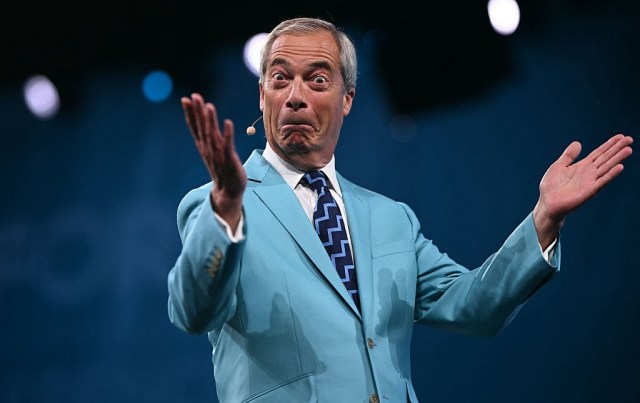
‘In Reform’s case, its leader’s crypto moment speaks to a profound identity crisis.’ (Oli Scarff/ AFP/ Getty)




In 2009, as the global financial system teetered on the edge of oblivion, a pseudonymous coder known as Satoshi Nakamoto released a piece of open-source software: the first Bitcoin. Buried within its blocks of code was a message referring to a contemporary front page: “The Times 03/Jan/2009 Chancellor on brink of second bailout for banks”. This was no accident. Here, after all, was a new means of payment and exchange, a new store of value, one free from failed central banks, incompetent governments and collapsing commercial lenders. The old model had been thoroughly discredited, and the principles behind Bitcoin were simple — and radically libertarian.
Most importantly, this new “crypto” would be decentralised. Transactions would remain anonymous, carried out directly and without intermediaries, between digital wallets across the world. And while advanced liberal democracies were busy printing money and injecting it into an insolvent banking system via quantitative easing, the total amount of Bitcoins would always be limited to a hard cap of 21 million. Where over-spending governments could stimulate hyperinflationary spirals, the new software would act as a “digital gold”, strictly rationing tokens to “miners” who used their computer processing power to create new Bitcoins.
In the midst of a financial crisis unmatched since the Wall Street Crash, a new techno-utopian movement was born. And it’s perhaps no surprise that Nigel Farage became an evangelist. An instinctive iconoclast, the Reform leader is temperamentally attracted to anything that’ll shake up our fusty old institutions. At a crypto conference last year, he told delegates he was “your champion”, promising to “bring crypto in from the cold”.
Lately, though, Farage has gone from fanboy to investor, putting £215,000 into a crypto startup headed by the former Chancellor Kwasi Kwarteng (of mini-budget and Trussonomics fame). Kwarteng quickly claimed that the Farage link would help his firm gain “institutional credability” (sic), a useful asset in a crypto world that remains murky, unregulated, and dogged by associations with tax avoidance and money laundering.
Quite apart from his general enthusiasm for crypto, this isn’t Farage’s first foray into unorthodox financial schemes. A former City metals trader, he’s spent years touting the benefits of commodities investments as part of his partnerships with Fortune and Freedom, a financial advice outfit, as well as doing ads for something called Direct Bullion.
With Farage now getting more involved in the crypto game, advocates doubtless hope their man will help Bitcoin disrupt finance just as he did British politics. Or, if we believe the naysayers, the crypto craze is a symbol of our intellectually decrepit age, a modern-day Tulip bubble inflated either by the dangerous or deluded, eager to sell assets with no underlying value beyond providing dark web services and anonymity for illicit activity. In this reading, the flow of money into Bitcoin and other digital currencies is less a sign of frontier innovation and more an emblem of our era: a damning indictment of the decline of productive, patient, long-term investment in favour of speculative gambles in unproductive assets.
Ultimately, though, Farage’s enthusiasm for cryptocurrency exists at the intersection between grift, personal self-enrichment, and an inchoate political ideology. Nor, of course, is he alone here. Bitcoin and the broader crypto phenomenon has become indelibly associated with the populist Right, from Javier Milei in Argentina to Marine Le Pen in France, who lately performed a screeching U-turn on her party’s opposition to what she once called a tool of the “ruling elite”. For his part, El Salvador’s President Nayib Bukele instructed his fellow citizens that businesses large and small must accept Bitcoin as legal tender. Farage has promised he’ll let people pay taxes using crypto, and has committed to setting up a sovereign wealth fund of digital currency assets.
If a vague libertarianism is part of the appeal here, there are other draws too. “Drain the swamp” was the rallying cry of Donald Trump, who netted a large fortune through the launch of his own crypto memecoin on the eve of his second presidency. The slogan most obviously referred to Washington’s insider networks, the liberal think tankers, corporate lobbyists and the captured elites in the Republican old guard. But it might just as well have been aimed at MAGA’s other adversary: the finance capital establishment, whose donations allowed Kamala Harris to outspend Trump by three-to-one in 2024.
Wall Street’s cliques sit atop the apex of the world’s dollar-denominated reserve system. They may have been tempted by Trumpian tax cuts, but not at the expense of losing those most valuable of commodities: predictability, stability, and borderless, frictionless open markets. Then there’s the Federal Reserve top brass, who Trump has wasted no time in attacking once back in the White House, not for their money-printing splurges, but for their parsimony, and their refusal to run the economy on hot at the President’s behest.
The crypto world serves as a strange mirror to the traditional Wall Street-Fed nexus. It’s the wayward brother, the rebellious trustafarian that nonetheless remains committed to sharing in the outputs of an over-financialised service economy, reliant on the proceeds of what Marx liked to call “fictitious capital”. The embrace of the technology by an ascendant Right-populist wave reveals an emptiness and superficiality at the heart of their projects. These are Janus-faced movements. On the one hand they feed off popular resentment at the ruling classes — the deracinated, ultra-rich “citizens of nowhere” — and instead promise nationalist, patriotic revivals. Yet all the while, they advocate for the further entrenchment of an unrestricted, borderless world, one facilitated by new financial technologies.
The collapse of the postwar Bretton Woods system, over half a century ago, preceded a new phase of globalisation, with the expansion of consumer credit and financialisation replacing industrial exports as the engines of the global economy. But whatever they might imply, the populists don’t propose to reverse these trends. Rather, they want to deepen them, with the further sublimation of national boundaries and the coherent economies they imply for digitised, globalised transactions. They rail against a globalist elite while promoting a technology that facilitates and smoothens global economic integration. They promise to halt national decline while actively boosting digital assets — assets that undermine the capacity of nation-states to fully control their own fiscal and monetary destinies.
For Farage, then, this is less “Take Back Control”, and more “Cede More Control” — to software that has an anti-statist, anti-national ethos embedded into its very code. All the while, crypto involves not the replacement of globalised capitalism, but merely its rejuvenation. And how will this be achieved? By pushing deregulation-on-steroids, turbocharged market liberalism without the mediating forces of the Federal Reserve to shore it up. That’s what’s at the very heart of the crypto phenomenon: the desire for a peer-to-peer currency functioning without the oversight of banks, legislators or indeed law enforcement. And, again, this isn’t so surprising. Faragism has always focused its ire on the free movement of people, of labour, while the transnational nature of capital mobility was taken as a given, or even an unalloyed good. And what all this shows, under proper scrutiny, is that the most mainstream of populisms can operate as a vehicle for intra-elite, rather than anti-elite, competition.
In Reform’s case, meanwhile, its leader’s crypto moment also speaks to a profound identity crisis. Yes, the party wants to stop small-boat crossings. Yet as Nigel began growing his collection of failed Tory ministers, his outfit has lost its outsider edge. We saw another symptom of its ideological confusion in its flip-flopping over Iran: should it remain attached to Trump’s transnational ambitions at all costs, or should it focus on the blunt economic fears of voters back in Britain.
All the while, the party is caught between pledges of reviving industry, rebuilding state capacity, and reorienting the economy towards manufacturing on the one hand — and its roots in the free-market, Austrian School dreams of City-based eccentrics on the other. In a world of burgeoning protectionism, and massive state-capitalist subsidies and aggressive mercantilism practiced by both the Americans and Beijing, the idea of reconciling both approaches is a fantasy. Industrial revival will require an active, agile state that shapes and directs market forces towards strategic, long-term goals.
Perhaps most of all, though, Farage’s crypto mania looks out of step with the times. Where the promise of bitcoin was a future of prosperity driven immaterially, with newfound wealth accrued in the digital ether, conflict in the Gulf reminds us of the centrality of hard goods: energy, steel, secure trading routes, and military-industrial capacity. In a world returning to the politics of production, Farage’s crypto evangelism feels less like a rebellion than strange nostalgia for a fading, borderless age.
Jonny Ball is a Contributing Editor at UnHerd. He formerly wrote under the name Despotic Inroad.
 DespoticInroad
Join the discussion
Join like minded readers that support our journalism by becoming a paid subscriber
To join the discussion in the comments, become a paid subscriber.
Join like minded readers that support our journalism, read unlimited articles and enjoy other subscriber-only benefits.
Subscribe