




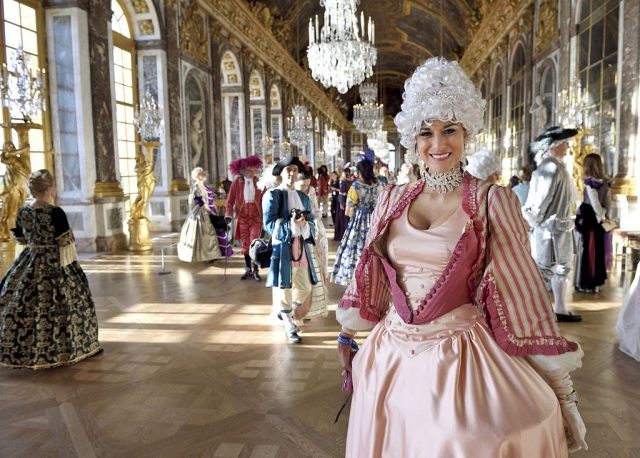
‘One day, royalists hope, the crown will rest once again on the King’s head.’ (Eric Feferberg/AFP/Getty)




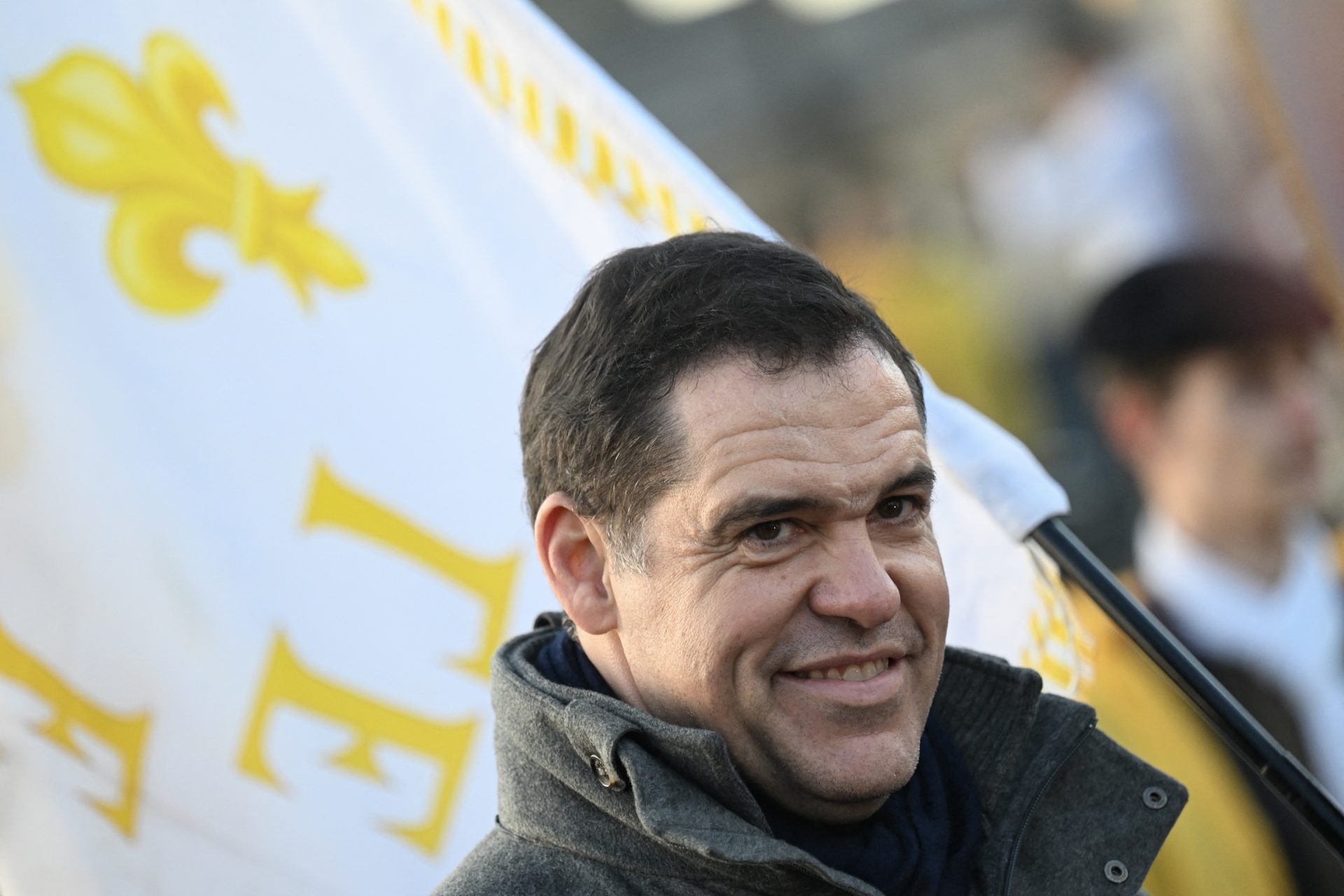
The crown of France lies in the gutter. It has lain there, grimy and rusty, since the fall of Napoleon III in 1870. Well over a century — and three republics — later, a swashbuckling nobleman still covets it. His patronym: Louis Alphonse de Bourbon. His title: Duke of Anjou.
With dark hair, a round face and a large nose, Louis Alphonse, 51, looks every bit the part of the roi. Clearly, blue blood doesn’t dilute. Louis Alphonse is directly descended from a long lineage of French monarchs that includes Saint Louis, Louis XIV and the hapless Louis XVI, guillotined during the French Revolution. As head of the House of Bourbon, he’s heir apparent to the throne. Were the hand of providence ever to crown him, he would be Louis XX.
But while Monseigneur may look the part, he doesn’t quite sound the part. Born in Spain — his second cousin is Felipe VI — Louis Alphonse speaks French with a thick Spanish accent. He often grimaces as he stumbles his way through declarations about the eternal virtues of royalty. Think Manuel in Fawlty Towers rather than Antonio Banderas in Zorro.
The crown isn’t Louis Alphonse’s sole preoccupation, either. Unlike his forebears, the man has to earn a living for his family. Every day, he grinds. A financier by training, Louis Alphonse worked for years for Banco Occidental de Descuento, a Venezuelan bank owned by his billionaire father-in-law, a self-proclaimed “socialist” said to have been tight with Hugo Chavez. Since 2019 he has also been honorary president of a foundation that promotes the memory of his great-grandfather on his mother’s side: General Franco, who he claims “created the Spanish middle class, built dams and roads [and] prevented the installation of communism”.
Yet, right now, Louis Alphonse’s heart aches for his ancestral homeland. With France mired in political chaos — and polls ranking Emmanuel Macron as the most unpopular ever leader of the Fifth Republic — Louis Alphonse has pitched himself as a king-in-waiting. “I see France in a situation of total blockage and I am dismayed,” he told France’s most-watched news channel last October, adjusting his webcam with customary panache. His message: “If France asks it of me, I will be at her service.” But he won’t go further. Like a Hollywood star angling for an Oscar, he lets his supporters campaign on their own initiative.
***
Far from Paris, in the small village in Corrèze, central France, a man dreams of helping Louis de Bourbon claim what fate stole away. Damien Pennes, 39, is a shopkeeper who has always felt a deep attachment to the monarchy. More than a year ago, he founded the royalist political party Lys Royal de France. It currently has around 142 members, though it punches above its weight on social media. Its spokesperson, a young woman who posts as Madame de France, has racked up nearly 200,000 likes on TikTok. It has a celebrity supporter too: Yellow Vests icon Jacline Mouraud, the hypnotherapist and accordionist who helped spark the protests that rocked France in late 2018.
Lys Royal is only fielding three candidates in the municipal elections next month — but that’s just the start. “Our aim, without pretence, is to run in the presidential election,” Pennes tells me. Still, should Lys Royal by some freakish miracle win, Pennes has no intention of governing. He would “do away with Lys Royal de France — as with all the other parties — in favour of the return of the monarchy”. He continues: “We have nothing else to gain from this… we are just simple French people. There are no nobles here, no great fortunes. We are shopkeepers, employees, care workers.”
The musketeers of Lys Royal aren’t alone. Other small outfits also advocate for a restoration. The most infamous is Action Française, an Orleanist movement long associated with the prewar nationalist Charles Maurras. Orleanists believe Jean d’Orléans, the descendant of the last French King Louis Philippe I, should be king; Legitimists back Louis Alphonse; Bonapartists aren’t really a thing since Napoleon was a proud product of the Revolution.
But while they are divided on who should rule France, the monarchists are broadly unified on the question of how they should rule France. Most of them loathe UK-style parliamentary monarchy. The ideal is a Catholic sovereign who actually rules, albeit with devolved powers at the local level. Above all, what they long for is a strong leader who can embody an ultraconservative idea of France. For Emile Chabal, a professor of contemporary history at the University of Edinburgh and the author of France, royalism may be “a negligible force in both French political and intellectual life,” but it is “one of the available far-Right ideological toolkits” in France today.
The monarchists share the same preoccupations as France’s far-right: the defence of national identity, opposition to high levels of immigration and hostility towards the European Union. Frexit is even on the agenda. Still, this doesn’t mean they support Marine Le Pen’s National Rally or Eric Zemmour’s Reconquête. Most abstain in national elections and reject the Left/Right divide, which they see as a dreadful by-product of the Revolution (which is, after all, where the very idea of a Left/Right divide comes from). Zemmour, who extols France’s Catholic heritage, is probably the most monarchy-coded French politician. In Chabal’s view, he combines a “reactionary, old-fashioned” programme with “a celebration of a hierarchical vision of Frenchness”. But even that isn’t enough for royalists. Zemmour plays the Republican game — and that sin can’t be absolved.
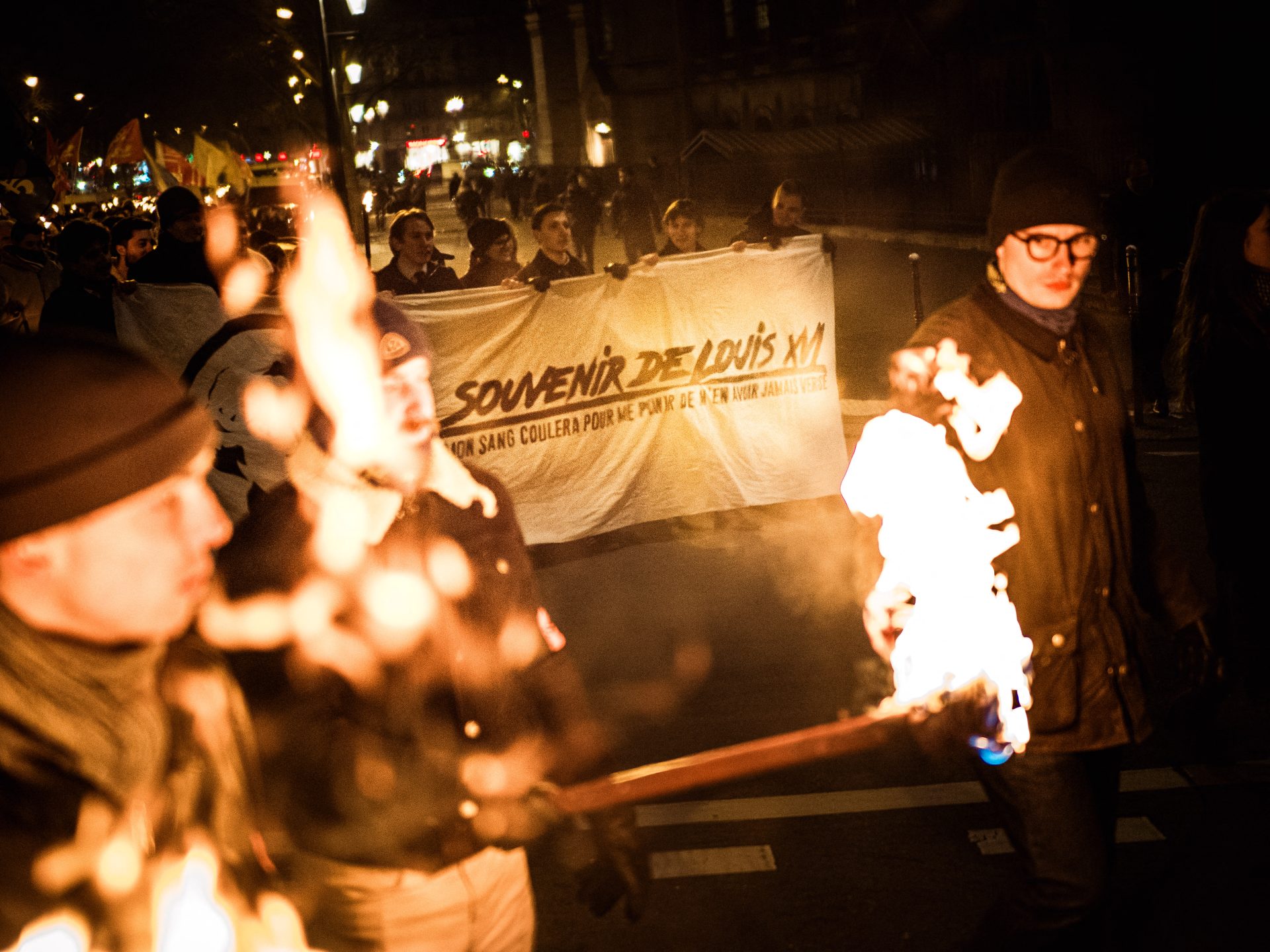
This rejection of the very idea of French democracy means that royalists, perhaps inevitably, play a negligible part in actual French democracy. Still, they do know how to put on a good show. Every year, they commemorate the execution of Louis XVI on 21 January 1793 with a torchlight march across Paris organised by Souvenir de Louis XVI. This year, more than 700 people showed up. Their slogans: “À bas la République!” and “Vive le Roi!”
And they also represent something far bigger than their small number. Some 17% of the French electorate support replacing the President with a King, according to a 2016 poll, and 39% say it would have positive consequences for national unity. Royalists are quick to cite these figures as vindication. The truth is that it’s more complicated. Most people aren’t familiar with royalist thought and probably picture a King as a French Charles III — rather than a divinely appointed ruler.
But where French royalism is most relevant is in its opposition to liberal democracy. Across the West, we are witnessing a growing rejection of liberal principles, a backlash that has intellectual roots that go back to 1789. It draws on doctrines espoused by French royalists who abhorred the Revolution’s promise of democracy. In other words, the reactionary vibes of French royalism haunt our moment.
In the late 18th and early 19th centuries, thinkers like Joseph de Maistre and Louis de Bonald formulated a grand critique of the Revolution: la contre-révolution. To them, the new system was illegitimate. Sovereignty didn’t come from the people but from God. It was mediated on Earth by long-established institutions: the monarchy, the Church and the family. Worse, democracy was a dangerous illusion. Far from leading the masses to happiness, it ruined them by unleashing their basest impulses. Chaos inevitably followed. The only winners were the new ruling elites gaming the system.
The return of the King was the prerequisite for the return of the old divinely sanctioned order. Royalism, therefore, became the animating force of the contre-révolution. And it was a force to be reckoned with throughout most of the 19th century. There were three kings after Napoleon’s fall. Even at the outset of the Third Republic in the 1870s, a restoration seemed on the cards. “There was a real hope of restoration for monarchists,” the historian Baptiste Roger-Lacan tells me, “and this hope engendered a republican reaction”.
Even after royalism lost majority support in the 1880s, it retained the power to disrupt. The monarchist group Action Française took off in the early 20th century at the time of the Dreyfus Affair. “By its ideological radicalism and its capacity to attract intellectuals it became an intellectual touchstone on the Right and the far-Right,” says Roger-Lacan. Its maître à penser, Charles Maurras, espoused a doctrine of “state-anti-semitism” believing French democracy had been captured by “internal enemies”: Protestants, Freemasons, foreigners and, of course, Jews.
At its peak in the Twenties, Action Française counted 60,000 members and reached many more with its newspaper. Today, it claims to have 3,000 members (journalists say the number is far fewer). Among them is Robin Vaillant, 24, a brewer who lives in the North of France. He insists that antisemitism is no longer part of Action Française’s doctrine. In his view, it was never central to Maurras’s royalist project and can be “taken out” without undermining its coherence. Historians tend to disagree, seeing Maurras’s visions as inextricably linked with Vichy.
Still, its vision for France is reasonably clear: Action Française continues to support “a decentralised monarchy”. The King would hold “regalian powers”: justice; national security; defence and diplomacy; state finances. The French Parliament would be abolished, and local assemblies would spring up all over the realm. These assemblies would be elected to deal with everyday life. People would also join corporations — or guilds — to represent their interests.
France would also no longer be secular. The King would be Catholic, and Catholicism would become the official religion — though other faith groups would still be allowed to practise. What about the will of the people? Royalists reject this too. There are issues, they argue, where vox populi should hold its tongue. “Can a French person give an opinion on nuclear energy when they aren’t informed, [or] on geopolitics, I don’t know, in sub-Saharan Africa?” asks Vaillant. “No, you need experts and the King sort of embodies that eminence with his ministers.”
People would only get involved where they know best. “People should give their opinion on questions where they are concretely knowledgeable: local and community life, the economy, the distribution of tax.”
The Legitimist vision of the restoration isn’t so different from this Orléanist version. It might differ on the details, but the basics are the same. “Action Francaise pinched all the good bits from the Legitimist doctrine,” says the good-humoured Loïc Baverel, head of the Cercle d’Action Légitimiste, who laments the fact that French monarchists spend more effort arguing among themselves than communicating with the public. “Our efforts of communications and interactions should be directed towards everyday French people,” he tells me, “not sniping at each other between telephone booths.”
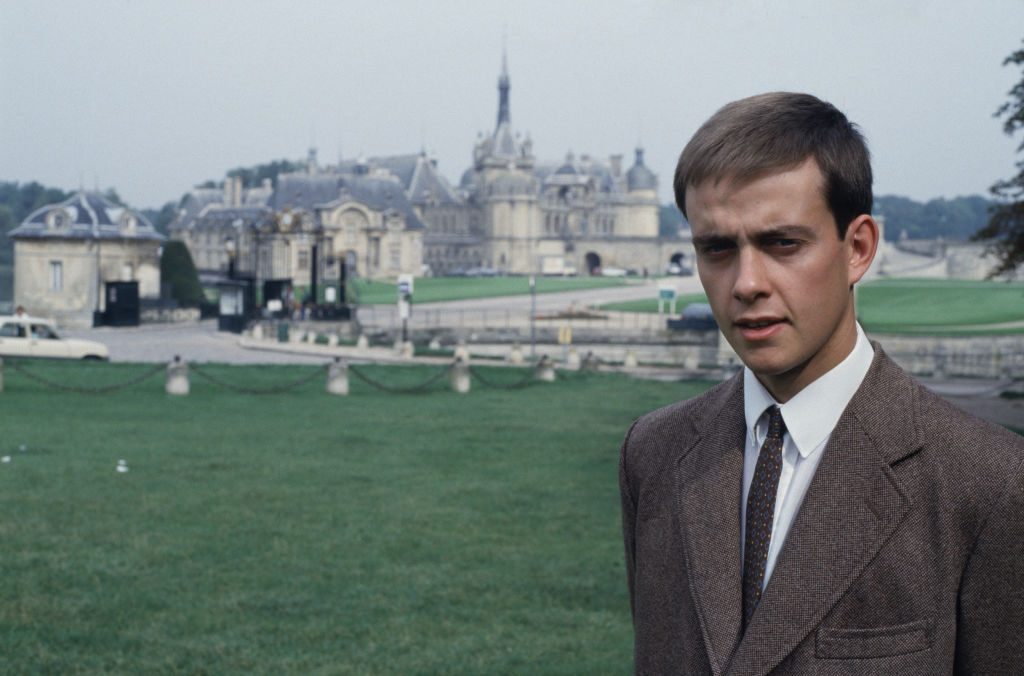
Unlike in the UK, the King would not be a ceremonial figure in Baverel’s France. He would wield real power and head a royal council made up of a principal minister and specialised ministers. For royalists, liberal democracy has led to decline. It has unleashed progressive forces, eroded France’s Catholic identity and sold off its sovereignty to the EU and giant corporations.
But the critique goes even deeper than that — it aims at the very idea of an elected government. Royalists believe that transferring power every few years to a new president — who comes with a new agenda and needs his party’s support to implement it — is reckless. It impedes strategic planning. Baverel’s initial attraction to royalism came from his frustration at “the inability of politicians to carry out long-term structural economic policies, which may require actions that are unpopular at first, because of electoral deadlines”.
So, the dreamed-of restoration would not just be a radical departure from what France is today. It would undo centuries of political development since the Enlightenment. It’s literally a reactionary project; its roots lie in the reaction to the French Revolution. Like de Maistre, today’s royalists defend a hierarchy they consider natural. In the imagined Kingdom of France, society would no longer be organised around the individual, but around traditional institutions and “organic” communities. The King would be the great arbiter. He would ensure, in Baverel’s words, “that society functions harmoniously and that justice is respected between the different intermediary or constituent bodies”.
But France is no longer where the reactionary party is at. These 21st century French counter-revolutionaries would surely have more success in another Republic born of revolution: the United States, where an unlikely band of monarchists are riding the coattails of President Trump, who has long fancied himself an American monarch. He has posted memes where he wears a crown with the tag “Long Live the King”. And he recently said that the only limit to his power is “his own morality”. Not even the Sun King himself, Louis XIV, would have dared utter something so brazen.
Under Donald I’s reign, a movement dubbed the Dark Enlightenment is emerging. Its leading figure, Curtis Yarvin, is a tech bro de Maistre. He has decried democracy as “weak” and wants the US to become a monarchy. But he envisions an even more powerful king than the French royalists: a CEO monarch who runs the realm like a Silicon Valley tycoon. Yarvin has reportedly influenced the White House and counts Vice President JD Vance as a reader. Elsewhere in the Magasphere, the far-Right streamer Nick Fuentes brags about being “a reactionary” and dreams of turning the US into a “Catholic monarchy”.
But while Yarvin and Fuentes borrow gleefully from the counter-Revolution, their visions of monarchy are ultimately dictatorial. They aren’t interested in theories of regalian powers and decentralisation. Roger-Lacan points to “post-liberals” such as the Catholic political theorist Patrick J. Deenen and the Harvard law professor Adrian Vermeule as closer in spirit to the French contre-révolutionnaires. “The American post-liberal movement really introduces in the US elements of counter-revolutionary doctrine that come from Europe,” he says. For him, post-liberals are “anti-moderns and anti-liberals who consider that liberal democracy is a catastrophe for humanity and that it was the last step of the separation, or the collapse, of Christian society.”
But the MAGA Right doesn’t just import reactionary ideas from the old continent. It is also obsessed with the aesthetics of traditional Christian Europe — cathedrals, medieval castles, Renaissance paintings — and fears this ancestral heritage is under threat. In its National Security Strategy, the Trump administration blames the European Union and migration for the “loss of national identities and self-confidence”. Europe itself risks “civilisational erasure”. At the Munich Security Conference, Secretary of State Marco Rubio hailed the “sacred inheritance” shared by Americans and Europeans.
Ironically for European reactionaries, it’s the United States that is now boosting their message — and it’s a message that increasingly chimes with voters. In the UK, according to a 2025 Channel 4 poll, half of Gen Z believe the country “would be a better place if a strong leader was in charge who does not have to bother with parliament and elections”. In France, things aren’t much better. A recent survey found that 41% of the population would favour “a leader who governs without parliament and elections”.
Amid this profound crisis of liberal democracy, it’s clear that French royalists have a card to play. Will they succeed? They are tiny in number but determined. “I tell people who feel discouraged by the numbers… the one thing that’s certain is that if we do nothing, nothing will happen,” says Loïc Baverel. While the monarchists will play basically no role at all in next year’s presidential elections, that’s not to say the ghost of their King won’t hover over it. Macron himself once remarked: “There is in the democratic process an absence. In French politics, the absent one is the figure of the King, whom I fundamentally think the French people didn’t want to die.” As such, the French “have tried to reoccupy this emptiness, to put other figures there”.
Whoever comes out on top in 2027 will be the leader who manages — if only temporarily — to occupy this emptiness. Charles de Gaulle did so in 1958 at the outset of the Fifth Republic. Napoleon did so in 1804, when he crowned himself Emperor. He reportedly said: “I found the crown of France in the gutter.”
One day, royalists hope, the crown will rest once again on the King’s head.
Theo Zenou writes about global affairs, culture, and power. He is a Visiting Fellow at the Australian National University.
 TheoZenou
Join the discussion
Join like minded readers that support our journalism by becoming a paid subscriber
To join the discussion in the comments, become a paid subscriber.
Join like minded readers that support our journalism, read unlimited articles and enjoy other subscriber-only benefits.
Subscribe