




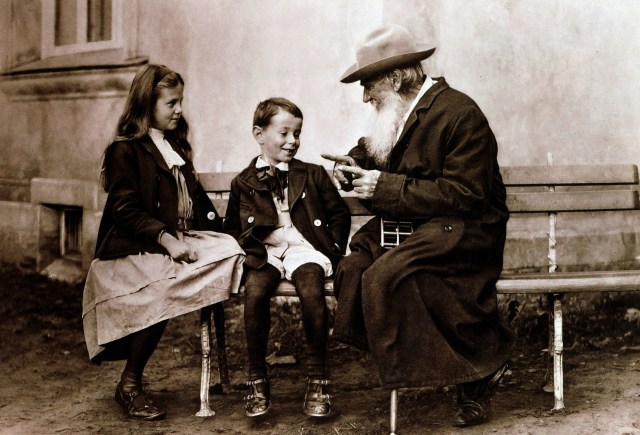
Patriarch and proponent of large families Leo Tolstoy, telling a story to his grandchildren. Credit: Getty




This Christmas Eve, as I’ve done every year since I was a child, I joined my father’s side of the family at my aunt’s house, a few blocks away from where I grew up in Bethlehem, PA. I’m the second youngest of 16 cousins, many of whom are much older than me and have children anywhere from between 2 and 22. And there’s a whole brood of second cousins between 4 and 8. I’ve always thought it’s more fun to play with the kids than hang out with the adults on Christmas Eve — make pillow forts, run around, look for Santa Claus, throw snowballs. At the same time, I understand, looking at my weary cousins, that the energy I have for fort-building is partly a factor of not having kids myself, of living in New York City and for the most part having lived an ultra-modern, basically hedonistic urban lifestyle since I was 22.
But as I’ve gotten older — and I’d like to think wiser — and as my own worldview has evolved, I’ve started to understand that the joy I experience around kids is not just about surplus energy or drawing a contrast with my New York City lifestyle, but actually the activation of an inborn paternal instinct. Some part of my being has a desire to make what sociobiologist Robert Trivers calls “parental investment.” That is to say: to play a crucial role in the future, to sacrifice something, to be a part of a clan and not just an isolated hedonic maximizer.
My generation, Millennials, is having children later, and at lower percentage rates than generations that came before us — only 40% of Millennial men are fathers, compared to 46% of Gen Xers, and only 33% live with a spouse and children, as compared to 66% of Gen X men. Among Zoomers, breeding is even less likely, in part thanks to a significant gender gap: 57% of Zoomer men want kids (a priority valued much more highly among Trump voters), but only 46% of Zoomer women want them (and likely they don’t want them with Trump voters). Add to this the ethos of AI, robotics, and life extension, and it suggests that one of the many schisms coming to our civilization will be that of the childless versus the parents: those who maximize life extension and hedonism, and those who value what will start to be considered “trad immortality” — that is, old-fashioned biological procreation. I don’t mean that everyone will fall into just these two camps, of course, but that this distinction will be a meaningful and historical one. The seeds of it are already planted.
Much is said, and rightly so, about the consequences of delayed parenting for women: both positive and negative. But there is far less emphasis on the consequences of delayed parenting for men. Men also undergo hormonal, neurological, and psychological changes when they become fathers. As biological anthropologist Christopher Kuzawa writes, “humans are unusual among mammals in that our offspring are dependent upon older individuals for feeding and protection for more than a decade.”
Men, like women transform when they have to provide care and protection to a family. The shifts are less obvious but no less existentially and morally meaningful. Men of my generation, however, are reaching or crossing the boundary of age 40 not only without having had kids, but without ever having thought about having kids, and thus remaining in what can only be deemed a long adolescence — or a long 20s, at least.
To be sure, not everybody should have children. And I suspect that lifelong bachelors do play a valuable role in civilization (for instance, there’s a reason why historically almost no philosophers have been married). Certainly some people’s most procreative acts are creative and intellectual, and not biological. But on the whole, something is wrong with a society in which increasingly few men unlock the deepest meaning of their own masculinity — a tissue-deep meaning. In a 2014 Emory University study, fathers showed much higher levels of plasma oxytocin, higher prolactin, and lower testosterone than non-fathers. A landmark 2011 longitudinal study out of Northwestern found that the men with the highest testosterone — the most competitive, virile males by the manosphere’s own metrics — were the most likely to become fathers, and then experienced declines of roughly a third in their testosterone levels after becoming fathers: peak masculinity leads to fatherhood, and fatherhood transforms it. For some in the manosphere, this sounds like a disaster (because “high T” is God), but we are meant to become less aggressive and more nurturing when we have children.
Fathers also live longer than non-fathers, even controlling for marital status. Fathers show lower rates of mental illness and engage in fewer risky behaviors. Moving away from the reductionist sociobiological point of view, any serious reader of great literature knows that fatherhood is often the mark of the hero, of a boy transformed into a man, who is ready to apply the lessons of his long education to the future and the next generation.
Whether extrapolating from Tolstoy — think of the birth of Prince Andrei’s son in the first part of War and Peace — or science, it is not hard to see why a world with fewer fathers, and a lower share of fathers, is less healthy, less civilized, less enmeshed in the meaning and drive of life.
Earlier this year, the internet writer and former academic sociologist Justin Murphy wrote a long post on X, perhaps to provoke conversation, about his own dislike of being a father. The responses to his post were, to my mind, salutary: one premise of Murphy’s confession was that fatherhood is central to manhood, and that manhood without fatherhood — or without a taste for fatherhood or love of fatherhood — is a manhood or masculinity that must question itself and interrogate itself. Certainly this is the right track.
The gulf is wide between the pleasures of a civilization that suspends adolescence forever and the ancient challenge of sacrificing one’s own gratification for the sake of new life and of the future. What Murphy’s viral post demonstrates is that it’s hard to transition from an easy life to a difficult one, where you must be ultimately responsible and seek more than self-fulfillment. I have this anxiety myself. One reason for it is that men of my generation never learned how to overcome such feelings. Without rituals of manhood, which bring men gradually, but definitively, into modes of responsibility both positional and spiritual, the shift from bachelorhood to parenthood produces anxiety and shock.
A highly technologized, ultra-modernized world where everyone lives far from nature, tradition, and religion, is one with more choices, and concealed preferences. So my point here is not to punish those who choose not to have children, but to inject some kind of paranoid philosophizing into the conversation. Are we forgetting that we have a choice — and that both tradition and biology make a very powerful case for fatherhood?
Some, yes, are meant to be monks, playboys, philosophers, esoteric computer programmers who spend their lives in largely solitary conditions. But those are few. How many of us are really Leopold Bloom without wives and without children — without a hero’s journey, without the inheritance of Odysseus, who knows who he is because he has an island home, a wife and a son, an old father, a loyal dog? Many of us. Which means, ultimately, that many of us will never experience the sweetness of growing old.

Join the discussion
Join like minded readers that support our journalism by becoming a paid subscriber
To join the discussion in the comments, become a paid subscriber.
Join like minded readers that support our journalism, read unlimited articles and enjoy other subscriber-only benefits.
Subscribe