




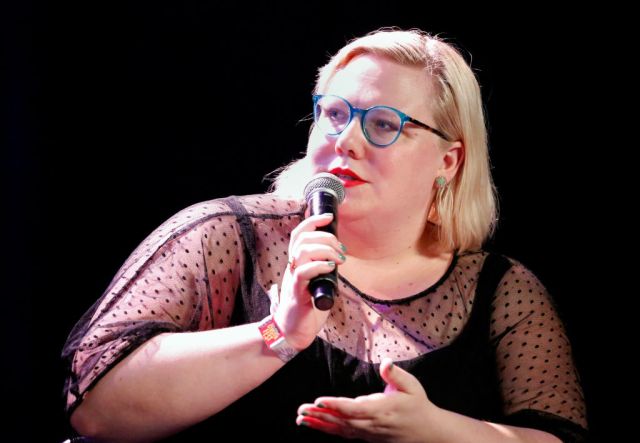
‘Whatever happened to Lindy West?’ (FilmMagic/ Getty)




Lindy West is a successful writer at a time when “successful writer” sounds close to an oxymoron. Against the backdrop of the 2000s print apocalypse, she navigated an ascent from her hometown alt-weekly (The Stranger, based in Seattle), via a stint at the Gawker-owned Jezebel, to GQ, The Guardian and The New York Times. She has also written four books, the first of which — a memoir titled Shrill: Notes from a Loud Woman (2016) — was adapted for TV and ran for three series.
She had a brash, snarky style that worked perfectly online and was widely imitated. If conflict was the currency of Web 2.0, West was an expert day trader. Her takedowns were vicious, and viral. Sex and the City 2, she wrote in one of her first breakout pieces, “takes everything that I hold dear as a woman and as a human… and rapes it to death with a stiletto that costs more than my car.” She tore into her Stranger colleague Dan Savage to accuse him of fat-shaming, in a blog post published on the Stranger. She tracked down and interviewed one of her own worst trolls. The internet was her element.
West’s fans tend to love her for what she is as much as what she writes. She became a role model for fat women who chose self-acceptance over self-hate. In 2015, she married the musician Ahamefule J Oluo, and presented their relationship as a “radical act” for body positivity. “[My partner],” she wrote, “is conventionally desirable and I am a ‘before’ picture in an ad for weight-loss tapeworm eggs. It is considered highly unlikely — borderline inconceivable — that he would choose to be with me in a culture where men are urged to perpetually ‘upgrade’ to the ‘hottest’ woman within reach.”
By 2018, West appeared to have everything she could desire. She was also, according to her new memoir Adult Braces: Driving Myself Sane, devastatingly, dysfunctionally unhappy: “The shift happened imperceptibly, in the two years after Shrill the book came out. I stopped wanting to work. I wrote less and less. I never answered emails. I let professional relationships slip away. I fumbled opportunities. I alienated my colleagues. I stopped seeing my friends. I was afraid to go outside, because I had become a public figure, at least in Seattle… I ate obsessively, just to feel some sort of tangible, reliable pleasure. I was in perpetual physical pain. I stopped moving my body. I couldn’t walk. I couldn’t breathe. I couldn’t sleep.”
Her marriage was no consolation. The fairytale vision she constructed in her writing and social media posts was, she writes, “an optical illusion, a conjurer’s trick, an inversion, a photo negative, a plaster cast for a life that didn’t exist.” She and Oluo only appeared to be contented because they were grimly suppressing any conflict: “we’d never figured out how to talk about anything hard. When things did crack open, he’d get angry and I’d grovel.”
The hardest thing of all? In 2012, in the early stages of their relationship, Oluo had made non-monogamy a condition of being with West. “He believed that monogamy was, at its root, a system of ownership. I had to admit that perhaps I didn’t feel it as keenly, as a white person.” (Oluo is mixed race.) But West wasn’t OK with non-monogamy. When she’d written about the significance of being a “fat bride”, she had been sincere: “Monogamous heterosexual true love had always been withheld, so that’s what I chased. I wasn’t naive; I was furious.”
But she also didn’t feel able to object. For one thing, she was a committed progressive, and in the 2010s, “being cool about polyamory felt like a growing imperative in progressive circles.” For another, she was afraid she would lose Oluo. (It is relevant that Oluo raised the non-monogamy issue shortly after West’s father died, when she was at her most pliable.) So she struck a bargain, with him but mostly with herself: if Oluo were to have other relationships, she never wanted to hear about them. This willed ignorance sort-of worked – for a while.
Then in 2019, West got a message from a fan who had spotted Oluo in a bar in Seattle, kissing another woman. So much for discretion. But Lindy West is not Lily Allen — and Adult Braces is not the story of how she kicked Oluo out the house and won back her self-confidence. Instead, it’s the story of how West convinced herself that she was also in love with Roya, the woman with whom her husband was having his affair. “I figured he probably had great taste in women,” West rationalises. Today, the three of them live together as a “throuple”.
West is insistent that embracing polyamory has cured her “codependency”, but her assertions sound hollow. Whatever erotic independence she is theoretically allowed, she doesn’t appear to have pursued it. She is far more convincing writing about her reasons for valuing monogamy than she is in the stilted, formal exchanges she quotes between her and Roya, who is younger and thinner and very much what the “culture” would see as an “upgrade” on West.
In fact, the whole book reads like a desperate, and desperately sad, cope. West is too intelligent to fully repress her insights. “Yes, it was spectacularly unlikely that I would — in a wholly uncomplicated, non-disordered way — connect with my husband’s girlfriend,” she writes. But she swats away the self-knowledge: “I don’t know, crazier coincidences have happened!” This surrendered pose is difficult to reconcile with the fighty, seemingly fearless writer of the 2000s and 2010s.
Whatever happened to Lindy West? And whatever happened to the kind of feminism she represented? These are questions that West appears to be asking herself, intermittently. “Sometimes I wonder if my last couple of years at The Stranger… were the very best of my life — if it would be worth it to go back to the smaller world of a Seattle alt weekly, a big fat fish in a pond I loved and understood, where everyone loved and understood me. I was broke and lonely, but I was myself; I was great at what I did, and I never second-guessed it.”
She’s right. She really was great at what she did. In 2009, West — then aged 27 — reviewed a branch of Hooters, the chain “breastaurant” where female servers wear tight shirts and short-shorts and are contractually required to flirt with the customers. The result was savagely funny and spikily political. “Hooters is like a misogyny theme park,” she wrote, “where… all the women are girls, all the girls who weren’t born ‘empowered’ have cut open their chests and stuck plastic bags of goo in there and sewn ’em up again in the name of making money and making men happy, and no one’s shaming you into treating them like humans with brain-parts.”
Then she added: “It’s like — a friend pointed out later — if someone opened a restaurant called N*****s, and the all-black waitstaff dressed like slaves and step ’n’ fetched you platters of watermelon.” She did not asterisk out the N-word, and it’s shocking to see; not only because the N-word has now become thoroughly taboo (a process that was already well underway by the late 2000s), but because West went on to become exactly the kind of writer who would prosecute linguistic taboos with vigour — a paragon of progressive right-think.
But the internet that made West successful was a place of roiling social mores. Things went from acceptable to edgy to verboten with breakneck speed — and West was one of the most significant writers in shaping (or at least, narrating) that process. That didn’t mean she was doctrinaire, or at least not at first. Her 2012 Jezebel essay “How to make a rape joke” does not say that rape is off-limits as a topic of comedy. In fact, it lays out several examples of rape jokes that West thinks are funny and have more than shock value.
It’s also self-critical. Revisiting her SATC2 review, and the “rapes it to death with a stiletto” line, she writes: “I chose ‘rape” on purpose at the time — because it’s gendered and jarring and I wanted to convey the severity of my disgust, as a woman, with that fucking garbage movie. But if I wrote that review today, would I write it the same way? Nope… I, Lindy West, am sorry.” The subtleties of her position were missed by a significant male contingent, who duly decided that the best way to punish West for writing about rape was to send her a tsunami of rape threats, largely via Twitter.
Being harassed at that scale is scarring, and when West writes about the experience in Adult Braces, she sounds fragile and wounded: “It turns out that having thousands of people make fun of you and threaten to rape and murder you can make you feel unsafe in certain spaces for way longer than you expect.” There’s a change in her writing around this time. She doesn’t become less aggressive, but she does become more selective about who she will be aggressive towards, as though the lambasting she received has made her more fearful of being rejected by her own “side”. When the British journalist Suzanne Moore was at the centre of a horrific Twitter pile-on six months later over a line in an essay that was deemed to be transphobic, West’s recent experience did not make her sympathetic. Instead, it seems to have hardened her attitude. “Trans women are women, and to say otherwise makes you sound like a batty old dinosaur,” she wrote in a snide post on Jezebel.
Having read her for a long time, it seems unlikely to me that West always believed “trans women are women”. Instead, it seems to be an opinion that solidified into conviction some time between 2012 and 2013 — when the social cost of being labeled a “terf” became inescapable. As West says in her piece, she is writing as someone “versed in the current social justice dialogue”. If you want to put it another way, she is writing as someone who has learned to second-guess herself. She is less concerned about what is true or fair than she is about what is acceptable to her peers.
You can see this same evolution in the adaptation of Shrill for the screen. In the second episode of season one, first broadcast in 2019, West’s Hooters trip gets revived for her on-screen analogue, the character Annie (played by Saturday Night Live’s Aidy Bryant), only the TV version is very different.
In the Stranger piece, West’s interactions with the server (who she nicknames “Professor Boobies”) were stilted and painful, and West is left feeling “fat and condescending”. In the TV version, though, Annie is a respectful tourist of the strippers’ workplace, diligently listening to sex workers in the way that, by 2019, all liberals had been instructed that they should. When Annie asks one (black) dancer whether she finds it undignified to do what a man tells her, the dancer replies: “Men do not tell me what to do. I’ve got a fat ass and big titties — I tell them what to do.”
Later in the episode, inspired by this pep talk, Annie will assert the value of her own “fat ass and big titties” to a disrespectful boyfriend.
There’s no room in here for a critique of plastic surgery. The “misogyny theme park” has been replaced with a female empowerment playground. And there is certainly no comparison here between girlie shows and black minstrelsy — never mind a provocative deployment of the N-word. By the late 2010s, the official progressive line was that sex work is work and waitressing in a breastaurant was no less dignified than serving in McDonalds. There was also a heavy taboo on drawing an analogy between racism and any other kind of oppression; indeed, to do so was considered to be in itself a form of racism. West’s own desire not to be racist was so strong that, as we’ve already seen, her husband used it to pressure her into non-monogamy by claiming that monogamy was tantamount to slavery.
To be entirely clear, I have no desire to return to a time when the N-word was dropped with impunity and rape jokes were background noise — though if I did, I could simply log into Elon Musk’s X. Nevertheless, when reading West’s old Stranger essay, it’s painful to see how much more fun it is than West’s output now. You’d have a considerably better time hitting up Hooters with the 2009 version of West and making jokes about boob jobs than you would obediently receiving homilies about self-esteem from a woman in a thong.
Her retreat to linguistic policing turned her into an exemplar of “conduct book feminism” (as the writer Victoria Smith calls it); and conduct book feminism, it turns out, was repellant to quite a lot of people. Earlier this month, New York Magazine published a report on “The Women Leaving the New Right”. The women’s reasons for leaving a movement they had once assiduously boosted were interesting, if predictable: turns out that when men say women should be subservient domestic chattel, some of them mean it. But more revealing than that, to me at least, were the factors that had drawn them to the New Right in the first place. The journalist Sam Adler-Bell profiles a woman referred to as Anna who rebelled against a conservative background to embrace liberal politics. However, when exposed to the “overweening, haughty moralism of Peak Woke” in the mid-2010s, she came to find the humourlessness of the Left “more alienating than the conservatism of her youth.”
You can trace precisely this creep of humourlessness in West’s career. But you can also see other things that might have persuaded a woman like Anna that the supposedly feminist Left did not have her best interests at heart.
West cleaved to all the beliefs a female writer was expected to have if she was to avoid ostracism from the progressive mainstream. She adhered to body positivity, even though she suffered terribly from being debilitatingly overweight. She learned that sex work is work and trans women are women — or at least, she learned better than to say she thought otherwise. And she learned that when your husband decides to move his mistress into your home, it’s better to convince yourself you’re also into her than risk losing him.
None of these things are advances for women’s rights. Instead, they are advances for male sexual entitlement which women like West have accepted under the aegis of feminism, because to fight against them would be to set yourself against the men of your own political tribe.
Throwing your lot in with ethnonationalists and opponents of female suffrage, as the women of the New Right did, is not a rational reaction. But nor can you say that staying primly within the bounds of accepted progressivism has worked out well for West. She still couldn’t keep pace. The New York Times review of her 2019 book on #MeToo essays, The Witches are Coming, chided her for being “heavily focused on white, cisgender men while overlooking the fact that white women can be just as invested in white supremacy”.
No wonder West is nostalgic for the late Noughties. Yes, it’s natural to be wistful for the era of your greatest potential — but it also makes sense that West would yearn for a time when she had both the freedom to make mistakes, and the confidence that she could survive them.
The genre of feminism that made West successful also made her, eventually, its prisoner. As she patrolled the bounds of acceptable discourse for others, she also shrank her own realm of the thinkable until it mapped exactly onto her husband’s whims. The feminism of the blogosphere was not a form of politics. It was a form of branding, a spritz of differentiation in an overcrowded market where the best way to get ahead was to clamber over somebody else. West, it’s true, was good at that. She left a trail of the cancelled in her wake. But reading Adult Braces, it’s difficult to avoid the conclusion that all the success this won her has left her more alone than failure ever could.

Join the discussion
Join like minded readers that support our journalism by becoming a paid subscriber
To join the discussion in the comments, become a paid subscriber.
Join like minded readers that support our journalism, read unlimited articles and enjoy other subscriber-only benefits.
Subscribe