




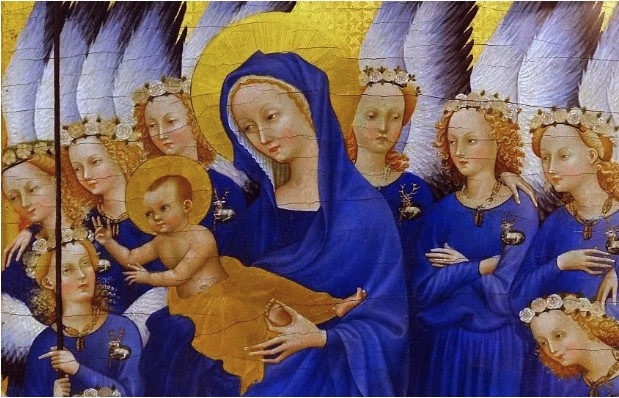
In the medieval imagination, everyone had their place in a divinely-created cosmos. (Getty Images)




Look carefully and you will notice that the moral imagination of the modern world feels, in certain respects, flattened. Not long ago, after immersing himself in 19th-century novels, the writer Matthew Yglesias remarked how foreign the language of honour now sounds to us, how distant the moral world of someone like Dorothea in Middlemarch.
Think about it: when was the last time you praised someone for being noble or honourable? Even the word good has receded. In its place we find the more domesticated commendations: kind and nice. They are agreeable words, certainly, but also modest ones — virtues stripped of grandeur, careful not to be too much of anything. Self-sacrifice is almost unheard-of.
The moral ends that guide modern life now tend to gather around three dominant aims. The first is safety. This reveals itself in a vigilant concern for the preservation of both the body and, increasingly, the mind. Both of these are now understood as biological systems requiring maintenance, hence the growing societal preoccupation with mental health and the medicalisation of emotional states. The second aim is utility: the relentless emphasis on efficiency, productivity and optimisation. Life is measured in outputs and improvements, and its worth is justified in terms of functionality.
Lastly, there is the obsession with equality — the only one of these aims that still gestures toward something like a moral ideal. The others are largely managerial and materialistic. When I speak of equality as a dominant aim, I do not mean equality in the classical sense of a universal human right. What I have in mind instead is the contemporary drive toward the equalisation of outcomes, the growing discomfort with hierarchy, and the proliferation of the narratives of oppression that now function as a central moral grammar in Western societies.
Nietzsche suggested that obsessive egalitarianism was the afterglow of Christianity: a moral residue that lingered after faith itself had faded. But Christianity bequeathed many values to the modern world: humility, charity, forgiveness, self-sacrifice. Out of these, equality, in particular, survived as the key virtue. The question is: why?
It seems to me that equality functions almost as a consolation prize of the secular age. The transition from an enchanted cosmos to a disenchanted, secular world has undoubtedly expanded human freedom. Yet in dismantling the old metaphysical framework, we have also stripped away the cosmic narrative that once conferred dignity even upon those at the margins of society: the so-called “losers”.
The modern valorisation of equality, of course, would be bizarre to our ancestors. In A Secular Age, the philosopher Charles Taylor offers a remarkable account of just how foreign the land of the past truly is. For Taylor, modernity is defined not simply by a decline in religious belief, but by a deeper shift in the background assumptions through which people experience reality: a change not merely in what people believe, but in how the world itself is imagined and lived. He describes this transformation as the passage from an enchanted world to one that is disenchanted and secular.
In the pre-modern “enchanted” world, the world of “spirits, demons and moral forces”, reality was thick with agency and meaning. The cosmos was not neutral or inert, and people understood themselves as vulnerable to powers beyond their control, capable of being corrupted or elevated by forces outside themselves. The boundary between the self and the world was therefore permeable.
Taylor describes this condition as that of the “porous self”: a self embedded within a morally charged universe, open to external influences and aware of its dependence on a larger, divinely structured order. While this dependence implied a certain impotence, it also provided a powerful sense of belonging, situating individual lives within a cosmic order not of their own making.
Disenchantment dissolves this structure. What disappears is not simply belief in spirits, but the very sense that meaning resides in the fabric of the world. The locus of meaning is relocated from the world to solely inside the human. And this gives rise to what Taylor terms the “buffered self”. The buffered self confronts the world from behind a kind of protective membrane. It no longer sees itself as vulnerable to cosmic forces. In the world of the buffered self, nature is no longer enchanted but inert, something to be explained, predicted, and manipulated. Even when we acknowledge the limits of human power, the dominant modern assumption is that natural obstacles will eventually yield to science and technology. Rather than propitiating unseen powers for a good harvest, we design irrigation systems and engineer crops.
The advantages of the buffered self — and of life in a disenchanted world — are obvious. Human beings no longer experience themselves as helpless before the powers of nature, nor do they feel their destinies to be at the mercy of capricious gods. Nature has become something to be understood and mastered. In this sense, the modern self appears capable of shaping its own fate.
This shift in mentality also helped make possible the extraordinary achievements of modernity. The economist Deirdre McCloskey is among those who have argued that this cultural transformation was crucial in enabling the Scientific Revolution and the economic changes that followed: developments that produced some of the greatest increases in living standards in human history. By any measure, it stands as an immense achievement.
But with such immense empowerment also comes a crushing burden: that of radical responsibility. Once we anchor meaning within the individual and we understand him to be radically able to improve his condition, we can no longer find refuge in helplessness. The secular mind implicitly understands power and merit as matters of will. The loser is solely responsible for their condition.
Formerly, within an enchanted worldview, earthly failure did not exhaust a life’s meaning: the poor and humiliated could still belong to a larger divine story in which salvation, not worldly success, was the ultimate measure. But in a disenchanted world, life’s losers are deprived of both the promise of ultimate reversal — “The first shall be last and the last shall be first,” as the Bible puts it. Even when it came to life on Earth itself, social hierarchy was seen as part of a divinely ordered cosmos, which granted even the humblest positions a certain dignity.
And more disturbingly, without all these, it becomes difficult to resist the conclusion that some lives contribute less, matter less and — even more disturbingly — might even be less necessary.
It is in erecting barriers to this conclusion that post-World War II modernity is at its most morally energetic. This moral energy manifests in the relentless pursuit of equality, the acute sensitivity to oppression and the refusal to accept hierarchy as natural. These phenomena are not merely fashions. They are attempts to supply, through political means, what religion once provided: an assurance that no life is negligible. In a world where dignity no longer descends from heaven, it must be constructed on earth. Or else the weak are left with nothing at all.
The “loser” is not a permanent class of people. It exists, in some degree, within each of us. Human beings are fragile creatures, capable of failure and weakness at any point. Indeed, the anxiety over “loserdom” is often strongest not among the most destitute but among the moderately successful — those who glimpse success and know they might yet fail to reach it. Something of this tension can be seen in the rising levels of anxiety reported at elite universities and other highly competitive environments.
Equality in a disenchanted world serves not only to reassure “the weak,” but also to place limits on the strong. It provides a moral vocabulary through which we can say that the strong are behaving improperly. In modern societies, strength is often defined in terms of utility: that is, those who are strong are those who generate wealth or have influence. Yet without a shared conception of the good life, it becomes difficult to explain why such individuals might still be failing in their obligations to the community. In earlier eras, even the most powerful figures were understood to stand under a higher moral order. Kings answered to God and power carried expectations of virtue and stewardship.
Modern liberal societies are less comfortable articulating such expectations. Over the past century, political thought, influenced no doubt by the rise of secularism, has increasingly embraced the idea that the state should remain neutral regarding competing visions of the good life. As the philosopher Michael Sandel has argued, freedom came to be defined largely as the ability of individuals to pursue their own preferences without interference. The result is a society that carefully protects rights but grows hesitant to articulate shared ends.
In this setting, criticism of the powerful often takes an indirect form. Public frustration with elites, whether directed at billionaires or corporations, is frequently expressed in the language of equality and redistribution. A recent flashpoint of this kind has been the proposal for a California billionaire tax. Yet beneath these demands often lies a deeper moral intuition: that the powerful are failing in some civic or ethical duty. Lacking a widely shared language of virtue or the common good, however, that intuition tends to be translated into the one moral grammar that remains widely legitimate — equality.
There remain pockets of the modern world where the obsession with equality recedes, most notably in the sphere of work. In such contexts, individuals can still find a sense of belonging and participation in a mission larger than themselves. Nowhere is this more visible than in start-ups. In such spaces, even the pretence of equality is often suspended in practice. Employees willingly subordinate themselves to a founder, often investing that figure with a quasi-prophetic aura. An entire mythology around the figure is born. “Founder-mode” might be the closest we get in the modern era to a grand hero narrative.
This hierarchy is accepted, even celebrated, because it promises belonging to a grand narrative: building the future and bending the arc of history through innovation. In recent years, companies like Anthropic have inspired precisely this kind of near-religious devotion in their employees. Access to such positions, however, is difficult, even for the fortunate. To most people, it is virtually inaccessible. A society cannot rely on such rare opportunities alone; it must find ways to generate sources of meaning for the many.
One possible response is a return to a civic form of republicanism — the tradition that animated many of the Founding Fathers — in which the value of citizens is not measured solely by their economic utility but by their participation in a shared common good. Such a vision would require a society willing to articulate what that good consists of, and to speak openly about the virtues and forms of life that sustain it.
Whether modern liberal societies still possess the confidence to define such shared ends — and whether disenchantment itself might be, even in part, reversible — remains an open question. What does seem clear, however, is that the hunger for such ends has not entirely vanished. Our continued ability to read 19th-century novels and not only recognise but feel drawn to their moral world is itself revealing.
At the same time, new technological forces — chiefly those unleashed by the rise of AI, from the spread of hyper-addictive gambling platforms to more subtle forms of behavioural manipulation — are beginning to unsettle even the most committed of liberals. The pressure to recover a richer moral vocabulary is gathering faster than almost anyone could have expected.
Join the discussion
Join like minded readers that support our journalism by becoming a paid subscriber
To join the discussion in the comments, become a paid subscriber.
Join like minded readers that support our journalism, read unlimited articles and enjoy other subscriber-only benefits.
Subscribe