




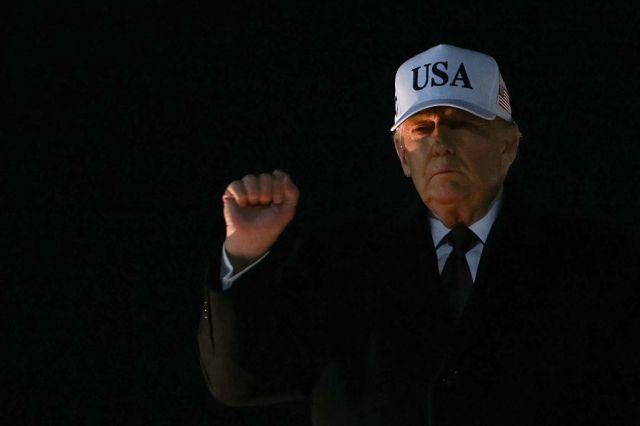
Indifference to older norms. (Andrew Caballero-Reynolds / AFP via Getty)




In DC last week, the atmosphere was deeply weird. It was my first trip to the imperial capital since Trump’s 2024 election victory, when the mood among Right-wingers had been elated, fizzy, and full of hope. This time it felt tense. Everyone weighed their words carefully on Iran; there was no very clear consensus on why the bombing is even happening. Rumours and speculations swirled: it was Evangelicals trying to bring about the End Times, Israeli lobbying, Iran’s nuclear programme, even assorted forms of China-related 6D chess were mooted.
Perhaps it’s simpler: we’re just out the other side of the experiment with mass-media democracy, and mass-mobilisation warfare. In other words, this is the West’s first fully post-liberal war. And in this new age, politicians have simply stopped feeling they need to give electorates an explanation.
The liberal order was supposed to be a global utopia of rules. Under this optimistic regime, states would avert open conflict by adhering to international norms — and even, latterly, spread the norms at gunpoint in order to globalise their adoption. Starmer’s stubborn adherence to this disintegrating raft of proceduralism has been greeted with Trumpian contempt. And perhaps we might also note that these rules are, themselves, a historical anomaly. Until the 20th century, leaders gave little thought to what ordinary people wanted, when weighing the necessity of conflict. For most of history before mass-casualty munitions, such decisions were seen as the preserve of specially educated elites.
But over the mass-broadcast age that began with radio, and continued until the digital revolution, it came to be accepted that the general public ought to have a say. In his account of the run-up to the Second World War, the historian AJP Taylor describes a dynamic in which “public opinion” became, for the first time, a meaningful factor for politicians in their decision-making, even on war. It’s not a coincidence that over the same era a new type of official communications — more colloquially, mass propaganda — also emerged, to shape “public opinion” in the desired direction.
This was genuinely necessary, for over the same industrial period, war itself also became a mass phenomenon: both mass-mobilisation, and mass-casualty. If you’re going to ask all your citizens to mobilise either for combat or the war effort, you do need some form of general public consent. The climax of “total war” in this style came between 1914 and 1945: an orgy of industrialised weapons-manufacture, death, and destruction, that only ended with the horror of Hiroshima and Nagasaki.
After this cataclysm, the world lived for decades in the comparative hush of Mutually Assured Destruction. Meanwhile, the broadcast-media legacy of “total war” entrenched a belief that electorates should be involved in any decision to fight. Especially in the USA after Vietnam and Watergate, the “third estate” came increasingly to understand itself as an indispensable component in the democratic settlement: both speaking truth to power, and at times cutting power back down to size.
In time, this also had a reciprocal effect on the way war itself came to be mediated. I vividly recall the considerable effort, after 9/11, to present the invasion of Iraq as legal and democratically mandated. By contrast, what feels strange about the current conflict in Iran is that it is just as real — real deaths, real refugees, real flames, real international economic chaos — but no one seems to have paid any attention to rules, or indeed “public opinion”, before embarking on it. And now here we are.
But perhaps this is fitting. Over the past two decades, both warfare and communications have mutated at warp speed. And one of the key characteristics of this revolution, which has happened through digital innovation, is a paradoxical mix of apparent decentralisation covering real centralisation. Think of the way social media “disintermediated” local newspapers in theory, in favour of “citizen journalism”, while in practice handing overall control to a handful of platforms and their oligarchs.
The same now seems to go, too, for war. Especially since the frenzy of drone innovation catalysed by Putin’s invasion of Ukraine, combat has been “disintermediated” away from human-manned artillery or soldiers, toward partially or fully autonomous weapons. Since Trump’s “major combat operation” began, for example, the Gulf states surrounding Iran have undergone heavy attack by drones and guided missiles, most of which has been repelled by equally high-tech automated interceptor systems. All of this is controlled by a comparatively small battery of experts, and supplied by a small number of firms.
Meanwhile, the field of domestic war communications also feels increasingly swarm-like, computer-generated — and indifferent to interference by the masses. The White House X account broadcasts grainy explosion footage mixed with high-gloss edits drawn from video gaming, action movies, and (really) Spongebob Squarepants, adding to the sense of high-tech unreality with AI-animated “Founding Fathers” imagery. Blaze Media founder Glenn Beck, too, has trotted out his “George AI”, a CGI rendition of George Washington dressed as a tech bro and trained on data “writings from the founding era”, to explain the importance of what the White House trumpets as “peace through strength”.
This is perhaps also the context in which to understand the recent standoff between Trump and Anthropic. The CEO of the AI firm, Dario Amodei, objected to his system being deployed by the US military to power fully autonomous weapons and domestic surveillance. Trump retaliated by threatening to designate Anthropic as a “supply chain risk”. Negotiations are ongoing; but the clear impression is of a US Department of War leaning full-tilt into the new high-tech arms race, and that will brook no dissent. Online, too, just as Amodei’s objections to the weaponisation of Claude have been dismissed, so too have protests from Ben Stiller, over the use of his cinematic work for war propaganda. The White House “Epic Fury” movie edit is still live.
This indifference to older norms, and seeming preference for vibes-based comms over clear messaging, has prompted a cacophony of secondary debate. This now occupies everyone’s newsfeeds; meanwhile, the “major combat operation” rumbles on. And who knows: perhaps there really is a robust national-interest rationale for the attacks, from an American leadership perspective, and those in the know simply aren’t saying. But whatever prompted the attack, it’s clear that the broadcast-media machine is increasingly irrelevant to such decisions.
Much as heavy artillery now takes second place to nimbler, cheaper drone swarms, so has mass media been disintermediated by a maelstrom of CGI edits, AI propagandists, bot-farms, and “citizen journalism”. And perhaps that’s the point: the aim is not clear messaging but a debate so hyperreal that messaging as such is impossible. Above the din, meanwhile, the postwar fiction of “the people” having any kind of democratic say in warmaking has been quietly shelved.
In the premodern era, war was for elites, with ordinary peasants only mobilised in extremis. Of course, the consequences of war were frequently devastating for those peasants; but by and large such decisions were taken over their heads. We seem now to be approaching a post-industrial retread of the same dynamic, in which warmaking is once again an elite choice, and everyone just has to live with it.
Some reports are now suggesting that Trump expected a quick operation, comparable with Venezuela, and not Iran’s determination to make it a regional war. And yet networked warfare will tend in that direction: the arrest of two self-radicalised “Islamic State” fighters in New York City last Saturday, for trying to detonate a nail-bomb at a Right-wing protest, is a harbinger of the vectors by which high-tech warfare, energised by memes, is likely to metastasise.
For the internet’s other core characteristic, along with centralising real power, is dissolving physical distance. Social media platforms such as TikTok, Facebook and Instagram have become both advertising channels and organisational tools for the global people-trafficking industry; meanwhile studies suggest that the internet’s power to connect people instantly across distance inhibits migrants’ assimilation in host countries.
Scaled up, the picture this presents is of increasingly diffuse, unassimilated, intermingled, and digitally networked populations across the globe, who hold (putting it mildly) a range of views about any given war, in any given place. In such a world, where communications are instantaneous, and populations linked more by ideology or ethno-religious affinity than geography, every battlefield is also potentially everywhere.
So we’ve exited the age of utopian globalism. But not (as Trump seemed to promise) for a return to moderate nationalism. Even if (as we all now hope) Trump is planning to end the war soon, what’s emerging as the post-liberal new normal is instead a volatile, hypermobile, high-tech and radically post-democratic form of global networked tribalism — but with sleeper cells, and autonomous suicide drones. God help us all.

Join the discussion
Join like minded readers that support our journalism by becoming a paid subscriber
To join the discussion in the comments, become a paid subscriber.
Join like minded readers that support our journalism, read unlimited articles and enjoy other subscriber-only benefits.
Subscribe