




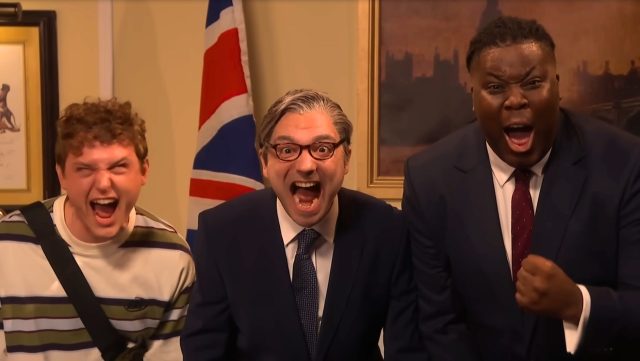
‘By using a young bunch of Instagram comics, SNL is attempting to create a single cultural focal point on a Saturday night’. (SNL UK/Sky TV/YouTube)




Donald Trump is no friend to American comedians. When they mock or criticise him, he fires back on social media, revelling in the subsequent downfalls of, for example, Jimmy Kimmel and Stephen Colbert. Before his first presidency, he was a guest host of Saturday Night Live, on which up-and-coming comics perform sketches based on current affairs, but he soon became an enemy of the show, calling for “retribution” after being sent up in 2019.
Which makes it all the more unlikely that the brand new UK version of SNL, which launched on Sky TV this weekend, should have caught his eye — but it did. In fact the very first sketch of the first episode was re-reposted by Trump on Truth Social, what with it featuring a skit of Keir Starmer agonising and dithering to David Lammy over what to say to Trump about Iran. “Oh golly,” asks Starmer — “what if Donald shouts at me?”
For a comedy show, this is unintentionally hilarious — though I’d wager that the cast and writers are mortified. What’s particularly unfortunate for them is that the Trump-Starmer sketch was one of the weakest links in a programme that was broadcast live and picked up steam as it went, with many flashes of brilliance later on.
The real question is whether those flashes of brilliance will grow into a show that endures like its American predecessor.
Launching a live TV sketch show in the UK now, in a cultural landscape where attention is fractured across a vast array of media — you can only admire the audacity. Will the younger generation, at whom much of the show was aimed, with its Charli XCX references and internet slang, actually switch on and sit through Sky TV at 10 o’clock on a Saturday night? Or will the show somehow survive by virtue of its best clips going viral online?
For this and other reasons, British TV audiences didn’t seem to expect much from the launch. An American comedy show that’s been running for more than 50 years, based on American current events and American celebrities du jour, announces it’s launching a UK version on Sky TV. Trailers appear with Tina Fey, one of the biggest stars to come out of the US version, landing in the London studio while dressed as Mary Poppins, which seems exactly like an American idea of what British culture looks like.
Advertising billboards pop up around the country, featuring a dainty teacup with a biccie dunked in it, or the show’s name spelled out in beans on toast — the kind of jokes made about the British rather than by us. We might be an easy country to caricature but we’re a tough one to make laugh. Who is this for — them or us?
Besides which, Saturday Night Live in the States is notoriously hit-and-miss. When I worked in Hollywood, I found that American audiences didn’t mind some inconsistency but Brits cast a more critical eye over comedy. Still, the announcements of the British version’s cast and writing team were well received in the comedy world: just the right sort of newish talents to already have a following, but not yet be household names. Which is how SNL has always done it in the States, taking budding comics such as Eddie Murphy, Bill Murray, Sarah Silverman and Kristen Wiig, and turning them into stars.
Their newly-minted British counterparts included Paddy Young, a stand-up comedian from Scarborough who can go from coquettish to brutal in a heartbeat, and Al Nash, whose awkward, surreal skits about modern life play well on Instagram. Among the writers were Jonno Johnson, from the “Sheeps” group of comedians who work with Jamie Demetriou of Stath Lets Flats, and the utterly deadpan Frenchwoman-in-London Celya AB. So far, so intriguing. But there were grounds to be suspicious of this well-resourced new show. Someone I know, with ties to the show, posted an ad on Instagram saying how excited they were for the programme, then posted a private message pleading with us to engage with the first post. “This is going to bomb, isn’t it?” seemed a common response among the comedy fans I know. The arts and culture section of Vogue’s website ran a video interview with the cast where each one said a line that fed into the next one’s line. By the end of the chain they still hadn’t landed a joke between them. Ouch.
And yet, “Actually good!” seemed to be the most common response from British viewers to the first episode. After the Trump sketch, the quality improved. I found myself laughing out loud at the mock advertisement for “Undérage”, a new beauty product that makes women look so young that their husbands get done for paedophilia. If you don’t like that line of humour then you might not like the rest. Other gags, as it were, came via a reference to Andrew Mountbatten-Windsor’s new residence, Marsh Farm, “which is of course named after the nearby marsh where his body will be found,” and a savage attack on Dubai influencers. “If any are killed… and we can only hope they are… they went there to evade income tax and now they have to evade incoming attacks.”
Perhaps partly because of the threat of Trumpian retribution, American television can be afraid to show bite. The British comics, however, seemed to enjoy some savaging, mainly of the media itself. The news, the adverts, the celebrity interviewers and the influencers — every kind of content creator was up for ridicule. Given Britain’s history of cutting political satire — Yes Minister, Spitting Image, Private Eye, Have I Got News For You — you’d have expected a little more savagery toward the Prime Minister. Trump may have enjoyed it, but the sketch about Starmer’s indecision felt indecisive in itself.
Which is a shame, because David Lammy was played by Hammed Animashaun, an actor recently nominated for an Olivier Award for his role in the play Dealer’s Choice, and who elsewhere in the show revealed himself to be a brilliant comic. His Ed Boovies character, interviewing film stars with the zeal of an overexcited young blogger, was portrayed with pitch-perfect finesse. Boovies began as an apparent puppydog fan of the movie star played by Tina Fey, only to confront her about why her new action film “fucking sucked. It’s so bad, like, all the way through — what happened?” Because the show started at 10pm, the cast was allowed to swear on live TV: a privilege that Animashaun used so liberally that the joke began to wear off.
As for Paddington, they savaged him too, by making him actually savage. The immersive Paddington Bear experience, as one sketch had it, is a new tourist attraction in London. As in the lovely films, the setting is a pastel-coloured house — but the bear inside is real, has no interest in the twee marmalade sandwiches and seems more intent on attacking the tourists. Not everyone is unhappy about the bloodshed and terror, however. As one mother says upon leaving the attraction, “I’ve always thought that three kids was a bit too many, and now I’ve got the optimum amount.” She looks happily at the empty space around her. “None!”
Concerns that Al Nash was being underused were put to rest when he arrived in the newsroom as Captain Birdseye, deployed by the government to sail his schooner to the Strait of Hormuz and stifle Iran. Turns out he’s not just been making fish fingers all these years but running a black ops mission too, slitting the throats of our enemies and keeping their fingers along with the fish. This sort of surrealism, Vic and Bob meets Charlie Brooker and Black Mirror, was inventive and brilliant. It is a style of humour perfected on the ruthless production lines of short-form online video.
But surely the biggest star of the night was Jack Shep, a fair-haired young chap who somehow brought the house down as Princess Diana, masterfully deploying that blushing bashfulness we remember from her Martin Bashir interview. He also played a full-term baby in the womb, a baby who, after a ten-hour labour, was described by the midwife as “shy”, but was then diagnosed by a senior medic as in fact merely attention-seeking.
If Shep reminded viewers of a happier time in Britain’s history of sketch shows, he also reminded us how far away that period now feels. British comedy is beloved around the world, yet it is incredibly hard to get it made on telly these days, and almost impossible when it takes the form of sketches rather than a sitcom. Add to that the challenge of broadcasting it live, in front of a studio audience. Then throw in the challenge of launching in the same week as the second series of Last One Laughing, the pre-recorded Amazon series that is very successful and the only comparable thing on British telly. This is not necessarily fertile ground for success.
Many of these talents grew on Instagram, where other British comics such as Munya Chawawa, a master of political satire via pop music, have already amassed followers in the millions for sketches they’ve got down to a 90-second art. The experiment is in whether this has created the perfect training ground for live TV or not. Instagram posts aren’t live — but you do find out pretty quickly if your jokes have landed, as the algorithm will soon bury your content rather than promote it, if few people like and engage. Can SNL UK successfully export the art of the comedy sketch back to the place it was invented: the telly?
TV used to be brilliant at providing a single cultural focal point of a Saturday evening. If viewers can tolerate the inevitable inconsistency of a live sketch show — ignoring, if only briefly, the algorithm-honed short-form video apps on their phones — then the reward will be one of those cultural focal points, rare in today’s world but precious. And if there’s one thing that attracts attention, it’s the fury of Trump. Expect a rather more aggravating send-up of the President in SNL UK’s second episode.
Join the discussion
Join like minded readers that support our journalism by becoming a paid subscriber
To join the discussion in the comments, become a paid subscriber.
Join like minded readers that support our journalism, read unlimited articles and enjoy other subscriber-only benefits.
Subscribe