




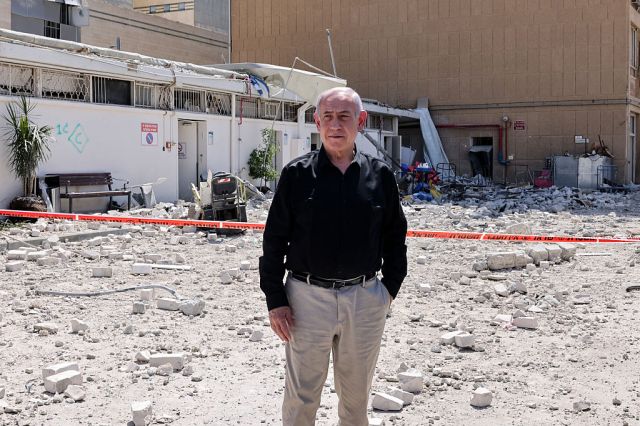
Netanyahu at the site of an Iranian missile strike. Credit: Getty




On Sunday, a Fox News reporter asked Benjamin Netanyahu what would constitute victory for the Jewish state in the current war against Iran. The prime minister answered that Israel aims to “break completely their nuclear program, their missile program, and their capacity to produce the components for both of these programs.”
Netanyahu hasn’t granted any interviews to Israeli media since the start of the war, but his statements in English, including this one, have left many of his compatriots confused. After all, at the end of last summer’s 12-Day War, Netanyahu proudly proclaimed that “we removed from ourselves two immediate existential threats: the threat of annihilation by nuclear bombs, and the threat of annihilation by ballistic missiles.” That bombastic statement now looks questionable, to say the least. If the two “existential threats” had already been removed less than a year ago, then why are we at war again, focusing on the same two objectives?
The confusion, and the resulting strategic overstretch, trace back to the notion of “existential” threats in Netanyahu’s discourse. To wit, Netanyahu exaggerated not just about the outcome of the June 2025 war, but also the severity of the threat posed by the Islamic Republic — to his own political benefit and the Jewish state’s detriment.
It’s clear that the Tehran regime was — and remains — a threat to Israel: Its leaders vow publicly to destroy the Jewish state, fund terror organizations that have been murdering Israelis for decades, and have laid the groundwork for developing nuclear weapons. So yes, to state the obvious, Iran is a threat that Israel must take seriously. But not every threat is an existential threat, one that should be placed at the very top of a country’s list of national priorities, eclipsing other threats in terms of the resources and intelligence devoted to it.
Describing the Iranian threat as an existential one has been at the core of Netanyahu’s politics for decades. His pitch to Israeli voters has been simple: Iran threatens our very survival as a country, and I’m the only one who can stop the mullahs in Tehran from exterminating us. He campaigned on this issue time and again, and it helped him remain in power continuously since 2009, except for the brief 18 months in 2021 and 2022, during which Israel’s short-lived “Government of Change,” led by Naftali Bennett, temporarily replaced him.
Israel’s opposition leaders during this period often upheld Netanyahu’s framing of Iran as the top threat, even if they criticized some of his tactical choices, such as his controversial speech before the US Congress denouncing Barack Obama’s nuclear deal in 2015. But for the most part, none of the opposition leaders has fundamentally challenged the idea that Iran should be placed atop the list of potential threats to the Jewish state.
A rare exception came in the summer of 2014. That’s when Tamir Pardo, the then-director of Israel’s Mossad intelligence agency said in a closed-door briefing that the conflict with the Palestinians, not Iran, is the biggest security threat to Israel. The quote was published by Israeli newspaper Haaretz, where I work, and made Netanyahu furious.
Netanyahu had appointed Pardo, yet the latter’s comments directly contradicted Netanyahu’s worldview. Netanyahu, while constantly emphasizing the Iranian threat to Israel, had for years treated the Palestinian issue as a minor nuisance, a small problem that could be “managed” indefinitely and that shouldn’t distract from the Iran crisis.
Pardo, by contrast, suggested that the Iranian threat was one Israel could manage. To Pardo’s mind, it was the Palestinian problem — Israel’s military occupation in the West Bank and Hamas’s rise to power in Gaza — that could someday explode in ways that would truly endanger the country. “The Palestinian question is the top external threat [to Israel],” he said at the time.
Netanyahu wasn’t convinced, and the spy chief’s comments were soon forgotten. When Netanyahu delivered his speech to Congress in March 2015 — conveniently for him, just two weeks before that month’s general election — no one in the Israeli political system challenged his assertion that the Islamic Republic was the biggest threat endangering Israel.
After his 2015 victory, Netanyahu took two substantial policy decisions that showcased his view of Iran as Israel’s top threat, and his corresponding view of the Palestinian issue as a mere distraction. First, he convinced President Trump to blow up Obama’s nuclear deal with Iran, known as the Joint Comprehensive Plan of Action. That move set the stage for a sequence of events that eventually led to the current war, as the Tehran regime intensified its nuclear activity without the constraints of the JCPOA. Israel responded to this by increasing its own preparations for war with Iran, in order to prevent it from developing a nuclear weapon.
Second, Netanyahu approved Qatar’s cash payments to Hamas in Gaza as a mechanism to keep the Gaza Strip from flaring up. The Qatari payments, which over the years amounted to hundreds of millions of dollars, were a terrible idea: they directly strengthened Hamas and allowed the Islamist organization to turn itself from a militia into an army of terror. But Netanyahu and his supporters in the Israeli media justified it at the time as a brilliant ploy to keep the Palestinian front quiet, while Israel focused on Iran — the “existential” threat.
To be fair, Netanyahu wasn’t alone in adopting this “Iran first, Palestinians last” strategy. He had many willing partners in the top ranks of the Israeli military — a reality reflected in the diversion of ever-more resources over the years toward anything related to a future war with Iran: fighter jets, missile-defense systems, nuclear submarines, covert operations, and more. It seemed that for the more “glamorous” sectors of the armed forces — those responsible for overcoming the Iranian threat — budget was never an issue.
At the same time, Israel’s “regular” army — the ground forces responsible for protecting the borders and policing the occupied West Bank — was gradually hollowed out. There were older, retired generals who warned over the years about this dangerous trend, warning that the military wouldn’t be ready in case of a surprise attack from Hamas in the south or Hezbollah in the north. But their warnings were mostly ignored or dismissed. The Iran-as-existential doctrine became dogma.
In that sense, Israel’s stunning recent achievements against the Islamic Republic — the aerial domination of Iranian skies, the decapitation of the senior leadership, deep Mossad penetration of the regime — shouldn’t be viewed separately from the equally stunning failures of the Israeli military on Oct. 7. These are two sides of the same coin, two elements of a deliberate strategy to focus completely on the threat from Iran, while dismissing the Palestinian issue as a minor problem that can be kicked down the road with Qatari bribes in Gaza and the aid of the corrupt and increasingly unpopular Palestinian Authority in the West Bank.
In retrospect, and in light of what we know today about Oct. 7, the Gaza War and the two Israel-Iran wars, it’s at least worth asking if Netanyahu’s set of priorities has been wrong all along. Hamas on Oct. 7 killed some 1,200 Israelis and kidnapped 250 hostages. Tens of thousands of Israeli families had to be evacuated from their homes, and hundreds of Israeli soldiers died in the Gaza war that ensued.
That war, which also led to the deaths of tens of thousands of Palestinians and the destruction of large parts of the Gaza Strip, also harmed Israel’s international reputation in unprecedented ways, as evident in recent polls showing that for the first time ever, more Americans sympathize with the Palestinians than with Israel. This by itself is a major strategic crisis for Israel, and it will only get worse in the future, since the levels of support for the Jewish state are significantly lower among younger respondents in virtually every poll on this subject.
Israel’s two wars with Iran, by comparison, have so far resulted in the deaths of approximately 60 Israelis — this, despite Iran firing almost 1,000 ballistic missiles at Israel, including direct hits against a hospital, residential buildings, and energy infrastructure. The Iranian regime is currently fighting a war of survival, and it may indeed survive by shutting down the Straits of Hormuz and choking the global economy; but in terms of the direct damage to Israel, the Islamic Republic has been much less destructive than Hamas or Hezbollah.
All this doesn’t mean that Israel should have ignored the threat posed by Iran, nor that it was a mistake for Israel to take military action against Tehran in June 2025 and again in February 2026 (the question of whether Washington should have joined Israel in those two wars is a separate one). The ballistic missiles that did penetrate Israel’s air-defense system caused extensive damage in Israeli cities. And to be sure, the nuclear threat is one Israel can never treat lightly, not least from Iran, a country ideologically pledged to Israel’s elimination. But it’s still important to ask whether the singular, years-long focus on the Iranian threat, and the dismissal of the Palestinian issue as a sideshow, had turned out to be a strategic blunder.
This question isn’t just important for our understanding of the past; It should be treated with urgency today, as Hamas tightens its grip over postwar Gaza, and Israeli far-Right extremists are trying to set the West Bank on fire with nightly attacks on Palestinian communities. Meanwhile, the Palestinian Authority — which today controls approximately 40% of the West Bank, and works hand-in-hand with Israel to thwart terror plots there — is on the verge of collapse; the tens of thousands of men employed in its security forces could soon be left without paychecks, but with their weapons in hand, a potential nightmare scenario for the Jewish state.
Once the second Israel-Iran war ends, Netanyahu will probably boast once again that an “existential threat” has been removed, no matter what the actual results on the ground and regardless of whether or not a third war with Iran will be needed in the future. He will describe Israel as stronger than ever — “a regional superpower,” in his words, that can bomb targets thousands of miles away on a daily basis and suffer painful but tolerable losses at home thanks to its advanced air-defense systems.
Maybe some parts of this description will even be true. But Israelis and supporters of the Jewish state abroad will be wise to remember the lessons of Oct. 7. We must ask ourselves if the real existential threat to Israel is truly buried under the sand somewhere in Iran — or whether it is actually found in our own inclination to bury our heads in the sand and ignore much more dangerous things happening right next to us.

Join the discussion
Join like minded readers that support our journalism by becoming a paid subscriber
To join the discussion in the comments, become a paid subscriber.
Join like minded readers that support our journalism, read unlimited articles and enjoy other subscriber-only benefits.
Subscribe