




‘Into such space, the intelligent viewer is forced to contribute something of his own.’ (Wuthering Heights)




Re-reading Pride and Prejudice for, he tells us, perhaps the fifth or sixth time, Martin Amis couldn’t help but feel the conclusion left something to be desired: “say, a twenty-page sex scene featuring the two principals, with Mr Darcy, furthermore, acquitting himself uncommonly well.”
Emerald Fennell seems to have approached Wuthering Heights in a similarly improving spirit. I must say I haven’t read Emily Brontë’s novel myself — though I was assured that wouldn’t be a problem when it came to following the film, and may even confer an advantage when it came to enjoying it — but I’m guessing the stable-room bondage scene, depictions of public masturbation, and corpses with erections were all Fennell’s tasteful additions.
In fact, a little research suggests that whole epochs within the novel hit the cutting-room floor in the journey from bookshop to screen, with characters ruthlessly conflated or excised altogether, so as to accommodate all the steamy sex scenes that Brontë thoughtlessly forgot to arrange for her protagonists.
On the promotional circuit, Fennell has repeatedly emphasised the deep impression the novel made on her as a teenager, and her film contains touches overwrought enough to bear that out. As has been noticed, the film unfolds more like a fan-fictionalisation of its source than an adaptation: the surrounding structural architecture of plot and character developed only to the degree that they can be taken for granted as a stable context for erotic wish-fulfilment. Even the title, which comes wrapped in coy little scare quotes — “Wuthering Heights” — seems an attempt early on to manage expectations. Though, of course, it’s not as if simply pleading guilty at pre-trial is a way of absolving yourself of a crime.
There is a peculiar cultural assumption that plumbing the detail of one’s sexual fantasies inevitably yields stark or revealing information about the self. To “explore” — like Sally Rooney and swathes of prestige TV — the dark allure of BDSM, and the supposedly psychologically complex interplay between affection and violence, is taken as a surefire way of advertising one’s artistic sophistication.
If Wuthering Heights achieves nothing else, it should be to put that particular misconception to bed, as it were. The inclusion of a BDSM scene seems a gratuitous, and slightly feeble, provocation. And if conceived as a quick-fix way of infusing Cathy and Heathcliff’s melodramatic love story with a sense of psychological depth — well, it fails.
Long stretches of the film consist of exactly the sort of breathless, derivative, fleeting encounters you might expect it to on the assumption that you were not watching Wuthering Heights, but something operating at a somewhat hazier degree of removal: an attempt to depict the erotic shadow cast by the book in the mind of a half-remembered adolescent reader.
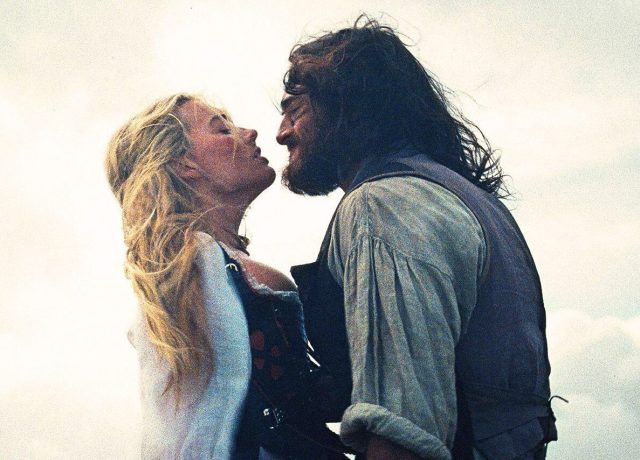
We watch while, as if on an endless reel, Jacob Elordi and Margot Robbie chase each other pointlessly across windswept moors. There they grapple with each other. Kiss. Lick each other’s faces. Breathe meaningfully. Look searchingly into one another’s eyes. The weather being what it is, they are forever getting caught in the most torrential downpours, and neither of them ever thinks to bring an umbrella or to wear clothes that don’t quickly go transparent.
They cry and mewl and pout at each other, break for a costume change, and then do it all again, striking postures of indignance and hurt as they growl about their feelings and heave their respective bosoms. They stand stoically by Cathy’s father’s grave, the wind tearing camply at her black veil, then, practically within sight of the funeral party, reunite with animal intensity. Occasionally in fits of love-stricken anger Robbie will beat her girly fists on Elordi’s manly chest. When all other ways of communicating their profound bond have been exhausted, they stick their fingers in each other’s mouths.
Throughout, there is virtually no suggestion of the existence of a wider social world, the whole film instead an unrooted universe of total mutual self-absorption. The effect is a flattening realisation of the montage of imaginative sexual fantasy. Sitting there, watching it, was like re-enacting the closing scene of Cinema Paradiso, except that instead of the touching variety of rescued black-and-white embraces, it’s just Elordi and Robbie sniffing and licking each other’s faces again and again.
Fennell’s attempt to not merely adapt a book for the screen, but somehow conjure up the imaginative impact it had on a teenage reader, faces considerable challenges. Polemicists of a cultural-declinist bent may be tempted to say this is because of the greater imaginative richness of the reading experience. But actually, some of the obstacles are to do with its comparative impoverishment.
There is something deceptively shallow about the contents of imaginative simulation: the kind of activity one gives might give way to in reading a novel or idly embellishing the romance of its protagonists. The internal spotlight of wandering imaginative attention makes fantasy feel rich from the inside, but it is a richness that relies on an illusion: a mistaken impression that one’s mind’s eye “sees” in more detail than it really does.
Many people are surprised to learn that vision itself relies on a similar cognitive trick: while the brain generates the illusion that the entire visual field is in focus, in reality the fovea, the central one or two degrees of the visual field, is tiny, equivalent in area to a thumbnail held out at arm’s length, the rest of the visual field implicitly filled in by a process akin to a simplifying inference.
Whether because of their inherent shallowness or otherwise, many of us come to realise it is a naive mistake to expect others to be as attached to our fantasies as we are. It is notoriously boring to hear others describe their dreams. In the same way, attempting to depict an object of fantasy can destroy its deceptive, impressionistic power. Most people are familiar with the dissatisfied feeling that a character played on screen is not at all how they imagined them — even if it is not always easy to put your finger on just how they depart from the under-specified but perfectly cast original.
Imaginative fantasy, then, has a propensity to crash-land when realised in the flesh. That propensity may only be greater when it comes to the kind of romantic escapism Fennell has tried to make flesh in Wuthering Heights. Writhing with Heathcliff on the moors, licking and gasping and striking a pose: from the inside of the teenage mind, these may grip one as the very heights of erotic profundity. Flattened onto the screen, they can seem like withering lows.
Of course, it’s not as if film, the standout expressive art form of the 20th century, is too limited a medium to evoke romantic fantasy in a viewer. But to do such material justice probably requires something other than Fennell’s trademark style of campy overstatement, of which the lavish aesthetic and anachronistic latex costumes are only the most obvious manifestations of a general inability to exercise creative restraint.
Some films can be almost novelistic in their tendency to invite an imaginative contribution from the viewer. Writing in 1972, the screenwriter Paul Schrader coined the term “transcendental style” for the peculiar effectiveness — the near-meditative quality — that was sometimes achieved in films of Ozu, Bresson and others, many only then being screened in LA for the first time. Schrader’s theory was that these filmmakers had learned to direct in such a way as to trigger introspection. The characteristic technique was to withhold — something akin to the intelligent use of empty time and space.
Into that space the engaged viewer is forced to contribute something of his own. Made to “add their own egg”. Of course, Fennell might argue she was trying to make a very different kind of film to those Schrader was watching; nevertheless, her Wuthering Heights stifles imaginative engagement in the very act of attempting to control it. Hers is a film in which all of the eggs are added on the viewer’s behalf — not least when Cathy is made to crack half a dozen of them into Heathcliff’s bed as an early provocation, and Elordi kneels there, plunging his fingers gormlessly into the gooey mess. (As ever no prizes are on offer for guessing subtext; there wouldn’t be enough to go round!).
The idea that information might be strategically withheld to creative effect is not a distinctively cinematic insight, of course. At the sentence level, Hemingway’s theory of prose seems to have been that there was imaginative danger in over-specificity — that it is in general an illusion that, as one modifier is piled on after another, resolution increases. Better to take advantage of an intelligent reader’s tendency to make an imaginative contribution of his own. Emerald Fennell, on the other hand, prefers to make films where all the adjectives are left in — italicised, underlined and in scare quotes too.
No doubt, in the contemporary attention economy, the natural tendency is to favour Fennell’s lurid approach over more hands-off alternatives. As Matt Damon and Ben Affleck recently recounted in a widely publicised interview, it is now de rigueur for Netflix to helpfully suggest that a film’s characters verbally reiterate the plot at least three of four times, and that large set-piece action scenes should be used to “grab” the viewer’s attention in the first few minutes.
Perhaps naturally suited to the cultural moment, Fennell has never shown any temptation to act on the maxim that less is sometimes more. “I will not stand for this grotesque performance a moment longer”, shouts Nelly at a bed-ridden Margot Robbie towards the end of the film, and it is difficult for the audience not to share the sentiment. The risk, in the end, in simply “grabbing” your viewer’s attention, and training it on the banal contents of an adolescent fantasy, is that you unwittingly reveal how shaky and under-developed those materials can be.

Join the discussion
Join like minded readers that support our journalism by becoming a paid subscriber
To join the discussion in the comments, become a paid subscriber.
Join like minded readers that support our journalism, read unlimited articles and enjoy other subscriber-only benefits.
Subscribe