




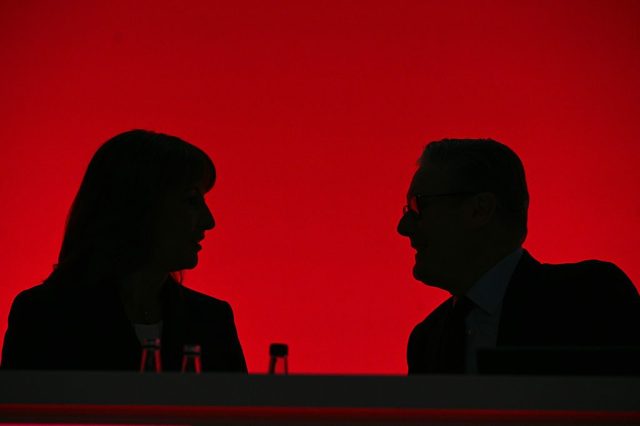
Rachel Reeves and Keir Starmer remain in situ. Photo by OLI SCARFF/AFP via Getty Images




The resignation of Morgan McSweeney dominates the headlines. Such wall-to-wall coverage of the fate of a staffer attests to a profound change in British political culture. Long gone are the days when headlines would have been: “Someone you’ve never heard of loses a job you didn’t know existed.”
Instead, British politics over the last decade has seen the rise of the celebrity adviser — staff who have been visible shapers of the government agenda and essential to the party leader or Prime Minister. When I was in Downing Street working for Prime Minister Tony Blair, the Chief of Staff was the former mandarin Jonathan Powell, a calm, long-serving presence who focused on the critical issues of Northern Ireland and defence and security. Personalities vary, but the elevation of Chief of Staff started with Dominic Cummings, who worked for Boris Johnson as Chief Adviser. As a named and known figure, Cummings had his own reputation as a political player, having successfully led Vote Leave to victory in the Brexit referendum, and maintained his own links with the media when inside No 10. He continued to narrate his own theory of the case to selected journalists even through the national crisis of Covid, culminating in the infamous press conference held in the Downing Street garden.
Cummings established a set of behaviours and assumptions that have continued to define the Chief of Staff role. Blaming the civil service. Attempting to strengthen the centre of government. Concentrating flows of information. Briefing journalists. Suspending the whip from MPs. This, sadly, became a model for Keir Starmer’s No 10 operation.
The obvious flaw in the Cummings model is captured by that former Labour Cabinet minister Clare Short’s description of special advisers as “people who live in the dark”. She meant it as an attack on spin doctors, but it was also good advice. The iron law of staffing is that you must not become the story. And when you do — whether you are Alastair Campbell, Dominic Cummings, or Morgan McSweeney — you will have to go. Each fell in different ways: Alastair went to war with the media, finally turning up on screen; Dom lost an internal Downing Street power struggle; Morgan took responsibility for his closeness to Peter Mandelson. Yet each had become a household name — the very opposite of lurking in the shadows.
The less obvious structural problem is that, over the past decade, the job of Chief of Staff to the Prime Minister of the United Kingdom has been held by 14 different people. This, too, is part of the Cummings legacy. The reason is Brexit. That was the ultimate project of change without a plan, and it has set the template for UK politics. A profound rejection of “things as they are” to which politicians repeatedly failed to respond. Theresa May — no plan, just a hard Brexit with a “dementia tax” and restoration of hunting. Boris Johnson — no plan, and he was not saved by his swift response to the global crisis of Covid. Rishi Sunak — no plan but some spreadsheets and some welcome but insufficient incremental changes. Keir Starmer — no plan, not even a plan to make a plan.
For a decade, voters have demanded change, whether opting for Brexit, surging to Corbyn, or delivering landslides in turn to Johnson and Starmer. What to change from is obvious: the status quo. What to change to is far more opaque, not least because neoliberal governance, or the “Treasury view”, as it is commonly known, is the paradigm within which government politicians live and think. The bond vigilantes have been beseeched to attack Greater Manchester Mayor Andy Burnham, to support the government’s Budget, and now to quell backbench Labour unease. Just look at how easily the current Labour leadership turns to the bond markets for support in party management.
There is a desperate need for Labour to break with the current political frame, which for a decade has ensured virtually no growth in wages and living standards. Yet there is stasis within the Labour party at the moment — apart from the call by Scottish Labour leader Anas Sarwar, who himself admitted he has no rule in changing the UK leader, for Starmer to resign. Sure, there is a structural problem: the possible candidates are waiting for the result of inquiries. Angela Rayner hasn’t had resolution of an HMRC inquiry; others await the full publication of correspondence between Peter Mandelson and ministers. Burnham, the single most popular figure in Labour politics, is marooned outside the House of Commons having been barred from standing in the Gorton and Denton by-election in McSweeney’s last backroom move to protect his boss. Burnham’s candidacy in that contest would have given a voice to voters and a potential vehicle for change for the Parliamentary Labour Party (PLP). So this is currently a Mexican stand-off in which no-one can pull a trigger.
Yet, as the former Labour Cabinet minister Tony Benn used to say, what matters most are not personalities but issues. The real question for anyone who wants to replace Starmer is what policy platform would restore Labour’s popularity to 25% — which would make it competitive with Reform UK. In reality, there are two options: focus on delivery or focus on change. The first of these, currently being pursued by the Starmer government as the “cost-of-living agenda”, is a cul-de-sac. Sadly, it is the path and error of the technocrat. It is more a tactic than a strategy, and it rests on making a series of small, incremental changes in the hope that those will accumulate into a meaningful difference.
The problem is that the cost of living never goes down, not least because, since the Thirties, politicians and economists have been conscious of the massive danger of deflation. So, if prices won’t go down, what to do? The Mayor of New York, Zohran Mamdani, has popularised the term “Affordability”. The concept brings increased spending power into the calculation — with more of that then things are more affordable. The record rise in the minimum wage is part of that, as is the reality of rent controls coming in through strengthening renters’ rights in England.
That’s why Labour’s second option — focusing on change, rather than delivery — is the real contest. Just look at the rise of insurgent parties in the UK. On the Left, there are the Greens, and on the Right there is Reform UK — both fuelled by voters who distrust big business, believe the system isn’t working, and have lost trust in the traditional parties.
Given these circumstances, the Labour Party needs a new political economy. Without a theory of how to allocate revenue and capital fairly, who the winners and losers are, and who their enemy is, changing leaders is pointless. That new political economy requires obeying the first law of politics — the voters are never wrong, so act on their worries. Yes, they complain about the cost of living, but the biggest element of that is housing — and housebuilding has fallen catastrophically. The only entity that can build at speed and scale is the government — so it is time for half a million council houses built on government land. The biggest existential fear for workers is the advance of AI, while for parents it’s the impact of Big Teach on their kids’ futures. For Labour, the natural party of intervention, that means swift and tough regulation.
Above all else, the party must apologise. Admit that Labour lost its way. None of its mistakes — the reasons it has lost support — were in the manifesto. Cutting winter fuel payments, attacking social security for people with disabilities, appointing the wrong ambassador — those were all done in government. Return to the manifesto and build a plan to implement big changes that will be visible and will be felt day by day, month by month, over the remaining years of the parliament. That landslide majority could still come in handy, if Labour can find a true social democratic purpose. Then there may be a Chief of Staff in Downing Street whose name we don’t need to know.

Join the discussion
Join like minded readers that support our journalism by becoming a paid subscriber
To join the discussion in the comments, become a paid subscriber.
Join like minded readers that support our journalism, read unlimited articles and enjoy other subscriber-only benefits.
Subscribe