




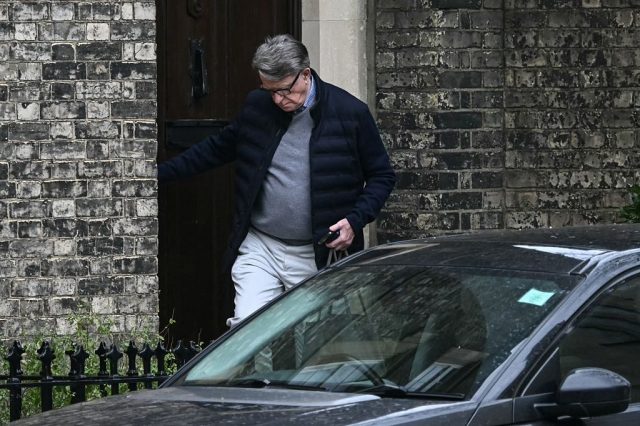
‘What has so far emerged is pretty weak tea.’ (Justin Tallis/AFP/Getty)




Something alarming has been revealed by the Epstein furore, and the showstopper arrests of both Andrew Mountbatten-Windsor and Peter Mandelson in the past week. Not the international paedophilic or sex trafficking ring involving dozens of prominent men (for which firm evidence remains forever elusive) but rather the complete disregard for the process of British justice for which we used to be famous.
Ideas such as: innocent until proven guilty; the independence of the police force and prosecutors from political pressure and public hysteria; the ability of a sceptical media to question, rather than swallow, party lines. Epstein mania has swept all these checks and balances aside. Of course, questions of due process and the proper functioning of institutions don’t sell newspapers. But they are more important than ever when the mob decides to pitchfork its victims.
Of particular concern is the hasty arrest of both Mountbatten-Windsor and Mandelson under the vague statute of “misfeasance in public office”. This common law offence is notorious among legal scholars for being poorly defined: the Law Commission recently dedicated a whole report to it, concluding that clarity is lacking both around the definition of what constitutes a public office, and what constitutes the “recklessness or wilfulness” required to prove criminality. It is not clear, for example, that the largely ceremonial role of UK Trade Envoy that Andrew held even counts as a position of public trust. It’s a woolly law and therefore easy to abuse; the Government had already tabled new legislation to replace it.
In recent years, the statute has been generally used (in 92% of cases) for police and prison officers who have been found in flagrant sexual or financial wrongdoing. In only four convictions out of the 191 since 2014 was the law deployed against senior officials — and no politician has ever been prosecuted under it. In 2008, Damian Green was arrested on suspicion of misconduct in public office after a civil servant leaked documents to him for political purposes, but the DPP at the time (a certain Keir Starmer) dropped the case as not passing the required threshold for criminality. It’s an unprecedented use of a bad law, and it just happened twice in the space of a week.
We might ask, too, why either man had to be arrested at all. Surely a discreet interview with police could have been arranged with Mountbatten-Windsor instead of a theatrical arrest at 8am at his home? As for Mandelson, he maintains that such an interview had already been agreed for the week commencing 9 March, but the police suddenly arrived asserting that an emergency arrest was required on the basis of new information passed to them that he was about to abscond to the British Virgin Islands.
Alongside the implausibility of this suggestion, and the fact that the UK has a full extradition treaty with the BVI in any case, the police claimed that this information had been passed to them via the Lord Speaker — a detail that Lord Forsyth vehemently denies. So who did provide them with this false information, bringing about a public arrest that would provide humiliating photographs for the media and a confirmation in the mind of the public that Mandelson had somehow met his comeuppance? The proper process had somehow been hacked.
Even more grave are the implications of dumping vast troves of private correspondence and truncated notes by investigators into the public domain, as happened with Epstein’s emails. Day by day, innocent lives are being upended as the media discovers a new intriguing name among the cache; careers are ended on the flimsiest of pretexts, as companies and institutions abandon anyone with the remotest connection with the scandal; wild theories about supposed code words have flooded the internet and deposed rationality. The thrill of glimpsing how the rich and powerful correspond privately with each other may make good copy, but it is not justice. If ever we needed a reminder that the flip side of free speech is a right to privacy, it was surely this. Without privacy, there is no freedom, and everybody will be a little more fearful about writing to friends or associates after this.
This massive release of private emails prompted another concerning development: in both the Mountbatten-Windsor and Mandelson case, the British state is deploying what you might call the Al Capone strategy. The American mobster was never convicted of the murders and gangsterism for which he was notorious, but instead was imprisoned for tax evasion. Most people in the UK by now, having been saturated in media coverage connecting both characters to the “convicted paedophile/sex offender” Jeffrey Epstein, will have made up their minds that both men are guilty by association of some kind of collusion in some kind of sex crime. That’s the “real” taint that is propelling these investigations.
But this is where the Al Capone analogy breaks down: Capone really was a mobster. But there has yet to emerge any firm evidence of sexual wrongdoing on Mountbatten-Windsor’s part, and for Mandelson it is not even seriously alleged. Context-free photographs of hanging out on Epstein’s island with young women are not proof of anything at all, nor is settling out of court, nor are suggestive private emails between friends, no matter how distasteful they may sound.
Instead, the Al Capone approach risks degrading the normal standards of proof for the lesser crime in order to deliver a politically convenient satiation of the wider public anger. Indeed, there is already the sense that both men have been found guilty of something — notwithstanding the fact that neither has been convicted of anything. But what crime are they supposed to have committed, exactly?
In the case of Mountbatten-Windsor, sharing details of his forthcoming trips as UK trade envoy to Epstein and his associates in order to set up meetings would not be particularly surprising or intriguing were it not accompanied by the stench of scandal shrouding Jeffrey Epstein. If all that emerges after this inevitably long, drawn out investigation, is the tawdry reality — and one that we already know — that Andrew had bad judgement in friends and deployed those connections to do business deals, it is neither new nor illegal. It is certainly not enough to provoke a constitutional crisis, with special acts of parliament to remove him from the line of succession. Labour minister Chris Bryant may be right that the former Prince is a “rude, arrogant and entitled man”, as he said in the Commons yesterday: but so what? If we arrested every politician or royal who fell under that category, how many would be left?
Meanwhile, the most serious claims against Mandelson are that he showed no loyalty to the government he served in and shared privileged government information for personal financial gain. Forwarding emails (even non-secure ones) originally addressed to the prime minister to powerful friends, apparently to show how useful you are, is no doubt unedifying. The breezy, disloyal indiscretions in the emails are deeply embarrassing, and would probably have constituted a sackable offence were he still in post. But the fact that Mandelson was indiscreet about the goings on in government, or that he said mean things about Gordon Brown, is hardly news — just ask any political journalist of the past 30 years who delighted in his briefings.
Things obviously get more serious should financial gain be shown. If indeed there were multiple payments of $25,000 from Epstein to Mandelson, that would demand explanation. But let’s apply a dose of reality: most of the indiscretions that have so far emerged would have been mildly interesting, titillating even, to an investor like Epstein. For now, though, there has been no smoking gun to indicate corruption. Most of Mandelson’s “revelations” were widely commented on in the media at the time. The most serious among them would seem to be the theoretically investible insight, confirmed by email by Mandelson to Epstein, that the €500 billion euro bailout would be announced that evening, 9 May 2010. Epstein emails: “sources tell me 500 b euro bailout, almost complete”, and Mandelson replies: “sd be announced tonight.“
Cavalier, sailing close to the wind, but hardly a big scoop — Epstein already had the information, as did thousands of others. The terms of the imminent deal had been discussed on the front cover of the Sunday Telegraph the previous morning, and economic correspondents across Europe were tracking the progress of the talks throughout the day. The day before, at a summit of all 26 EU finance ministers, the terms and timing of the euro bailout had been breathlessly reported on, and the UK had refused to take part. Each of those European teams, with their staff and civil servants and accompanying journalists, would have known as much or more than the outgoing UK Business Secretary. Of course, there may yet be revelations that prove serious wrongdoing. But what has so far emerged is pretty weak tea.
A world in which due process is bent in service of political panics, supercharged by an increasingly deranged social media, is a less just one. Both Andrew Mountbatten-Windsor and Peter Mandelson have been hung out to dry by their own teams (respectively the Royal family and the Labour party) who have their own agenda, fearful for their own survival. The two men have no allies left. This is precisely when a sober-minded media, police and justice system should be the last line of defence. Right now, they are nowhere to be found.
Freddie Sayers is the Editor-in-Chief of UnHerd and CEO of OQS Media. He was previously Editor-in-Chief of YouGov, and founder of PoliticsHome.
 freddiesayers
Join the discussion
Join like minded readers that support our journalism by becoming a paid subscriber
To join the discussion in the comments, become a paid subscriber.
Join like minded readers that support our journalism, read unlimited articles and enjoy other subscriber-only benefits.
Subscribe