




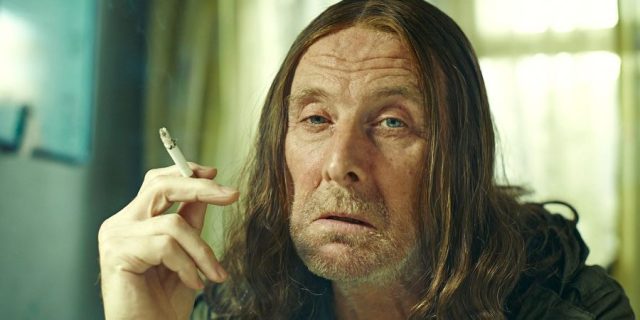
Not every estate-dweller is like Frank Gallagher.(Shameless)




Chavs were everywhere in mid-Noughties Britain. Yet amid the Vicky Pollard skits, and the grubbiness of Benefits Street, and a wider moral panic about ASBOs, Shameless offered an altogether more human spin on Britain’s much-maligned underclass. Set on the fictional Chatsworth Estate — sharing only a name with its palatial Derbyshire namesake — the Channel 4 series offered a tragicomic vision of life on the New Labour breadline. Past the burnt-out cars, the casual violence, the scams and benefit fraud, the show humanised its subjects, presenting complex and intelligent characters at the centre of estate life.
The show’s stumbling star Frank Gallagher is undoubtedly a selfish and untrustworthy figure, trapped in a never-ending hustle to score his next drink. Yet despite his failings, both as a father and citizen, his character periodically hints at a deeper political awareness, mediated primarily through his boozy rants about the depredations of “Thatcher’s Britain”. The eight Gallagher children are clever and entrepreneurial — most of them destined to outgrow and ultimately leave the Chatsworth estate for love, university and better things. Frank’s eldest daughter Fiona is caught in a constant struggle between her personal aspirations and her responsibilities to her neglected siblings, while eldest son “Lip” is a child prodigy, earning a living selling homework to his classmates.
But if the Channel 4 series tackled its subjects far more humanely than the red tops, Shameless still ultimately presented life on the Chatsworth Estate as obsolete, a trap which imprisoned its residents. Indeed, this view of life on Chatsworth, from the uplands of New Labour in its pomp, in many ways echoed the prevailing contemporary narrative on Britain put forward by its leaders — that, post-Thatcher, Britain had changed. The dirty industries that once sustained cities like Manchester were no more, and the country’s destiny instead lay in the course of globalised services, or the “knowledge-based economy” to use the dreary Blairite parlance.
For its first season, Shameless was filmed around Wenlock Way and Clowes Street — an iconic example of boxy Seventies architecture in the throes of neglect and decay, replete with graffiti, rotting wooden fences and spartan stretches of municipal lawn. Wenlock Way is itself located at the far edge of the Gorton and Denton constituency, the far-flung corner of Manchester due to go to the polls today. Perhaps fittingly, the estate has since been demolished as part of Manchester’s regeneration process, a transformation which has rebranded a city once renowned for dingy, sooty alleyways into a glistening steel-and-glass metropolis.
Manchester Council, under unbroken Labour leadership since 1971, fully embraced the post-industrial future heralded by the national Labour leadership. From the Eighties, it deliberately pursued a policy of attracting high-productivity services into the city, replacing the old textile mills and factories. At the heart of this was a gigantic programme of investment in the physical infrastructure of the depopulated and grimy city centre, financed primarily by foreign investment, pump-priming property values to attract high-earners from London. At the same time, and as I document in my book on the subject, Manchester Council pursued incredibly hostile policies towards the building of affordable housing — seen as an embarrassing throwback to an industrial era New Labour had left firmly behind.
This focus away from Manchester’s pre-existing residents was felt hard by residents like those depicted in Shameless, embedding a deep sense of abandonment and enmity towards the whole political class. As Frank himself poetically notes in his opening monologue to series eight:
So you’ve had your Labour reclassifying scum sending prices sky high, literally, literally taking the grass from its own roots. Now you’ve got your Con-Dem-Nation. Liberals noshing Tories like altar boys picking dim-sum. Have we had a national fucking stroke, or what?
The truth, of course, is that real-life Chatsworths were always so much more than the lager-soaked hangover of deindustrialisation. Behind the cultural noise, these places retained incredibly strong communities, mutual aid networks and inter-generational family ties. Even once the factories closed, solidarity persisted on estates sustained by affordable housing, enabling communities to remain rooted to their homes even as as their economic function vanished.
All the same, the estate life depicted by Shameless has been in decline. At the end of the Seventies, over four-in-ten of the British population lived in social housing — and in cities like Manchester, that figure was far higher. Today, the figure nationally stands at just 17%, with the proportion of Manchester households living in social housing dropping by a tenth. And despite the grand ambitions of New Labour, the story of fictional characters like Lip, leaving the estate in series five to start an undergraduate degree at Nottingham University, has failed to truly materialise. In the real world, the people of places like Chatsworth have been cast adrift — unable to sustain the stable life they once expected.
It’s no surprise, anyway, that such communities now form the vanguard of Nigel Farage’s insurgency, both in Gorton and Denton and across the country. The evidence is clear that as well as geographically — following the pattern of deindustrialisation — Reform’s vote is positively correlated with the most deprived communities and co-morbidities of poverty: including poor health and low levels of social trust. Gorton itself is one of the most deprived wards in the country, with over 65% of households considered deprived by the indices of multiple deprivation and with 47% of children living in poverty.
In the absence of any understanding or interest from political elites, promises of pride, identity and purpose are clearly appealing. And yet one can’t help but note the discord between the self-proclaimed “Thatcherism” of Reform — and the voters it’s currently courting in places such as Gorton. It was, after all, Margaret Thatcher’s project which assaulted the economic bedrock of these places, destroying livelihoods and purpose, and starting the systemic financialisation which has hard-baked inequality into British life. Manchester lost 82,000 manufacturing jobs between 1981 and 1991, and the population of the city declined by over 120,000. These statistics reflect an economic catastrophe which afflicted almost all of Britain’s industrial regions.
All the while, it was the Thatcherite Right and its successors that began a moral crusade against “the underclass” of “benefit scroungers” — cultural forerunners of Noughties chavs. You can’t help but notice that Reform’s candidate Matthew Goodwin himself came to prominence articulating the importance of high fertility, fertility which the same Thatcherite Right assaulted for decades on the basis that families were “having children they can’t afford” and running up the benefits bill. At the time Shameless was aired, meanwhile, you would more likely find politicians of the contemporary populist Right disparaging “the chavs, the losers, the burglars, the drug addicts” — in the 2005 words of Boris Johnson.
Yet somehow these same “chavs” are now the backbone of a new English nativism: a transformation in attitude which does, fittingly, feel rather shameless. Of course, Reform’s economic stance continues to be a matter of dispute — with calls to nationalise steel and other industries somewhat consciously courting voters in its new northern base. Yet with the defections of senior architects of the previous Tory government now embedded into Reform’s “shadow cabinet”, the party seems more than ever committed to the Iron Lady’s economic legacy.
That this transformation has been possible is testament to the extent to which Labour and the broader Left embraced Thatcher’s ideas. When the former prime minister told reporters that her greatest political achievement was Tony Blair, she wasn’t simply making a wry joke. New Labour was the formalisation of the uniparty which has since come to define British politics, a rejection of our industrial heritage and the collectivism, community and solidarity that came with it. New Labour’s message was, ultimately, hardly more compassionate than the cruel mockery of the urban poor by the Tories, thriving on authoritarian “crackdowns” of various kinds, with ASBOs and the surveillance state largely there to discipline the tiresome oiks.
Once again, Shameless dealt with these themes explicitly, with one character receiving an ankle tag alongside his ASBO in series three, while elsewhere Department for Social Security officers swarm the estate to tackle benefit fraud. It’s hardly irrelevant that the Gorton by-election was itself triggered by the resignation of the area’s former MP Andrew Gwynne, after WhatsApp messages emerged showing him hoping an elderly constituent would “croak it” for daring to criticise him.
In the end, no one has become more convinced of the redundancy and insignificance of their voters than Labour. Yet when pushed, and whatever they might claim, many on the new Right still retain their contemptuous attitudes towards benefits claimants and the urban poor, possessing a basically instrumentalist approach to their new base. Earlier this month, for instance, Goodwin was caught sending out letters purportedly written by “concerned neighbour” Patricia Clegg — despite the 74 year old claiming she never signed off on them. Things have become so bad that Clegg’s son, a former Reform-voting veteran, has publicly attacked Goodwin online.
Though he was born and raised in leafy St Albans, meanwhile, Goodwin has emphasised his plastic Manc credentials via a campaign suggesting that he is as working class as Green candidate Hannah Spencer (who works as a plumber), and more Mancunian than Labour’s Angeliki Stogia on the basis that she was born in Greece (despite being a fully naturalised British citizen of over 30 years, and a local councillor for more than 10).
Yet this rebranded Thatcherite may tomorrow be the next MP for Gorton and Denton, carried into office promising to improve lives with the very same policies that caused such misery. Many Gorton and Denton voters have been ignored by Labour for decades, their support taken for granted. Goodwin may be selling snake oil, but at least he bothered to show up. And if, by some miracle, Labour hold the seat, the gap between the party and its downtrodden voters only seems destined to grow. That’s a shame. Estates like Chatsworth’s might not have been a “Garden of Eden”, in the wise words of Frank Gallagher, but they offered purpose, place, identity — all prerequisites for a life free of shame.
Join the discussion
Join like minded readers that support our journalism by becoming a paid subscriber
To join the discussion in the comments, become a paid subscriber.
Join like minded readers that support our journalism, read unlimited articles and enjoy other subscriber-only benefits.
Subscribe