




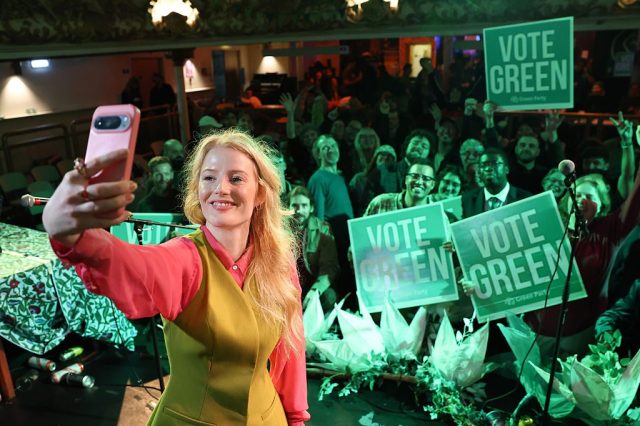
‘What matters is vibes, signals and the loose cadences of political affiliation.’ (Ryan Jenkinson/Getty)




“It’s really clear,” proclaimed Hannah Spencer after her historic victory last night, “that people are ready for something different.” It’s hard to disagree. the Green Party’s huge win in Gorton and Denton represents a tectonic shift, the sort of generational upheaval James Callaghan called a “sea-change in politics”. Gorton and Denton is a sign of things to come — the realignment of our politics around new poles. What we’re witnessing isn’t just the shattering of our two-party system, but a seismic chapter in the strange death of Labour Britain. The former voter blocs of the governing party, already in an unhappy marriage, living under the same roof but barely speaking for many loveless years, finally have splintered and gone their separate ways.
Despite Labour’s propagandising that the result was on a knife-edge, and the polls suggesting a three-way split between the Greens, Labour and Reform, it wasn’t even close: Spencer won 60% more votes than the hapless Labourite Angeliki Stogia. Reform was a distant second to Labour’s disastrous third. (The Tories didn’t even keep their deposit.) Yet this was never Farage-friendly territory: too young, too inner-urban, too diverse. It was not Matt Goodwin’s to lose. But the ruling party has been cannibalised from two directions in a safe seat, its coalition riven in a way that defies repair.
Divorces are rarely amicable. This one least of all. Labour’s fractured base is represented perfectly across this Mancunian constituency. In Denton, to the east, the old, post-industrial white working-class; and to the west, in Gorton, the Muslim and ethnic-minority vote, living cheek-by-jowl with the declassé elements of Britain’s urban liberals. Here was the tripartite alliance of the contemporary Left in all its glory, fused together awkwardly just like the constituency itself, with a motorway in the middle. Labour has not lost an election here since 1931. Yet today, each of its tribes has found its own reasons to despise Starmer’s Labour: a project that was never comfortable in its own skin.
Perhaps it needn’t have been this way. When candidate selection for the by-election took place in the long-lost days of Morgan McSweeney, the party saw fit to block Andy Burnham — a man pollsters have consistently shown to be the most popular Labour politician in the country. Someone who might have united the disparate factions. But despite the Mayor of Greater Manchester’s epic support in the area, he was blocked from running to “end the leadership psychodrama”. The humiliated party may now regret that move as Starmer, in the coming days, shifts from “dead-man-walking”, staggering on until May, to simply “dead man”.
Labour has presented voters with a heaving table of grievances from which they’ve filled their plates: Palestine, small boats, winter fuel, Shabana Mahmood’s punitive asylum proposals, proposed disability cuts, the cost of living, Labour’s repeated tendency to excuse proximity to paedophilia on the part of their factional allies. Each of these might have been carefully designed to alienate a completely different member of the famous “Labour family”. And so the party is being consumed like the spaghetti in Lady and the Tramp.
There will, of course, be no kiss between Reform and the Greens when they reach the middle: the space between Faragism and Polanskism is a cultural chasm. Once the Labour family was united under a social-democratic banner. Now, two sides face each other with a mix of bemusement and horror. The Greens have proved they can hegemonise the Left vote, and Reform the Right, each offering a brand of unapologetic, insurgent, abrasive politics that eschews the old model of median-voter triangulation in favour of brash authenticity.
And what can tired old Labour do, an Edwardian party saddled with a late-20th-century politics, facing the archetypal entrepreneurs of our peculiar age: the unfiltered, un-focus-grouped model of political communications delivered in short-form vertical videos by men-with-an-iPhone without the mediating influence of the “MSM”. Farage mastered the medium, Polanski has merely tweaked the message — ditch and switch the easy panaceas; mass deportations become a wealth tax; net zero goes from national self-harm to national salvation. In Gorton, if not Denton, this noisy brand of “eco-populism” has been brilliantly effective.
Yesterday, on the ground, Green activists seemed ubiquitous. Levenshulme was a sea of “Vote Green” posters. A swarm of young enthusiasts asked for cars to honk in support outside the Lidl. Next door, an Afghan flag flapped outside a newsagent. Residents walked down a high street as diverse as any London borough, while a Labour van blared a warning that the Green Party would “teach our children to use drugs including crack and heroin and let our daughters be used for prostitution”. Dirty tricks, perhaps, or simply an exaggerated reflection of the ecologists’ foray into an extreme form of Left libertarianism at odds with the socially conservative instincts of Gorton’s Muslims?
The Green bloc marries ultra-liberal young gentrifiers to often deeply conservative British South Asians. But these quirks — even amid claims of “family voting” breaches in polling stations — don’t matter right now. What matters is vibes, signals and the loose cadences of political affiliation. As the cause of labour has wilted, the bobos and the brothers can get behind the cause of Gaza. The Greens have now staked their claim to the mantle of Britain’s foremost progressive party, with their first seat in the North, in a safe red citadel, trouncing Labour’s always-dubious claim that “only Labour can beat Reform”. Labour is no longer the “stop Reform” tactical option in our fragmenting system. They weren’t in Caerphilly last year, and they weren’t in Gorton and Denton last night. For the Greens now find themselves the acceptable home for the virtuous, the over-educated, the bien pensant opinion-havers. They’re the nice party, for nice people, not the génocidaires or crypto-fascists (notwithstanding internal tensions over the trans question). “I think everyone should have a nice life, and clearly other people do as well”, Spencer said during her victory speech. That may as well be used as the next manifesto’s epigraph.
Just before the polls closed yesterday, I found a disgruntled Labour member from outside the constituency. They were despondent. Who would they have voted for if they lived in the area? “Green, obviously. I’m not a monster,” they say with a self-deprecating laugh. It’s a reaction instructive of many people’s complicated relationship with their own party: they stay only out of habit, pining after a Reformation of Labour’s “broad church” that may now never come.
When the historian George Dangerfield wrote his interwar classic, The Strange Death of Liberal England, he blamed the decline of the once-great Liberal Party on “three wild strands”: “hysterical” proto-feminists, demanding women’s suffrage; “unreasonable” organised labour, demanding a greater share of the national income; and the Irish, demanding Home Rule. Today, with Labour seemingly in its death throes, the party established to represent the labour interest faces its own strands of rebellion: problems far more structural than the Suffragettes or John Redmond.
The working class no longer has the manufacturing industries or trade unions that bound it so tightly to Labour politics, even as they balk at the repeated importation of low-wage workers from abroad. The educated middle classes find their children locked out of the housing market with stagnant wages, and are wedded to the mores of very online contemporary cultural progressivism. And, finally, the biraderi culture that once guaranteed wins for Labour, with its tight ethnic and clan-based voter-blocs, has broken down. The tripartite Left alliance is over.
Perhaps social democracy was merely a 20th-century phenomenon, a force for the era of mass production lines, trade unions and the Cold War. Starmer certainly can’t save what’s left of it, and Gorton and Denton makes it uncertain that even a politician with skills, charisma, and determined force of will can either. No contenders on the Labour benches have the communicative abilities or political dexterity to put a broken cross-class alliance together. Hannah Spencer might cheer that “we do things differently” in Manchester — but this city’s future could soon be the country’s too, with the death of Labour England writ large.
Jonny Ball is a Contributing Editor at UnHerd. He formerly wrote under the name Despotic Inroad.
 DespoticInroad
Join the discussion
Join like minded readers that support our journalism by becoming a paid subscriber
To join the discussion in the comments, become a paid subscriber.
Join like minded readers that support our journalism, read unlimited articles and enjoy other subscriber-only benefits.
Subscribe