




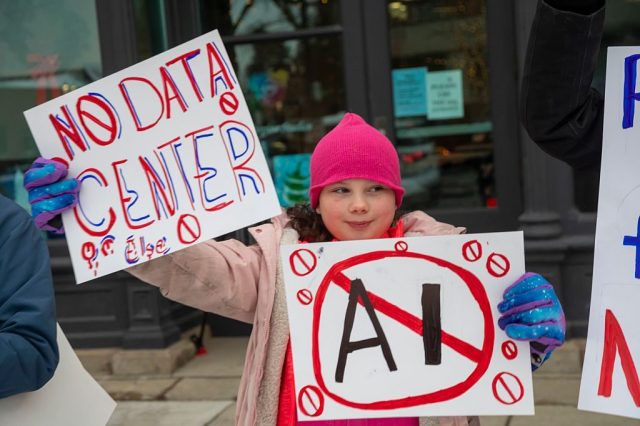
Michiganders protest a proposed data center in December, 2025. Credit: Getty





In his 1974 masterpiece Working, Studs Terkel tried to put words to the quiet dread settling over American labor. He was writing in the midst of what we now think of as the Third Industrial Revolution: the early computerization of offices and the automation of factories, forces that — along with globalization and outsourcing of labor — would go on to hollow out entire regions of the country. What haunted the workers facing this disruption most was “the planned obsolescence of people,” Terkel wrote. “It is perhaps this fear of being no longer needed in a world of needless things that most clearly spells out the unnaturalness, the surreality of much of what is called work today.”
The rise of AI, the so-called Fourth Industrial Revolution, is now reviving that old dread, but this time it portends a far more volatile political horizon than the last one. It’s now the college-educated, office-dwelling winners of the age of the internet and globalization, who are suddenly discovering that they, too, can become the needless things alongside the blue-collar manufacturing base that Trump and MAGA has thus far failed to revive.
We will soon find out which way the political winds will shift in response. The first act of the AI revolution was a content explosion. Generative AI and large language models like ChatGPT, Claude, and Google Gemini flooded the internet in the early 2020s with cheap words, cheap images, and cheap expertise, warping media, education, and the economy of attention into something closer to a hall of mirrors. That phase began bending politics by accelerating misinformation, flattening expertise, and lowering the costs of persuasion. We are now entering a more destabilizing phase: job loss.
As of 2026, AI “coming for jobs” is no longer a speculative future-of-work panel at Davos. In a limited sense, it’s already here. By the end of 2025, AI had been cited as a contributing factor in nearly 55,000 domestic layoffs, according to executive-coaching firm Challenger, Gray & Christmas. The January jobs report was rosier than expected, but the underlying data was grim. Healthcare and social assistance accounted for 124,000 of the 130,000 jobs gained last month, industries essentially dedicated to managing an aging, poorer population. An AI executive at a top consulting firm told me last week that end-of-year updates — Opus 4.5, the Anthropic model that launched at the end of November; and GPT-5.2, the OpenAI model that launched in December — have crossed a threshold and can be trusted to handle more complex tasks with fewer mistakes. “Most people don’t realize it yet. Now [AI] is at the level where I think we’ll start seeing real economic impacts this year, and it will snowball relatively fast,” she told me. Investors have noticed, and software stocks are being punished on Wall Street as markets begin to price in the possibility that AI handles the bulk of global programming.
The snowball may have already begun rolling. In January, American employers announced more than 108,000 job cuts, the worst start to a year since the 2009 Great Recession, with layoffs up 118% year over year and up more than 200% since late 2025. The casualties are not obscure startups. Amazon eliminated roughly 16,000 corporate jobs in a single month as part of a broader plan to trim tens of thousands of white-collar roles. Meta pruned 1,000 jobs from its virtual reality unit Reality Labs. Salesforce’s CEO acknowledged that the company shed 4,000 customer-support workers after AI tools absorbed roughly half of the workload. What we’re seeing now isn’t mass unemployment but a subtler erosion: fewer entry points, thinner career ladders, and a growing sense that the white-collar future once sold as stable and dignified is about to go the way of the video store clerk.
It’s about to get worse: CEOs aren’t hiding it anymore; they’re now openly advocating reorganizing firms around AI labor as a cost-cutting imperative. Dario Amodei, the CEO of the AI company Anthropic, said that AI could drive unemployment up 10 to 20% in the next one to five years and “wipe out half of all entry-level white-collar jobs.” Microsoft AI CEO Mustafa Suleyman is sounding an even louder alarm, predicting that most white-collar work “will be fully automated by an AI within the next 12 to 18 months.” Progressives like MSNBC’s Chris Hayes are calling this development a deliberate class war by Big Tech CEOs against white-collar workers for being too uppity, but this is not a conspiracy against professionals. It is capitalism working exactly as intended. The software doesn’t have to be perfect; if it can get to “good enough” at drafting reports, writing code, moderating content, summarizing documents, or optimizing logistics, then the $120,000-a-year credentialed professional becomes extinct, as more profit can be extracted. Robots and conveyor belts did this to factories and will continue to do so; now models and chatbots are doing it to the cognitive economy, turning thinking into the next assembly line.
This will upend politics because jobs lie at the heart of America’s social contract. As Franklin Roosevelt warned a century ago, “people who are hungry and out of a job are the stuff of which dictatorships are made.” We have already seen how downward mobility reshapes politics because we’re still feeling the tremors of the last employment-quake. In the 50 years since Terkel’s Working, deindustrialized and job-starved blue-collar communities lost more than jobs. Factory closures unraveled unions, apprenticeships, and entire local economies, shunting displaced workers into a service sector defined by precarity and downward mobility. Elites sold the transition as inevitable progress and told blue-collar workers to “learn to code,” as if your uncle could simply download a new career. The promised “knowledge economy” absorbed a narrow slice of the workforce, leaving the rest to navigate wage stagnation, disability rolls, and social decay in towns that had lost their reason to exist. Over time, this produced institutional estrangement: trust in government, the media, and expertise waned; participation declined; and resentment grew.
And so, the anxiety born of the previous wave of automation and the legitimate economic grievances of blue-collar communities were largely rerouted into a new political identity, one that fused material loss with cultural resentment. As unions withered and Democrats recast themselves as the party of the ascendant professional classes, many working-class voters concluded that no one in power was actually trying to rebuild the world they had lost. Into that vacuum stepped MAGA and a Right-wing populism that promised results but has instead given rise to a politics of recognition — an inverse woke — embodied in the unlikely avatar of Donald Trump.
So, what happens to American politics when the script is flipped, and we enter a new era of white-collar precarity? We can look back to the recent past and recall that, after the 2008 recession, it was young men who got especially angry. Downwardly mobile urban millennials drifted toward radical Left-wing politics, including the Occupy Wall Street movement and both Sanders campaigns, myself included. In the current decade, the Gen-Z men shut out by elite institutions often join their grandfathers and turn toward MAGA, or worse, into Groypers. But an AI-driven white-collar apocalypse has no equivalent of the American Rescue Plan around the corner, and it will move faster through institutions because the people experiencing it — journalists, lawyers, policy staffers — are the ones who produce political legitimacy itself. When that class loses faith in the system’s stability, the political climate may quickly become volatile.
Marx, the prophet of the Second Industrial Revolution, would argue that as economic obsolescence metastasizes into political instability, a revolution will soon be upon us. After all, yesterday’s bourgeoisie is soon to become tomorrow’s proletariat. That’s unlikely, but if AI brings about a college-educated jobs apocalypse rather than a utopia of zero work and universal high income, then we will see a more drastic political shock over the next decade than we’ve seen in our lifetimes. Call it W.H. Auden for the white-collar age. “The Age of Anxiety” was the poet’s name for a post-WWII world in which the old guarantees had collapsed, and everyone felt one missed-step away from the void: “the wolves will get you if the moths won’t,” he warned. Large catastrophe or nibbling decay: either way, your previous life is over.
In the short term — the next one to three years — the primary victim of this upheaval will inevitably be the Republican party and the MAGA movement. Economy and jobs remain the top issues for American voters. Whether it is fully deserved or not, the electorate will blame the incumbent leadership for the AI-driven displacement. The current administration, having tethered its brand to a return to American greatness and a blue-collar resurgence, will find itself presiding over a white-collar bloodbath. The 2026 midterms are shaping up to be a massacre for the GOP as voters react to tariff-driven inflation and rising costs for everyone. By 2030, both parties will face the wrath of young people who are expected to build a life on internships, side hustles, and selling themselves on OnlyFans.
But this isn’t necessarily a victory for the center-Left or center-Right. Mainstream democrats are trapped between worker-friendly rhetoric and donor-class dependence on the industries driving automation. Republicans are trapped between populist grievance, pro-market orthodoxy, and vying for Big Tech’s hand in political marriage. The lesson that the pandemic-era satire Eddington expertly captured was this pathology: social media trained Americans to see their neighbors as existential enemies based on voting behavior, while the political establishment quietly benefited from the infrastructure boom, tax abatements, and data-center gold rush that accompanied the platform economy. The culture war supplied the noise, and capital captured the signal.
But maybe not forever. We are already seeing the emergence of a new, non-partisan “AI Populism” where something like the “Humanists” square off against “Tech Accelerationists.” Across the country, local communities are already revolting against the construction of massive AI data centers, even without the sting of massive job loss. These eerie windowless temples of compute strain local power grids and suck up millions of gallons of water, and arrive with the footprint of a fleet of spaceships: alien, resource-hungry, and indifferent to local life. The political backlash is no joke. These fights are erupting in swing states and battleground districts, animating local elections and straining party coalitions.
In Pennsylvania this week, the Montour County commission denied rezoning for a proposed data center tied to a major tech company after residents warned it would hike utility bills and worsen energy insecurity in a region already wary of industrial disruption. In Arizona, grassroots groups gathered enough signatures to put data center siting decisions on the ballot, signaling that tech infrastructure could soon be one of the few issues that actually mobilize voters outside the traditional culture wars. These skirmishes are shaping up to be an early indicator of what the next phase of the AI revolution will look like politically. Not a clean Left-Right realignment, but a messy conflict between those who bear the costs of automation and those who harvest its efficiencies.
The Republican Party finds itself in a weird squeeze on the AI question. Many GOP lawmakers and governors have enthusiastically backed Big Tech’s AI build-out as an economic and national-security imperative. President Trump’s pro-AI infrastructure agenda — from rapid data center approvals to limiting state and local regulatory power — has been presented as a key front in a global competition with China. At the same time, rank-and-file voters in data center host states are increasingly troubled by the real costs — from utility bills to grid strain — that these facilities impose, leaving Republicans vulnerable to being tagged as defenders of distant tech interests at the expense of Main Street.
Democrats, meanwhile, are trying to make sense of this new landscape. Party standard-bearers like Pennsylvania Gov. Josh Shapiro have heralded AI as the future of the economy of their jurisdictions, while also awkwardly defending the backlash. Some progressives have embraced calls to slow or regulate data-center construction, framing it as an issue of worker protection, environmental justice, and local control. Others worry that overt opposition to AI infrastructure will hand Republicans a cudgel to beat them with on innovation and growth.
There’s a bizarre alignment emerging where figures as ideologically opposed as Bernie Sanders and Ron DeSantis find themselves on the same side. In a post on X over the weekend, Sanders said that the key disruptors of the 20th century economy — automobiles, radio, TV, computers, the internet — pale in comparison to the revolution AI will bring about. This week, Sanders is traveling to Stanford, the heart of the Big Tech beast, with US Rep. Ro Khanna (D-Calif.) to call for a moratorium on construction of new AI data centers to “make sure AI works for workers, not just billionaires.” Meanwhile, in December, DeSantis proposed an “AI Bill of Rights” to safeguard Florida residents by addressing the misuse of personal data and allowing local governments to block new data centers. “I really fear that if this is not addressed in an intelligent and proper way, it could set off an age of darkness and deceit,” DeSantis said during a press conference. When a democratic socialist and Florida’s No. 1 Right-wing culture warrior start sounding like joint authors, something real is happening.
If we look a decade ahead, the AI revolution may force a complete rewrite of the old political spectrum of “Liberal vs. Conservative”, which will collapse into incoherence. In its place, we could see a structural realignment around — to borrow from Marx — who controls the Means of Prediction.
As AI automates the “cognition economy,” the debate over Universal Basic Income (UBI) or a Universal Basic Dividend (UBD) will shift from Silicon Valley pipe dreams to the center of the debate. Governments will be pressured to tax “robot labor” simply to prevent the total collapse of the consumer economy. If people don’t have wages, they can’t buy the products the AI is making. Just as the 19th-century state had to break up the trusts and monopolies of the Gilded Age, 21st-century politics will be a battle between the federal government and a handful of what Sanders calls tech oligarchies. These companies now control the world’s primary compute resources — the digital equivalent of oil or steel. Or we could see the opposite: a command-and-control economy, as the state and tech formally merge and the trend of state capitalism takes firmer hold.
The danger, I believe, isn’t that AI will produce a single coherent political movement or a technofascist state (so put away your dog-eared copy of 1984). Instead, it may fracture the old coalitions faster than new ones can form, producing a volatile landscape of backlash, regulatory whiplash, and even more opportunistic demagoguery. On the far Left, we see a rise in techno-skepticism and a demand for the abolition of “bullshit jobs” — the idea that we should stop pretending we need 40 hours of work if the AI can do it in four. On the far Right, nationalist protectionism may not align with the needs of the global AI industry. The future, for better or worse, is up for grabs.
From this vantage point, the AI revolution is the final insult to the American worker, but over the rest of the 2020s, it may also represent the final test for American democracy. The Third Industrial Revolution taught factory towns that the future could arrive without them; the Fourth is teaching the same lesson to the laptop class. And when millions of people are suddenly told, by code, that they are surplus, it won’t be the moths that get the elites. The wolves will find them first.
