




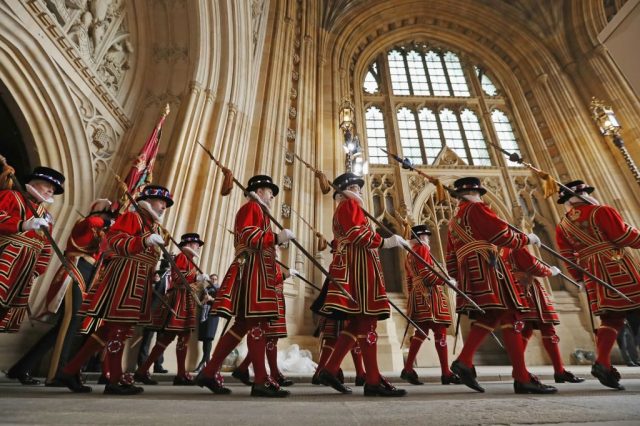
’Like pigmies parading in boots several sizes too big.’ (Dan Kitwood/Pool/AFP Getty)




In December 1914, the first president of the Chinese Republic, Yuan Shikai, travelled to the southern outskirts of Beijing in the hope of reviving an ancient tradition. Here, at the Temple of Heaven, the Chinese Emperors had for centuries performed their winter solstice rituals. Through elaborate ceremonies, they had communed with the ancestors and sought auspiciousness on behalf of their subjects. Such longstanding conventions had played a stabilising role in China’s history, allowing new Emperors, and even new dynasties of conquering barbarians, to assume the mantle of continuous imperial rule. The rituals had been performed right up to the turn of the 20th century. Thus President Yuan, hoping to found a dynasty of his own, swapped his military uniform for ceremonial robes, and assembled the ritual handbooks, musical instruments and sacred paraphernalia demanded by the great occasion.
Alas, he did not fool anyone. Yuan’s bid to become Emperor was met with widespread revolt, and only hastened China’s descent into political chaos. The ancient rites could no longer be performed except as a modern charade; the giveaway was that Yuan had cameras present to record what none had previously been allowed to witness. There comes a point where the changes a nation undergoes are too large to be quietly folded back into a story of deep continuity.
Perhaps this tale can help us to parse the uncertainty which hangs over the ceremonial heart of British government, the Palace of Westminster. Last week, a joint commission of the Lords and Commons published costed proposals for “restoration and renewal” of the building. The plans are so expensive, extensive and disruptive that the task of refurbishing Britain’s Parliament, which has already loomed for years, looks set to drag on much longer still. So now is the time, before this magisterial building is dismembered in the name of modernisation, to ask whether its own magic has not already turned to empty gesture.
The Palace of Westminster embodies a constitution that was also fabled for its continuity, its traditional framework evolving by peacefully incorporating change. Parliamentary government emerged without discarding the monarchy, which aged into a symbol of national unity transcending politics. Through the House of Commons, democracy was progressively extended to encompass more of the population, even as the aristocracy retained its influence in the Lords. New classes of wealthy businessmen were brought into the establishment through the lower house, and then the upper one, a path later followed by the Labour Movement. For generations, a widespread Whiggish view held that this gradual process of change, perhaps reflecting the hand of divine Providence, protected Britain from the revolutions and dictatorships that rocked the European continent.
The current Parliament building entered this story halfway through, but tellingly, it was designed to invoke a much deeper past. The Commission which selected it during the 1830s had asked for proposals only in the Gothic and Elizabethan styles (although the contract had originally been awarded without competition, leading to a procurement scandal; some things really are continuous in British history). The winning submission, by Charles Barry and Augustus Pugin, combined classical stability in its structure with delirious masses of Neo-Gothic ornament, the latter signalling Pugin’s preference for an idealised medieval social order over what he regarded as a squalid modern world. It was a bold decision by a political class which was, in the same decade, undertaking the contentious process of expanding democracy through the Great Reform Act. In the ensuing decades and centuries, Barry and Pugin’s masterpiece provided a symbolic anchor against countless further storms. This is where the great rituals of democracy are performed, investing the country’s leaders with authority: the debates and votes, the spoken formulas, the waving of order papers and confrontations at the dispatch box.
But the new proposals to renovate Parliament are an omen, if one was needed, that this Westminster world cannot continue forever. It is a baffling report, symptomatic of deep problems with how the British state tries, and fails, to manage its projects. Parliament needs upgrades to its fire safety and services such as sewerage and heating systems, along with asbestos removal and conservation of the building’s fabric. Somehow this refurbishment has spiralled into a proposal of eye-watering cost and duration. One option, costing up to £11.5 billion, would see the works going on for 24 years, during which the Commons would leave the building for up to a decade, and the Lords for up to 15 years. Should the Commons prefer to remain in place, and Lords to decamp for a mere eight years, the works will take up to 60 years, at a cost of up to £20 billion in today’s money. Worst of all, the revamp will insert various new spaces into the building, including a visitor area and education centre, in the most horrifically dull style imaginable.
Part of the problem, as so often with state procurement today, is that a practical task has been swamped with nice-to-have social schemes. The renewal programme “will seek to create opportunities for small and medium-sized enterprises”, with partners given “contractual obligations to achieve the widest practical geographic spread of the supply chain”. As Nicholas Boys Smith points out, the goal of reducing the building’s energy consumption by 40% comes at a price that could produce far greater environmental dividends if spent elsewhere, and step-free access is demanded for parts of the building where few people go even on foot. The Commission has gone for the second most expensive of six initial options, partly because it will allow still more tampering in the future. Even if this renovation avoids the budget overruns and delays we see in so many other projects, it will become a potent symbol of governmental dysfunction and waste, adding another layer of ridicule and scorn to the word “Westminster”.
Unless, that is, Parliament takes an option not mentioned in the report, and moves out of the Palace for good. This would surely be the best way to honour the historic beauty of the building itself, by saving it from further misguided renovations and allowing it to become a heritage site. More importantly, though, it would free Britain’s lawmakers from the weight of a civilisation which has already, for the most part, passed into history, and whose rituals they struggle to perform with conviction or plausibility.
The Palace of Westminster was built in a society in the midst of an Industrial Revolution, moving towards mass democracy, at the heart of an expanding global empire and undergoing a boom in Evangelical Christian faith. It served the country through enormous convulsions, including two world wars, the loss of its empire and a transformation in social attitudes. But whatever authority was once bestowed by images of green benches, state openings and robed peers is now largely gone. As Parliament’s own website reports, between 2014-24, “the proportion of people with low to no trust in MPs rose from 54% to 76%”. According to last year’s British Social Attitudes survey, just one-in-five respondents think that Britain’s system of government — the one embodied by Parliament — needs little or no improvement, whereas half did in 1999.
At what point does change become too great to bury behind the façade of continuity? This question is impossible to answer with certainty, but it feels as though the line was crossed at some point in the past few decades. There is nothing wrong with anachronistic customs; they are, in fact, important for nourishing the emotional dimension of politics. The problem arises when the figures performing those customs evidently no longer belong to the world they invoke, creating an impression of self-importance which makes those concerned appear like pigmies parading in boots several sizes too big.
Consider, then, that Britain’s constitution is increasingly remote from the one which the Palace of Westminster once represented. The upper house, whose grandeur Pugin sought to recognise with ornament far more lavish than that of the Commons, has only a dwindling rump of hereditary peers left, which the current Labour government has tried to remove. The Lords is now a constitutional appendage, hosting a combination of diligent legislators and political cronies, its ranks swollen by wave after wave of appointments and its future an elaborately dressed question mark. Meanwhile, some MPs are apparently unaware that the separation of powers, an American concept, doesn’t apply in Britain, which may be the result of confusing innovations like a US-style Supreme Court. The fundamental principle of Britain’s constitution, parliamentary sovereignty, has been undermined by Blairite reforms, dispersing authority to devolved governments, international courts and a vast web of unelected bodies.
No less striking are the changes in the nation that Parliament is meant to govern. Most obviously, London’s transformation into a city of immigrants means that fewer than half of its residents come from families that lived in Britain at the time of the Second World War, a single lifetime ago. Taking the British population in general, around a quarter have no familial presence in the country before 1945. British people no longer attends the churches, read the newspapers, work in the industries or hold the class loyalties that they used to, nor do they have the same understanding of themselves as a nation. These shifts are undermining the political foundations on which Parliament was built. The adversarial system of governing party versus opposition which always underpinned the House of Commons is falling apart, as Britain becomes effectively a multi-party system trapped in a two-party constitution. Last year, for the first time, a majority of Brits surveyed claimed to prefer coalition over single-party government.
It seems that no one currently benefits from British politics playing out against the traditional backdrop of Westminster. For voters of a conservative bent, that hallowed setting can only be a reminder of the history the country has abandoned; for those of a progressive or radical one, the survival of such a hidebound institution implies that history has not been abandoned enough. Politicians shout endlessly about “change”, about the broken system that needs fixing and the establishment that needs to be overturned. As long as they do so from what is itself the unchanging home of a broken establishment, they will struggle to be heard.
Providing a connection to the past, even an imagined one, is a valuable function for a public edifice. Indeed, historicist monuments like the Palace of Westminster, which inspired parliaments in a number of other countries, represent one of the great innovations of modernity, helping to steady a society in the face of disorientating change. But there are other roles which such buildings can perform. Britain does not have a great record of constitutional reform in recent decades, yet its leaders cannot just look on as the country’s governance becomes increasingly unfit for purpose and the public’s anger increasingly implacable. Commissioning a new Parliament building could be an opportunity to properly think through the roles of the two chambers, and possibly a spur to a wider reorganisation, or in some cases restoration, of the British system. It seems sacrilegious to move government away from Westminster, where it has existed for the best part of 1,000 years, but the alternative is a forlorn hope that the authority of the old rituals will return.
It would also be helpful to have a tangible representation of the British state as it exists today, rather than in its 19th-century pomp, for us all to see and judge accordingly. At present, Britain’s lawmakers are hiding in the remnants of a vanished country, cloaked in a borrowed dignity which is wearing thin. Is it not time to see, in the cold light of day, how the living centre of the constitution would choose to present itself? To judge by the recent renovation proposals, not to mention Scotland’s modern parliament building at Holyrood, the successor to the Palace of Westminster could be very uninspiring. But why the state manifests itself in such ugliness is not a question we can shy away from forever, and need not be the end of the conversation. Seeing its parliamentarians encased in soulless fibreglass, like glorified office workers, might be just the reality check the country needs.
Wessie du Toit writes about culture, design and ideas. His Substack is The Pathos of Things.
 wessiedutoit
Join the discussion
Join like minded readers that support our journalism by becoming a paid subscriber
To join the discussion in the comments, become a paid subscriber.
Join like minded readers that support our journalism, read unlimited articles and enjoy other subscriber-only benefits.
Subscribe