




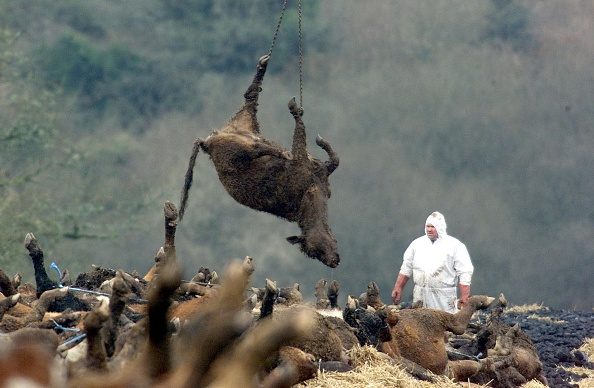
A sign of things to come. (Gerry Penny/AFP/Getty)




It has been 25 days since the rain last stopped in Longtown, but Joe has other reasons to be unhappy. “Tek a look at this,” he says, his mouth gaping. He leads me to a bench outside of a livestock auction mart. Inside his folders there are assiduous photographic studies of police helicopters, monoliths, and Hadrian’s Wall. It’s all evidence, he says, of Cumberland County Council’s frantic attempts to thwart his discovery of “summat unique, at the centre of Britain, the centre of the Roman wall”: a small hill on his farm which, if you squint hard enough, looks a little bit like a face.
Joe comes here most weeks, not to buy anything, only to talk. I follow him through the paddock, into the auction room, where a pair of young farmworkers doom-scroll in the corner. A door opens, and a Red Bull can skates across the floor. A police siren rises over the bleating sheep. The auctioneer enters: some 5,500 lambs will be sold today. I am at the furthest reaches of England, the Cumbrian-Scottish border, formerly known as “the Middleland”: the lawless marches which neither country could control for long.
Joe’s paranoia is rooted in history. On 15 February 2001, right here at Longtown Mart, under another Tupperware sky, he came to buy sheep at one of the busiest auctions of the year. Some 14,000 “yows” were sold that day, and he bought 12 of them. A few days later, at Cheale Meats abattoir in Essex, an animal bought at Longtown tested positive for PanAsia Type-O, a new strain of foot-and-mouth disease (FMD) more viral and afflictive than most, killing some animals and laming many more. They say it first started over at Heddon-on-the-Wall, just outside of Newcastle, where old Bobby Waugh fed his pigs on illicit swill, made from a Chinese restaurant’s waste. But it jumped species at Longtown, meaning that, as the British countryside was harrowed into a hell of restricted movement and rotting corpses and burning pyres, it was north Cumbria that suffered most.
Around 70% of farms in north Cumbria had their livestock culled. Joe’s was one of them. Some farmers sold up, and some restarted; others just went mad. Nationally, there were only some 2,000 cases of the disease, and yet 0ver six million animals are estimated to have been culled (a Private Eye investigation suggested it’s much higher), costing the British economy some £8 billion. There was a human toll too. Over 60 farmers and three vets killed themselves in 2001 alone, and by the following year the suicide rate among rose to more than one a week, a figure that had been steadily increasing since mad cow disease struck in the Nineties.
Altogether, it would arguably become the worst FMD epidemic in world history. But it should have been expected: foot-and-mouth has been around for hundreds of years, and is endemic across much of Asia and sub-Saharan Africa. The last time it plagued Britain was in living memory, in 1967, which saw 2,364 outbreaks with some 430,000 animals slaughtered and burned. It was only a matter of time before it returned: limited customs checks made sure of that. “The single market meant we scrapped 500 years of port controls,” said Tim Land, a professor of food policy, in an interview at the time. Some would later claim that the wind blew it over the Channel.
It would always come; it should have been expected. Yet when it did, that dreary February, the trauma was made so much worse by the conduct of the Government. Its handling of the 2001 foot-and-mouth epidemic would prove the first in a long rollcall of 21st-century state failures that severed the connections between Westminster and its subjects, between the city and the countryside. “There was a big cultural disconnect between what people understood to be going on, who of course weren’t going to rural areas,” says Professor Maggie Mort, an academic at Lancaster University who studied Cumbria’s post-FMD recovery. “A lot of the trauma and isolation was to do with that feeling of not being understood.”
* * *
It was over a month before anyone came to check Joe’s sheep, by which time they were so lame they could hardly feed. A vet arrived, and then an execution squad was summoned. They would have used captive-bolt pistols, common in abattoirs but not for mass slaughter. They jam and overheat and lose power when used repeatedly, which means the killings can take hours, often more. Some animals were shot many times before dying. Over the course of a day, a farmer’s life could be reduced to a pile of corpses, either burned on a pyre or else left to rot in the farmyard before being crane-lifted into a còrtege of red “Snowie” trucks, which then proceeded to the mass burial site near Great Orton — all while making their owner, the eponymous Malcolm Snowie, the first “foot-and-mouth millionaire”.
-
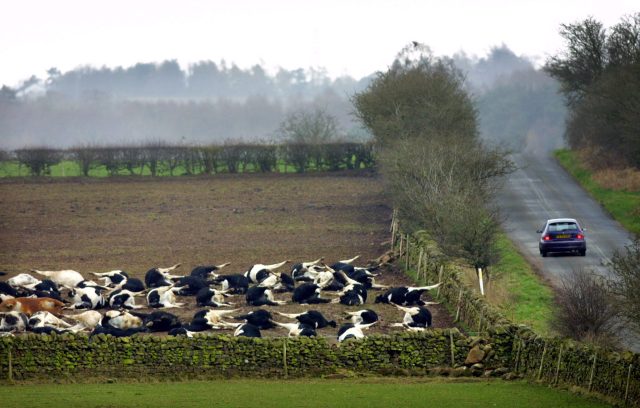
(Adrian Dennis/AFP/Getty)
As cruel as the killing was the time of year. “The hardest thing,” one farmer tells me, “was the sheep were lambin’ and they shot them as soon as they were born.” Peter Frost-Pennington, a vet, tells me that he remembers “standing at a farm, looking at all these dead sheep lined up and their lambs, and looking around at the countryside, completely devoid of animals, and I stood there, and just wept”.
Joe’s own sheep were burned on a pyre on the Roman wall. It would be days before the bonfire stopped, during which a thick, grey cloud spread uninterrupted across the landscape. The worst thing was the smell: the nidorous honk of bone and skin and fur and rancid fat, which permeated everything. All through Cumbria, the windows were shut, the washing lines brought in.
-
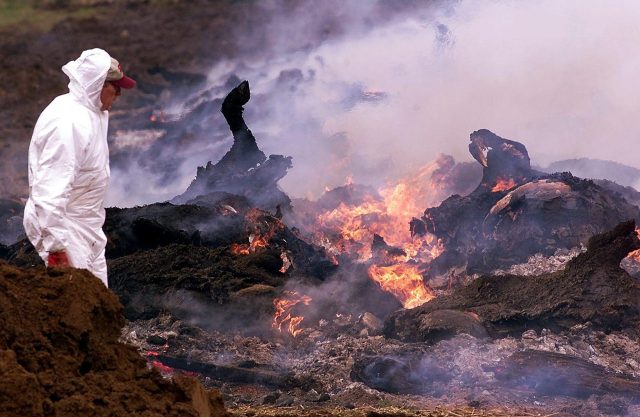
(Gerry Penny/AFP/Getty)
Back in Westminster, there wasn’t a plan. Each outbreak was a red pin stabbed into an outdated map; each farm and village a problem to be resolved more than a living place. Government-in-crisis always seeks solutions rather than understanding, and in postwar Britain that increasingly means delegating responsibility to “experts”. And so Nick Brown, the Minister of Agriculture, Fisheries, and Food (Maff), made the precocious decision — later emulated by Matt Hancock — of outsourcing government to scientific advisors and computer models.
The latter, cooked up at Imperial College by Professors Neil Ferguson and Roy Anderson, miscalculated the disease’s spread. Fed on unreliable figures from Maff, it also didn’t account for the fact that FMD affects different animals differently. In practice, that meant Maff unnecessarily ramped up the “contiguous cull”, whereby all livestock on premises that neighboured an infected farm would be pre-emptively slaughtered — even though many at Pirbright, the national Animal Health Institute, considered this both cruel and incorrect.
The then-Prince Charles privately condemned it as “mindless” slaughter. And, far beyond the modelling, it was: there were stories of sheep being “accidentally” culled, such as Punderland Farm, Little Clifton, where an official’s misreading of a map led to the slaughter of a farm some 100 miles away from the target. In a sense, one can hardly blame them: some of Maff’s maps were so old that they didn’t even have the A66 marked on them. Even the disposal trucks got lost: one man at The Wellington pub in Great Orton remembered how they’d often stop outside the village school to ask for directions, uncovered carcasses in the back of the truck. Meanwhile, one small-talking executioner asked the farmer if the particular bull he was about to shoot was male or female. Elsewhere, in Monmouthshire, a gunman was filmed chasing sheep around a field and shooting at them. Naturally, the local council said that he wouldn’t be prosecuted; the farmer would instead — after all, he’d lost control of his animals.
-
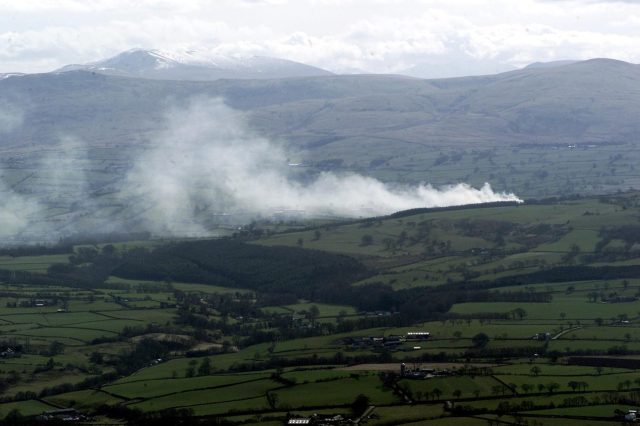
(Gerry Penny/AFP/Getty)
Terrible as it was for culled farmers, at least they were compensated. Yet as those suicides of vets imply, FMD’s impact went far beyond the farmyard. Andy, 51, a tree surgeon, says business was so bad that year that “everything was just haemorrhaging money”. By 23 December, 2001, he had only £62 left in his bank account. To make matters worse, his brand-new Land Rover was stuck on a quarantined farm, irretrievable for the best part of a year. In hindsight, perhaps that was just as well: so neurotically was everything disinfected that, by the end of the year, most Land Rovers in Cumbria had been corroded by citric acid. 2001, at least, was one of the best years in living memory for rural car salesmen.
Back in London, Tony Blair kept insisting it was under control. Once he visited Cumbria on the 22 March, and saw the scale of the devastation, he called in the Army, and turned the airfield at RAF Great Orton into a “killing field” and mass grave: within only a week, some 20 trenches, four metres deep and 150 metres long, were hewn into the landscape. The General Election was delayed by a month, the first time since the Second World War, shortly after which Nick Brown’s Maff was replaced by Margaret Beckett’s Defra (“Destroy Every Fucking Rural Activity,” as one farmer quipped). Things were better organised now, but it was all too late: such ineptitude combined with bureaucratic slaughter had made a lasting impression. “You don’t give a shit about the North,” one protester shouted at Blair, as the prime minister slipped out of his Jag in Carlisle town centre.
-
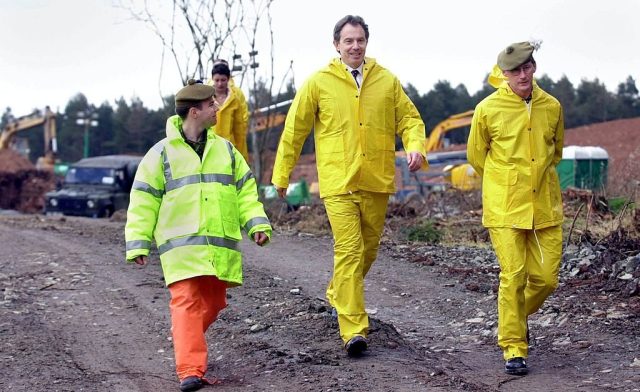
Everything under control. (Ben Curtis/AFP/Getty)
That was how most people felt back then; it still is. And no wonder. Joe’s flock hadn’t just been his livelihood, but his father’s too. Flocks are built up over generations; a living heritage destroyed in a day. The day the farm was culled, his mother slipped and broke her hip. She never recovered. Neither did he. Not long after, the next-door farmer was found hanging from a ceiling beam. “It was a bad year, a bad time,” Joe says. “Farm’s a hell of a mess.” Has been ever since. But he found salvation of a sort in his belief that the hill under which his cattle were burned was something special that the Council wanted to take away from him. He wrote three letters to the Queen, and one to Barack Obama. Neither replied. “I’d rather get in touch with them than the police,” he tells me.
And if Joe became especially paranoid, it was more a matter of degree. Such was the extent of the cockup that it fed conspiratorial thinking. Some blamed the EU, long-suspected of wanting to destock the countryside; others Blair’s attempt to neuter the Countryside Alliance by refurbishing rural England as a holiday destination. Someone even told The Sunday Times that FMD was a covert operation by Saddam Hussein. Even now, the farmers I speak to at Longtown tend at first to respond to my questions with an attribution of blame: three mention the “EU” and “destocking” but most blame either Blair’s indifference or his active resentment of the countryside.
To that extent, then, something like inheritance tax is just the latest humiliation in a long, long line. One man I speak to at the livestock mart curtly informs me that he won’t tell me anything, except that FMD was linked to 9/11, but then he keeps on speaking: about the migrant hotels in Carlisle, Peter Mandelson and “the Epstein stuff”, and the “tarts” and “dogs” and “crooks” in London. He visited London once, and was repulsed: as he recounts it, his handlebar moustache, half-concealed by distended cheeks, quivers in disgust.
Amid all this swirling resentment at urban Britain, even Nigel Farage is tainted. For all his pint-swilling Barbourism, Reform’s is a taut coalition of Kentish colonels and the Left Behind, of Middle England and the post-industrial white working classes, in which there’s little space for an organic political expression of rural Britain. Just 50 miles away, on the coast, is the home of 2019’s median voter: the Workington Man, who the political system has been scrambling to appease for much of the last decade. He’s not appeased yet, but Westminster continues, in its hamfisted way, to try to understand him — they need his vote. Given that only 1% of Britain’s workforce is in agriculture, no one needs to court the farmers. So if the last YouGov seat-by-seat polling has Reform winning every seat but one in Cumbria at the next General Election, it’s equally clear that many here crave something more attuned to their distinct and fragile culture.
One predictably popular option is Jeremy Clarkson, but really he feels more like a vessel for an inchoate kind of rural radicalism. “What we need is a new Cromwell, to walk into Parliament, and lop their heads off and fling them outside,” says Howard, a 68-year-old sprawled at the bar of the String of Horses at Brampton. Dressed in an undone, white-quarter-zip jumper, he’s on his fourth Snakebite and chaser of the night. Then he stands, his barstool scraping the stone floor. “Let it be me,” he cries, and mimics the executioner’s blow. Soon, Howard starts crying about his dead labrador, and the bartender brings him a plate of chips.
If there is room for such a Cromwellian figure in modern British politics, it’s likely Rupert Lowe. In his Restore Britain campaign video, released last weekend, he addresses his audience “from the farm… because places like this represent what proper Britain is about”. Though in Gloucestershire, his countryside is far from the dappled leafiness of the political countryside. With its skies drab and weather half-cold, and its common-sense inhabitants weaned on an elemental conservatism, Lowe’s England is epically different from the Cotswolds cliché.
-
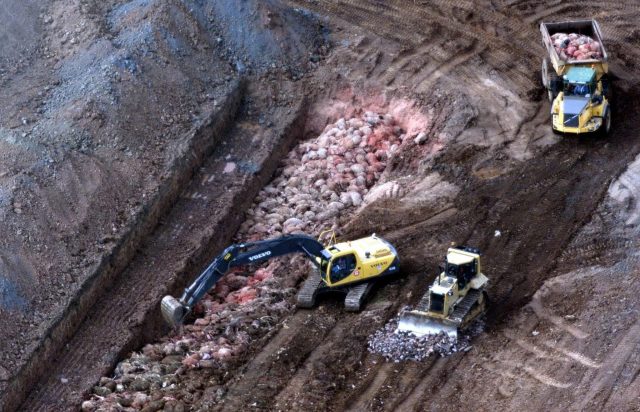
The killing field. (Gerry Penny/AFP/Getty)
Of course, how these credentials will hold up under the advice of metropolitan ideologues remains murky. That feels fitting. “Long after the last pyre has stopped burning,” wrote Guardian columnist Jonathan Freedland at the height of the slaughter, “foot and mouth will stand as an indictment of British public life — and of the way we govern ourselves.” Yet who remembers FMD now? Outside of the Middleland, and the far-off places like it, almost no one. The only real memorial to the catastrophe is at RAF Great Orton, the former killing field transformed into a nature reserve. Of sorts: with its copse of wind turbines and plains of wild tarmac, set on the severe flatness of the Solway Plain, this is an absurdly natureless place. Beneath the grass, some 500,000 animals lie buried, entombed in sealed chambers of lime and excavated mud. Locals tell me that, every so often, they still have to extract fluid from the chambers, lest they overflow.
Once FMD was nearly over, Lord Haskins, then Blair’s “Rural Tsar”, said that “the idea of turning the clock back is not the way of dealing with the problems in Cumbria today”. Instead, he argued, “the future is looking at the future, not building up fantasies of the past, like some people might think.” But his future, unseen in 2001, has stuttered and stalled — not because we built up fantasies of the past, but because we ignored it altogether.
Had such a disaster been inflicted upon, say, the sub-postmasters, or the miners of Orgreave, it would have been absorbed into our national, postwar story — the story of victimhood and decline. There would be new laws to assuage their grief, and BBC dramas to re-enact it, and lordly think pieces to cite it in their aetiology of the “Great Populist Revolt”. That revolt is long from finished here, barely even started, and yet the Government lumbers from crisis-to-crisis, condemned to a sort-of amnesia: repetitiously forgetting all the lessons it’s learned, only to be forced to learn them again.
In 2020, that very same crack team from Imperial, presided over by Professor Neil Ferguson, reassembled to battle yet another public health crisis, offered the country yet another “totally unreliable” model that sent us into an ill-advised lockdown. And what did we learn? Only to move harder, faster in delegating control to unelected academics, statistics, models. And all the while, FMD is sure to come again. Only last year, Dover Council warned that it’s a matter of “when, not if” it returns through the port, even as a lab leak in 2007 almost led to a repeat of 2001. There is, of course, a plan for when it appears, but chances are it won’t be followed. Once again, the Stygian fumes will suffocate the land, and the roadsides will be lined with corpses, and another generation will have their almost-instinct proven true: that down there in London, they just don’t care about us.

Join the discussion
Join like minded readers that support our journalism by becoming a paid subscriber
To join the discussion in the comments, become a paid subscriber.
Join like minded readers that support our journalism, read unlimited articles and enjoy other subscriber-only benefits.
Subscribe