




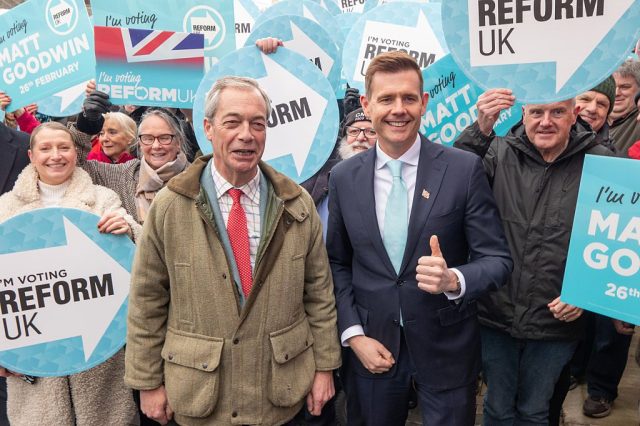
Farage has welcomed Goodwin into Reform. Photo: Gary Roberts/SOPA Images/LightRocket via Getty Images




It was the curse of Professor Matt Goodwin to be more intelligent than the average political scientist. The guild to which he once belonged did not, it would be fair to say, comport itself well during the Brexit years. Having failed to predict 2016, many academics doubled down on the idea that the vote, and the concerns which gave rise to it, were fundamentally illegitimate. Often they diminished their own legitimacy as a result.
The task of political scientists during the 2010s was to spin a mythology in which the elites could cocoon themselves. “The extent of Russian-backed fraud means the referendum is invalid,” said one social scientist; Brexit was a “tsunami of bile” vomited up by the Murdoch press “that has downed and drowned a once great nation”, said another. All this was par for the course in Goodwin’s old milieu. In his most recent book, Bad Education, he reveals that one of his colleagues at the University of Kent gave lectures in a “Bollocks to Brexit” T-Shirt. You can hardly blame him for wanting to leave that sordid world behind.
He has left it for the no less sordid world of politics. When Goodwin, as a young scholar in the late 2000s, first embarked on his academic research into the radical Right in Britain, it was in the manner of Jane Goodall and the chimpanzees; now he is swinging from tree to tree as Reform’s candidate in the Gorton and Denton by-election. He has been plotting his entry into electoral politics for some time. He had promised that, once he had got to 100,000 subscribers on Substack, he would launch a party of his own. It’s probably for the best that Reform snapped him up before he reached that milestone: what with “Advance”, “Reclaim” “Restore”, and “the Conservative and Unionist Party”, the last thing the British Right needs is another vanity project splitting the vote.
Academics tend not to fare well in the political domain. A dozen years ago, when still deep in the weeds of the Right as associate professor of politics at the University of Nottingham, Goodwin co-wrote Revolt on the Right with Rob Ford. The book’s early drama involves the trials and tribulations of Alan Sked, the LSE historian who set up Ukip in the Nineties. Sked was no good at politics: he was “only interested in obscure constitutional issues, and had little grasp of how to run a campaign”. Having written several books about political campaigns, Goodwin is today at some advantage — though it will still be a tall order for Reform to win in a constituency which is over a quarter Muslim. It is presumably for this reason that he has so far toned down the strident anti-immigration views for which he has become notorious, such as his claim that people from ethnic minorities born and raised in the country were not always British.
Sometimes Goodwin’s unusual 15-year journey, from liberal political scientist to Right-wing pundit and thence to Reform politician, is presented as a Damascene conversion — or, by the more cynical among his critics, the product of audience capture, ego, or grift. His earlier academic work does, however, contain some seeds of the Substack and the GB News show that have since come to flower. Goodwin himself describes his early endeavours as having argued that “the people voting for things like Brexit had legitimate grievances over issues such as mass immigration”. His 2018 book, National Populism — co-written with his former doctoral supervisor, Roger Eatwell — did not shy away from addressing those “legitimate grievances”, and neither did his public interventions around that time, including for UnHerd. That he had some sympathy with the grievances of his subjects was sensed, in fact, rather earlier, by the BNP’s Eddy Butler, who wrote in 2011 that the young scholar might have “an element of empathy with [our] aims if not the means”. “Perhaps,” he conjectured, “the hours of interviews he has undertaken has had a Stockholm syndrome effect.”
Largely on the basis of conversations with Butler and his ilk, Goodwin has for a very long time been banging the drum — or sounding the alarm — that there exists in Britain far broader support for the radical Right than the elites and political scientists would wish to think. Already in his first major book, New British Fascism: Rise of the British National Party (2011), one can sense his frustration at the complacency of other political analysts, who believed that “extreme Right parties like the BNP will never attract and sustain mass support”. There existed, for parties on the radical Right ranging from the extreme BNP to the more mainstream Ukip, a natural constituency of “angry white men”. Goodwin has been consistent, throughout his career, that this constituency could not be easily ignored.
Notwithstanding this degree of consistency, the younger Goodwin certainly cut a different figure in the public sphere from the one he cuts now. He was happy, for a time, to add his voice to the elite chorus. In 2013, during the Cameron era, he argued in the New Statesman that Ukip’s popularity had little to do with immigration concerns after all, and that everyone in the country would be happier if we had simply stopped talking about the subject altogether. He would surely include his past self in the “elite failure” which was in his view responsible for the riots of summer 2024.
Likewise, where now he paints a gloomy picture of demographics and integration, his earlier work tended to sound the hopeful note that social cohesion and tolerance would triumph. The New Extremism in 21st Century Britain (2010) — another collaboration with Eatwell, and one markedly different from National Populism — ends with a point about “the football” that prefigures the preoccupations of the Southgate Era: “Squadloads of young fans play football games on their Xboxes and PlayStations which feature the slogan ‘Let’s Kick Racism Out of Football’, and they are the future.” The presence of black players in the England team seemed a sure sign that liberal multiculturalism would win the day, and that the natural constituency of the populist Right would die out eventually. The “angry white men”, the “losers of modernisation”, would stay forever in their place: a “quiet revolution” in attitudes about immigration and diversity would leave them as yesterday’s men.
Goodwin’s stated positions were elite ones then, and in a certain sense they remained so. You would hardly know it from all the criticism lobbed at him from the sequestered and low-powered faculties of sociology and political science at Britain’s middling universities, but his interpretation of Brexit, set out immediately after the referendum, has more or less dominated discussion and steered policy for the past 10 years. His analysis tended, at least initially, to devote more attention to the economic and cultural depression of Britain’s “Left Behind” than to any specific concerns over immigration — and this, in essence, was the logic that allowed Boris Johnson to combine his “Levelling Up” agenda with unprecedented levels of immigration. Indeed, there is a moment in Values, Voice and Virtue, his 2023 polemic against the “new elite” that drove the country into the ground, when Goodwin sheepishly admits that the true meaning of Brexit — that it was, in essence, a scream of the “Left Behind” — had been grasped by Theresa May and Nick Timothy in the damp squib campaign of 2017.
Goodwin’s books are markedly Blue Labour in places, with all the anti-Thatcherism and anti-liberalism that this implies. Values, Voice and Virtue contains some praise for Peter Shore, even Tony Benn, and trots out the well-worn Lord Glasman narrative about how the socially-liberal Blairites — the lanyard classes — betrayed Labour’s working-class base. Goodwin, like Glasman, describes himself as economically Left and culturally Right. He will want Reform to pursue this political sweet spot, and to realise what he has long prophesied as the “great realignment” — the potent combination of social conservatism with economic interventionism. That alignment was supposed to occur with Brexit, and then it was supposed to occur with Boris Johnson’s victory in 2019. These, in Goodwin’s view, were two false starts, two wasted opportunities — the latter, with the “Boriswave”, amounting even to betrayal.
Will Reform, with Goodwin’s assistance, at last bring the great realignment to fruition? It seems quite likely that he will once again be disappointed. Nigel Farage is on the economic Right, and Zia Yusuf even more so. As are all the recent arrivals from the Conservative Party, with the exception of Danny Kruger. The presence of such people and ideas in the Reform coalition — low tax, small state — is something that Goodwin’s model of politics, with the “great realignment” as its logical terminus, has always struggled to accommodate. One of those interviewed in Revolt on the Right is John, a 64-year-old factory-worker from Nottingham; he voted for the Tories under “Maggie”, shifted to Labour after she resigned, came close to voting BNP in 2005, and backed Ukip in the EU elections in 2009. Goodwin (and Ford) used this example to substantiate what is in effect a “postliberal” theory of modern British politics, to tell a certain story about the “Left Behind” and the “losers of modernisation”. Does it not matter, here, that John is a Thatcherite?
Clearly Goodwin believes that Reform’s current popularity is the product of material grievances on the ground; clearly, too, he thinks those grievances have much more to do with immigration than he used to. But he also knows, to quote from an article he wrote when he was 26 years old, that parties have the power to “influence their own destiny”, and that their fortunes depend as much on “organisation, personnel, and propaganda” as to the conditions that push and pull ordinary voters in various directions. For someone with considerable ambition, or an appetite for power, this would quite naturally provide a strong incentive to quit merely observing political trends and to enter the fray in order to shape them. “Many people”, he says at the end of Values, Voice and Virtue, are “searching for a radical alternative… the only question that remains is what form this radical alternative will take and when it will arrive”. This, really, is how all his books have concluded, even the ones he wrote back when he was cooped up in the Ivory Tower. He used to have to go into the field to see what form it would take. Now, he can fancy himself in the mirror instead.

Join the discussion
Join like minded readers that support our journalism by becoming a paid subscriber
To join the discussion in the comments, become a paid subscriber.
Join like minded readers that support our journalism, read unlimited articles and enjoy other subscriber-only benefits.
Subscribe