








February 15, 2026 - 8:15am
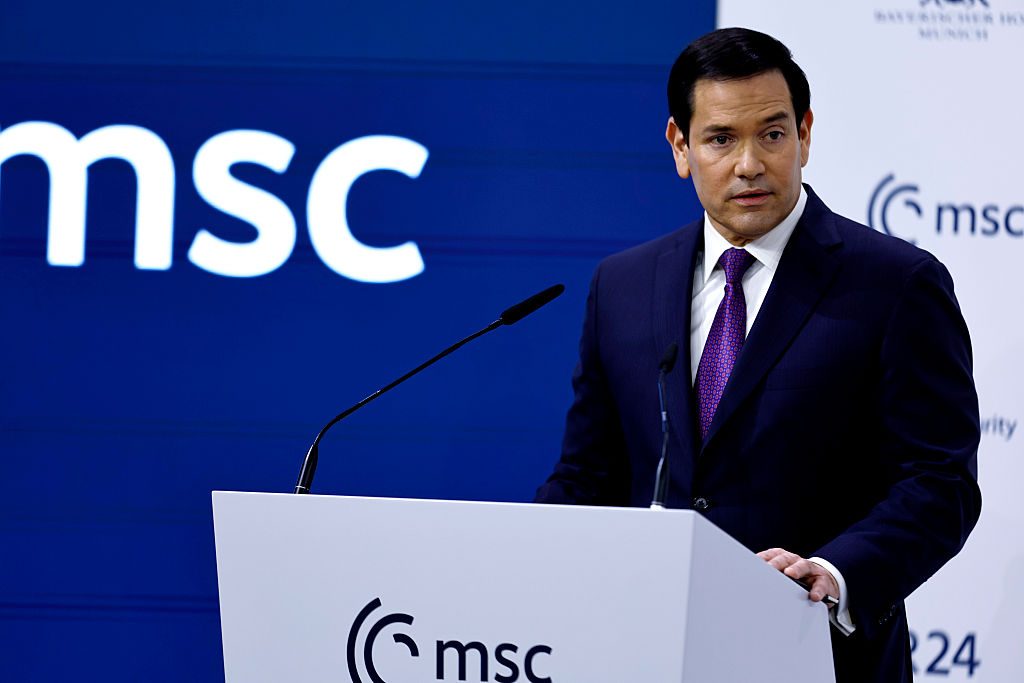
In his speech at the Munich Security Conference yesterday, US Secretary of State Marco Rubio did not waste time mourning the end of the so-called “rules-based order” which has governed international relations for decades. Instead, he celebrated it, branding that old order a foolish delusion and putting forward the Trump administration’s vision for what comes next: a future based on hard power, pursuit of national interests, and revitalised Western leadership.
European leaders should not be reassured by Rubio’s gentle tone or his repeated appeals to the deep historical and cultural ties linking the United States with their continent, however. His speech was intended not as a love letter, but as an ultimatum. According to Rubio, Europe faces a choice. It can either align itself with Washington’s agenda in building a “new Western Century”, or it can go it alone and find itself on the receiving end of continued US pressure. Whether Washington can make good on its threats is unclear, but the reality facing Europe should not be.
Rubio deserves credit for his honest and clear-eyed diagnosis of the mistakes made at the end of the Cold War, and his unsentimental acknowledgement that the old way of doing things no longer works. His speech departed from the consensus in important and productive ways, for instance, by discarding the democratic liberalism that has long been the foundation of the transatlantic relationship. He was right to call out the failure of institutions to address contemporary economic challenges and to fault Europe for leaving itself geopolitically vulnerable by outsourcing its security.
But the new world order Rubio called for looks remarkably like the one he criticised in at least one respect: it has a dominant America at its centre, ready to coerce allies and adversaries alike.
Rubio’s speech did not throw out everything from the past. He was genuine in his hope that, for all its flaws, the transatlantic relationship could be sustained and restored — this time not with a focus on shared values and security threats, but on common culture, history, language, and religion.
The foundation of the transatlantic bond is different in Rubio’s narrative, but its purpose and utility for the United States is not. Donald Trump’s Washington still seeks American preeminence, and still hopes that Europe will sign up to support this project — as it has for decades — by strengthening itself militarily and economically, and backing the administration’s vision of the “new Western Century”. But Rubio’s speech also contained an implicit threat. If Europe does not join this effort, America will go its own way, and the old continent will be left behind. Compliance, then, is the price of a continued transatlantic partnership.
Non-European leaders should be equally uncomfortable with Rubio’s speech. Decades of US primacy have been harmful for the world, due to America’s ready use of military power and exploitation of economic advantages. Yesterday’s speech promises more of the same, even if the rhetoric, rationales, and institutions enabling America’s pursuit of dominance change. Rubio’s vision is also a confrontational one, which pits a vaguely defined West against unnamed adversaries and rivals, not only in competition for resources and security but in an existential civilisational struggle as well.
There are two looming challenges facing the Trump administration as it works toward this desired future. First, because this imagined new order retains the core characteristics of the old one, with the United States at the centre and the collective West locked in conflict with its rivals, it is not clear that this system will be any better at addressing today’s challenges, preventing fresh wars, or correcting the mistakes of the past.
Second, Trump’s coercive approach to building this new order may not work in an increasingly multipolar world. States in Europe and elsewhere now have many options, including the ability to form new balancing coalitions against the US which protect their interests. At the same time, Washington’s power has declined in relative terms.
Rubio is right to proclaim the rules-based order dead, but by clinging to what remains of American hegemony, his vision for the future misses the mark. It risks leaving not Europe but the United States isolated and alone.
 jekavanagh
Join the discussion
Join like minded readers that support our journalism by becoming a paid subscriber
To join the discussion in the comments, become a paid subscriber.
Join like minded readers that support our journalism, read unlimited articles and enjoy other subscriber-only benefits.
Subscribe