




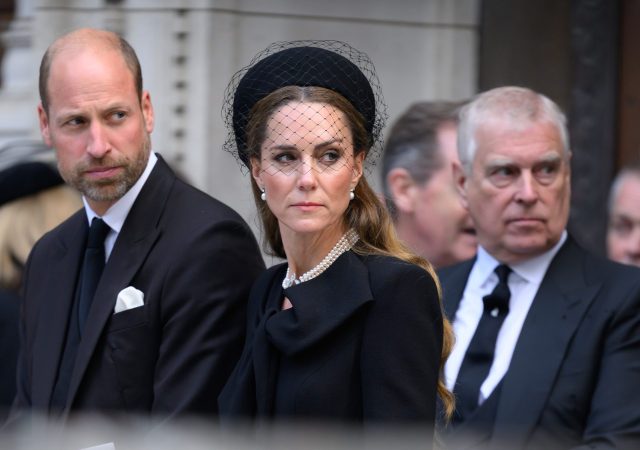
Heir and spare. (Karwai Tang/WireImage)




Can the monarchy survive Andrew? That may sound like a stupid question given everything else the monarchy has survived so far —including being abolished for 11 years in the 17th century. And it’s true that, disappointing as it may be for British republicans, the disgrace of Andrew’s friendship with Jeffrey Epstein has not yet damaged support for our royals.
In a YouGov poll from January — conducted before Andrew’s arrest on suspicion of misconduct in a public office, but after the revelations that led him to lose his titles — just over two thirds of Britons said they were in favour of the monarchy. That’s the same as in 2019, before Andrew’s calamitous Newsnight interview. However much opprobrium the ex-prince attracts personally (he has a net approval rating of minus 87), it seems he can’t drag the rest of his family down with him.
The House of Windsor is, if nothing else, resilient. Its history is a history of crises, every one of which it has weathered: Edward VIII’s abdication; Charles and Diana’s divorce; Diana’s death; the subsequent cataclysmic unpopularity; Harry and Meghan’s resignation in 2020. Every one of these was pitched as an existential challenge to the institution of the monarchy, and none of them ultimately was.
But Andrew could be different. That’s the sense you get, at any rate, reading Russell Myers’ new joint biography of the Prince and Princess of Wales, William and Catherine: The Intimate Inside Story. The book is, on the whole, spectacularly boring, perhaps because the Prince and Princess of Wales are too. The several paragraphs on the intricacies of Kate’s family’s party planning business, and the detailed breakdown of her nursery schedule, suggest that Myers had slim pickings from which to build his portraits.
That’s not, however, for a lack of sources. Myers (the royal editor of the Mirror) had access to dozens of people from William and Catherine’s inner circle, both named and anonymous. While this biography is unauthorised, it has also clearly been written with a “team Wales” slant. It would be too much to read William and Catherine as a manifesto for this heir to the throne’s future reign, but it’s certainly sympathetic to his and Catherine’s interests. Unpleasantness tends to get glossed over: the false “rural rivalry” rumour of William having an affair, which eventually made it into a Stephen Colbert monologue on US TV, is only alluded to opaquely as “hurtful and often dangerous speculation… untruths and fake news.”
Wherever William and Catherine risk coming off badly, Myers is keen to give their side of the story — particularly in the case of their disaster-strewn 2022 visit to the Caribbean. Throughout the tour, which took place during what we can now term as “peak woke”, the couple were beset with demands to apologise for slavery on behalf of both Britain and the Royal Family. A photo of the couple having an unscheduled encounter with a group of local children was described as “a white-saviour parody” (four years on, it looks touchingly organic and rather sweet).
In Myers’s telling, everything that went wrong happened because William and Catherine were imposed on with bad advice. But it was an experience with an important lesson: in his speech at the end of the trip, William broke with protocol to address some of the criticisms. This, writes Myers, was a sign that “William and Catherine would be approaching things very differently”.
Perhaps most significant, though, are the mentions seeded throughout of William’s antipathy towards Andrew. We learn that, after the Newsnight interview, William lobbied Queen Elizabeth and his father Charles to take immediate action. “He never much liked his uncle and wanted him out of the picture immediately before the rot further set in,” says a source. We discover, too, that William was an early adopter when it came to Andrew: “Long before he was embroiled in the scandal [involving Virginia Giuffre], he’d always thought his uncle was a bit of an ignoramus.”
The repudiation is so total that you might even feel sorry for Andrew, were it not for everything we suspect about his character and personality (Andrew denies any criminality). But there is a delicate balance here. Yes, the rest of the Royal Family has been insulated from association with Andrew’s misdeeds up to this point. The problem is that much of the family’s current popularity derives from that of Elizabeth II. Unfortunately for her posthumous reputation, Andrew was her favourite child, and she protected him for far longer than is defensible.
“The late Queen sought to protect her son from complete banishment, clinging to the hope that he would one day be exonerated,” writes Myers. “Similarly, while acknowledging that his brother could never return to public duties, Charles attempted to honour his mother’s wishes and for a long time stopped short of pushing for Andrew’s complete banishment.” Elizabeth reportedly contributed £7 million of the £12 million settlement Andrew paid to Virginia Giuffre, who alleged that Andrew had sex with her while she was trafficked by Epstein (Andrew denies this). Another £3 million was taken from the late Prince Philip’s estate, while a further £1.5 million came from unnamed other members of the family: the King recently issued a denial that any of it came from him. It looks, and is, grubby.
That leaves William in a difficult situation. Being Elizabeth’s beloved grandson is an asset, for so long as the public continues to think of her as a benign and morally impeccable woman who shepherded Britain through one century and into another. But if that perception switches — if Elizabeth begins to be seen as a grotesquely indulgent mother who used her privilege to ensure that Andrew’s accuser was paid off rather than heard in court — then the association turns into a liability for William.
Andrew’s conduct has the potential to deeply discredit the whole institution. While Myers refers to the allegations against him, rather prissily, as “a vulgar scandal”, they are more profound than that. The decision to appoint Andrew as a trade envoy (despite what was already known about his worrying associations) points to the alarming cost of habitual deference to the royals. Andrew was already nicknamed “Randy Andy” and the subject of headlines about him “chasing girls”. The government must have realised it was, at best, subsidising a libertine, even before we heard reports it was bilked for Andrew’s massages.
The parliamentary manoeuvres required to discuss all this in the House of Commons, where criticism of the Royal Family is generally forbidden, puts the lie to the idea of Parliament’s supremacy. The monarchy’s place in the British constitution is underwritten by its shows of deference to our elected leaders — hence the theatre of Black Rod having the door slammed in his or her face every year when asking for admission to the chamber on behalf of the monarch. If the public begins to see that as a fiction, the monarchy’s future looks perilous.
The case against Andrew, then, could easily become a case for the abolition of the monarchy altogether. Why, the public might begin to ask itself, should we foster a sub-class of the indolent and entitled — “spares” who are necessary as back-up for the succession, but who almost inevitably become redundant and curdle in their own uselessness. It’s all very well to point to the counter-example of the diligent, hardworking ones like Princess Anne, but there’s no way to stop potential Andrews from being born without tearing the whole institution down. As a secular age made it increasingly absurd for monarchy to rest on the idea of divine right, the royals have claimed authority from its popularity. This has a costly flipside for them: if they’re not likeable, or even actively disgusting, their existence becomes hard to defend.
This is why one of William’s most important jobs between now and his accession to the throne is to put as much distance as possible between himself and Andrew: not only to condemn Andrew’s actions (at a minimum, associating with a suspected sex offender), but to make it clear that William was always, always wise to Andrew’s turpitude. Monarchs have always had to be unsentimental about their own family to secure their own rule. Once, you might have had an embarrassing uncle locked in the Tower, and arranged for him to be beheaded (or discreetly strangled) when convenient. Now, the murder is figurative, but no less ruthless.
Myers’s version of William is fair-minded but implacable when the things he cares about are threatened: he is frequently described as “angry” when he perceives either that Catherine has been mistreated, or that someone within the family (usually his brother) has failed in their duties. That’s a trait that will be invaluable as he reshapes the monarchy to fit the sensibilities of a modern nation.
But his greatest weapon may well be Catherine. The descriptions of their relationship offered by Myers are often saccharine to the point of nausea (one source says they embody “love in its rawest, most powerful form”), but there is a hard-edged point to this. Their marriage serves in a way to reconcile the hopes of his bitterly divided parents. Charles and Diana understood themselves, and eventually each other, as victims of the royal machine: both sought to make their sons’ lives a little closer to “normal” than their own had been.
Catherine is portrayed here as the exemplar of that normality. Not a member of the aristocracy, but a regular middle-class girl he met at university. Not a trembling virgin many years his junior, but a peer and (emotionally, at least) an equal. Not a fairytale princess, but a young woman who takes her work seriously, whether that was her pre-engagement job at the fashion retailer Jigsaw, or her current job as a member of the royals. The snobbish jibes once aimed at Catherine and her family for being new-money social climbers, now look very misplaced.
Strangely, given Myers fetish elsewhere for chronicling every minute detail of his subjects’ lives, there no mention in this book of what I think of as Catherine’s most significant public action. In 2021, after the murder of Sarah Everard by police officer Wayne Couzens, Catherine attended the vigil in Everard’s honour. She did this not as part of a planned media op, but as a private individual, laying her own flowers.
Even as a longstanding royal cynic, I found it moving. Everard was not much younger than Catherine, living the kind of life Catherine herself might have lived under other circumstances; it also showed that she was one of “us”, even though she was now one of “them”. As a gesture, it was modest and compassionate, and the antithesis of everything Andrew has been accused of. More than anything, it articulated the kind of royal she might be. An ordinary princess — the true inheritor of Diana’s “people’s princess” tag.
Breaking the gilded cage that bred Andrew, or at least bending the bars, is good politics: it shows a rejection of the kind of irresponsible privilege that made his misdeeds possible. It also might be a little more humane for the individuals in the cage. No monarchist should feel comfortable defending an institution that has such apparent power to corrode a man’s morals. Our Royal Family will only be able to retain its special status if, paradoxically, it can assure its subjects that it is (in some ways) just like us. But when it is just like us, will we still remember what it is for?

Join the discussion
Join like minded readers that support our journalism by becoming a paid subscriber
To join the discussion in the comments, become a paid subscriber.
Join like minded readers that support our journalism, read unlimited articles and enjoy other subscriber-only benefits.
Subscribe