




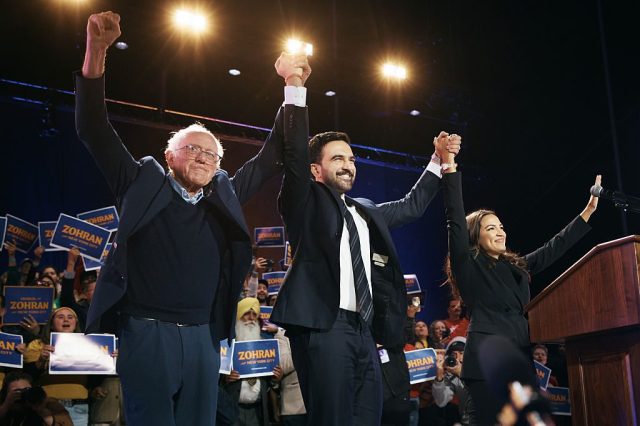
What can they learn from the Eighties? (Andres Kudacki/Getty)




Realignment. It’s the one political truth Americans have always agreed on. True in 1896 and 1932, and the Reaganite upheaval of the Eighties, each constitutes the successful search for a new democratic majority. One political party assembles a durable cross-class coalition that secures it in power, enabling it to shift the policy debate. The result, writes historian Gary Gerstle, is “a constellation” — of ideologies, policies, constituencies, that together shape American politics well beyond the next election cycle.
For many commentators, November 2024 was another such moment, with Donald Trump forging a working-class GOP coalition that would similarly “realign” US politics for decades to come. No longer. From Greenland to ICE, Trump’s popularity is shaky, while the Democrats’ robust electoral performance last year vividly illustrates the flimsiness of the President’s 2024 victory. Yet if Democrats are to exploit these sanguine conditions in this year’s midterms, then craft a durable majority, they must unite round an ambitious policy agenda responsive to voters’ discontent. And to do all that, they need realignment — and could do worse than learn from their party’s response to Reagan’s own revolution.
What is the conventional wisdom about Democrats’ reconstruction in the Eighties? Broadly: national and state-level Democrats engineered a Rightward ideological shift, led by the so-called Democratic Leadership Council (DLC). Centrists and moderates laud the DLC as a model for present-day reform; the Left castigates it as party elites’ forcing-house for liberalism’s betrayal. But admirers and critics alike seem to agree on the history’s basic narrative: ideologically motivated party reformers reacted to economic turmoil and the Reagan revolution by pulling the Democrats to the right.
Unfortunately, this narrative is a stark simplification of how Democratic leaders pursued renewal through the Eighties and Nineties. The most reform-minded Democrats were a diffuse group who spanned elected officials like Gary Hart and Bill Clinton; business figures like Felix Rohatyn; policy entrepreneurs like Robert Reich (years before his rebrand as a sort of Diet Thomas Piketty); and economists such as Lester Thurow. Never a unitary ideological movement, such figures cycled through voguish labels like “Atari Democrats” or — fatefully — “neoliberals”.
Let’s call them, collectively, “New Liberals”. They existed in a Venn diagram of networks, party factions, and policy institutions that overlapped across a diagnosis of Democrats’ problem: the rise of Reagan’s free-market Right was a symptom, not cause, of a structural crisis of liberalism. This structural crisis was the declining “competitiveness” of America’s regionally dispersed productive economy, especially in relation to Japan’s high-tech “economic miracle.” Though US manufacturing generally rebounded during the Clinton presidency, as Japan sank into its “Lost Decades”, manufacturing employment, and the productive economy’s regional dispersal, never durably recovered from the shock of the Eighties. This is crucial for understanding both the resonance of Trump’s 2016 calls to “restore” American industry, and the oft-frustrated efforts of “Rustbelt” Democrats to supply their own flavour of this potent rhetoric.
The DLC came into being in 1985, several years after reformers created a new economic agenda. New Liberals’ real animating spirit was a vision of long-term growth centered on high-tech production and channelled into industrial policy. Popular memories of Reagan’s “morning in America” obscure Democrats’ success in 1981-3. After all, Democrats across the country turned industrial decay and the White House’s proposed cuts to Social Security against the GOP, leading to their decisive victory in the 1982 midterms and Reagan’s retreat from the more radical imaginings of free-market revolutionaries. Today’s GOP bears — at least for now — the political costs of DOGE-inflicted job cuts, economic turmoil, and last year’s shutdown. This dynamic echoes that of the Eighties. In the words of the biographer of House Speaker Thomas P. “Tip” O’Neill, Democrats back then forced Republicans to “take ownership” of the hardships stemming from Reaganite policies.
Two key points stand out. First, though the Eighties Democrats ultimately established a united front, the party was every bit as riven by factional discord as it is today. Just as the Democratic Party of 2026 is a fissiparous political family — spanning from the Ocasio-Cortez Left via moderate “Third Wayers” to the the much-winnowed-down Blue Dogs — Tip O’Neill had to finesse Right-leaning Democratic dissidents in his own day. In fact, O’Neill had far more Right-leaning Democrats to manage than do today’s Congressional leaders. All the same, Democrats back then ultimately coalesced around a response to Reagan. This leads to the second key point. Democrats had to establish a sense of what they were for as well as what they were against. Here, New Liberals, to whom O’Neill granted considerable autonomy to devise a new economic programme, came to the fore. Congressional New Liberals spearheaded the creation of an ambitious industrial policy agenda that brought together disparate party factions, business backers in high-tech and “traditional” industries, and organised labour.
This approach was profoundly different from a Rightward ideological shift. New Liberals recognised their party needed to change: not by mimicking its ascendant opposition, but instead by crafting a distinctly Democratic response to the economic malaise and changing demographic dynamics of which GOP wins were themselves symptomatic. Understood this way, Reagan’s landslide 1984 reelection — which would be analogous to a new GOP leader consolidating the MAGA coalition in 2028 — was not inevitable. It happened, rather, because of Democrats’ failure to sustain momentum. Walter Mondale, the Democrats’ 1984 nominee, navigated a middle path between party factions rather than determining a policy agenda that could unify them all. And Mondale’s astringent campaign rhetoric prioritised deficit reduction over a long-term vision for broad-based growth.
Party reformers learned from the 1984 fiasco — to an extent. Over the course of Democrats’ subsequent sojourn in the Reagan-era wilderness, New Liberals developed a political strategy that combined their policy vision for growth with soft economic populism and cultural moderation. These three terms equated to electoral renewal. In 1992, Clinton won the White House by campaigning on the latter two themes. But advocates of the New Liberal growth agenda furnished the intellectual undergirding of Clinton’s campaign.
Democrats’ return to power in the Nineties proved a lost opportunity. For a variety of reasons spanning internal policy debates, the global economic sea-change brought about by the Cold War’s end, and political missteps, the Clinton administration failed to realise New Liberals’ formative growth vision. But this does not change the fact that contemporary Democrats can learn from the intellectual and political renewal of the Reagan era.
After all the populist Right’s triumphalism in the winter of 2024-5, the reality of Trump 2.0 gives Democrats an opening. Some on the New Right, like American Compass’s Oren Cass, claim the GOP can pursue reindustrialisation and consolidate a working-class MAGA majority.
Yet if reindustrialisation is the goal, then why take a chainsaw to long-term investments in productive tech and green energy? This is economic policy as vibes and cultural resentment. The outlook becomes bleaker still when one considers Trump’s marquee domestic-spending legislation in his first year: the One Big Beautiful Bill. This served up a witches’ brew of vicious spending cuts (often targeting the president’s own base) and plutocrat-friendly fiscal policy, leavened with a kind of ersatz populism like the “no tax on tips” provision.
Many Democratic leaders seem to sense the broad contours of an effective response: turn Trump 2.0’s false promises against him and embrace an agenda of affordability and growth, flavoured with moderately populist rhetoric. Compelling figures spanning the Democratic spectrum — from Zohran Mamdani to Washington congresswoman Marie Gluesenkamp Perez — speak eloquently about bread-and-butter concerns. This is essential. But it must be paired with a longer-term vision for growth. To repurpose political scientist Steven Teles’s formulation, think of the former as election strategy and the latter as reelection strategy.
Why did New Liberals stumble in the Nineties over delivering their bold economic ideas? More recently, why did Joe Biden’s “market-crafting” fall short, both politically and substantively? Partly, the answer involves communication and messaging. In both instances, the growth vision itself remained an elite preoccupation rather than a mass political project. Industrial policy-style initiatives underpinned midcentury Democratic hegemony because they were so “visible”. Think, for instance, of rural electrification. All the same, communications missteps are not the whole story. Key to more successful Democratic renewal will be implementation. It is here that some version of the emerging “abundance agenda” offers genuine cause for hope.
At its heart, abundance is about delivery: make government effective again, move fast and build stuff. A “procedure fetish”, arising from dispensations like public-interest law and environmental preservation, ensnared local arenas of liberalism from the Seventies onwards. More seriously, after the New Liberals’ lost opportunity, Democrats emphasised meliorative social policies over the fostering of broad-based, regionally dispersed growth. The result, since the turn of the 21st century, was a liberalism of “compensating the losers”; 2016 showed where that led.
These political pathologies need to change. Today’s Democrats should be laser-focused on building: economic development projects, housing, public infrastructure. Ironically, and given the history sketched out above, such an approach would fulfil what New Liberals in the Reagan era originally envisioned.
False prophets on the populist Right proclaim a new working-class majority. But 18 months into Trump 2.0, MAGA has stifled growth, eviscerated the social safety net, undermined American innovation, and speeded-up the transition to a “Chinese Century.” In 2026, beleaguered Democrats can’t afford to miss the opening this provides. The party will be revived when it convinces voters that it has a vision of, and a blueprint for delivering, long-term growth. Yet the Democrats’ greatest challenge here is not even the formidable task of unifying around a message. Rather, it’s thinking through a long-term growth model in the context of a still-uncertain AI revolution. The spectre of machine learning means that, even if Democrats successfully focus on rebuilding America’s productive economy, policymakers can’t simply upgrade the postwar political economy as the original New Liberals once hoped.
Additionally, pure techno-optimism will do little but reheat the political failure of “compensating the losers”. A hands-off approach would likely exacerbate the decoupling between productivity and workers’ wages that Americans have suffered since the Seventies. Since Democrats still need to unify politically around growth, the contours of the practical model are far from clear. At minimum, though, it must pair sensible regulation of AI with the targeted procedural deregulation for building suggested above. This is only the first step towards recoupling technological and productivity gains with wages, and remains a daunting task. Yet such a comprehensive realignment could be Democrats’ only hope.
Join the discussion
Join like minded readers that support our journalism by becoming a paid subscriber
To join the discussion in the comments, become a paid subscriber.
Join like minded readers that support our journalism, read unlimited articles and enjoy other subscriber-only benefits.
Subscribe