




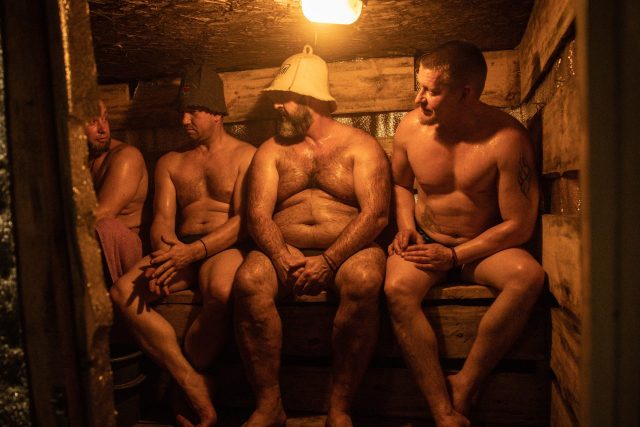
The smell of eucalyptus and encanaillement. (Chris McGrath/Getty)




Enshittification and gentrification should, in principle, describe different processes; though, in practice, they have become almost perfectly synonymous. I was reminded of this recently while stewing in a schmancy sauna in self-consciously hip Hoxton, surrounded by Gen Zs, chronologically adjacent to my own millennial cohort, yet, culturally speaking, a colossal distance from it.
The heat was gentle — “therapeutic”, as the twentysomethings would have it — yet the prevailing mood was one of intense concentration. Around me, bodies glistened with purpose. A girl on the top bench scrolled through her phone with the solemn attentiveness of a monk of Iona illuminating a manuscript; opposite her, a boy communed restlessly with his smartwatch, as though the experience might not quite count if it were not measured. Nobody spoke. Nobody even cleared a throat. This was not the companionable hush of a library but the disciplinary silence of a wellness rite — the sort imposed by shared belief rather than mutual ease. We were not sweating together so much as performing parallel acts of self-surveillance, each of us sealed inside our own small regime of improvement.
The contrast with the New Docklands Steam Baths — my salt-of-the-earth haunt in Star Lane — is instructive. This is the real thing: a place of noise and noisome sweat, set up in the late Seventies at the urging of East London’s Eastern European immigrants and still patronised largely by Slavic construction workers and Caribbean Tube drivers. The heat is more ferocious, the décor stubbornly down-at-heel, the badinage unavoidable, and one may encounter rather more pubic hair than one bargained for. Men and women argue about the footie, marital failure and mésalliances, about whether the country has finally gone to the dogs, while actual dogs, and occasionally a curious goat, wander through the premises.
When I first started frequenting New Docklands, newly down in London during plague times, lockdown scepticism was cheerily aired at full volume between plunges, an antidote to the antiseptic misanthropy of social distancing. Nobody had much time for such quaint notions as wellness, let alone healing. You go to sweat, chat, and kill time. No one checks their phone. Nor does anyone monitor their heart-rate variability. You emerge not calmer, exactly, but looser, altogether less sealed off from the world. Heat here functions as a social solvent, making the banya one of the few remaining heterotopias where people still mix across class lines — rather than merely endure one another in sullen solidarity as on the Tube. Hierarchies melt and you are reminded — bracingly — that other people, annoying and indispensable, continue to exist.
Saunas were once part of the city’s unpretentious social plumbing: humble, functional spaces attached not to aspiration but to routine. They belonged to the working week and the working body. In Turkish baths, Jewish shvitzes, and Russian banyas from Brick Lane to Bayswater, people went not to transcend the self but to mislay it for an hour or two. Like booze, the heat loosened tongues and muscles alike. Sweat was a leveller. Everyone shuffled home smelling roughly the same. You did not attend in pursuit of improvement. You went because it was Tuesday.
This instinct, of course, is ancient vintage. We’ve been steaming ourselves into sociability for millennia now. Archaeologists have unearthed what look suspiciously like prehistoric sweat lodges on Orkney and near Stonehenge, complete with pits and hearths, suggesting that even the Bronze Age ancestors of wellness influencers understood that warmth and water made life more tolerable. When the Romans arrived, they merely formalised what they found: grand thermae built atop sacred springs, where sweating and bantering were civic obligations. The laconicum — their dry hot room — was not so much a private spa as a public utility.
Victorian Britain, for all its repressed skin and buttoned-up anxieties, revived the tradition, after a fashion. Turkish baths spread through industrial cities as municipal institutions rather than upscale indulgences: places where labourers and lords alike might boil, plunge and scrub themselves into a condition fit for public life. Later arrivals brought their own versions. Shtetl Jews established vapour baths in the East End — steamy sanctuaries where health and identity were maintained in tandem. In the mid-20th century, Finnish expatriates quietly introduced their own severe, wood-fired gospel of heat, first as cultural diplomacy, later as community infrastructure.
The sauna survived sanitary ascendancy, English pudeur, and the popularisation of the private bathroom in great measure because it answered a need in a cold, inhibited society. Then, without ceremony, the wellness industry arrived and performed its usual act of cultural alchemy. The sauna was tarted up, priced up, branded, and, most decisively, quietened. What had once been a collective habit was reframed as a private project; what had functioned as a communal lubricant was rebottled as a protocol. Somewhere between the stratospheric rise of kombucha and rents, London decided to embrace the sauna as its latest bourgeois sacrament. Sweating ceased to be something that happened between people and became instead another exercise in managed selfhood.
Thus hot-cold therapy became — in the language of a lifestyle zine — “Shoreditch Saturday… part endurance test, part Instagram opportunity”, catering to the new tribe that has seized control of Hackney, Peckham, and cognate neighbourhoods. You have seen them: pale of limb, bold of tote bag, trudging from their warehouse conversions towards some waterside industrial estate clutching a robe made from a fabric called something like ScandiCloud™. Their destination is one of the proliferating “Nordic-inspired” thermal ecosystems, usually constructed from reclaimed Lithuanian barn wood and smelling faintly of eucalyptus and encanaillement.
Inside, conversation, when it breaks out at all, tends to concern the benefits of infrared therapy or how capitalism has “co-opted wellness” — a bravely expressed sentiment from someone who has just shelled out £85 for a session of as many minutes. The rules of bourgeoisified sauna culture are stringent, if unwritten. You must book some 52 weeks in advance. You must take a cold-plunge snap while discoursing earnestly on how sweating is, in fact, self-care. You must vibe to the playlist, titled something along the lines of “Heatwave Reverie (soft techno remix)”. And you must allude vaguely to Nordic ancestry, performing a delicate tight-rope act while steering well clear of such alarming notions as craniometry.
All of this, admittedly, is less oppressive than it sounds. Sneer at the £12 cans of rehydrating birch sap and the ritualised pouring of essential oils that smell faintly like Gwyneth Paltrow’s understudy all you like; the fact remains that, against all reason, it is rather pleasant.
Yet this life-affirming exercise in tasteful self-regard still misses the point: the social function of the sauna. Happily, however, there are holdouts where the sauna is less an arena for performative middle-class self-improvement and more the communal, unpretentious, inexpensive cultural practice of old. In these rough and ready enclaves, the sauna performs the work the pub once did, fostering that unfashionably un-English state of disinhibition — not by means of alcohol, but through the deprivation of clothes and the surrender of dignity. You talk because it would be peculiar not to. You listen because there is nowhere else to look. Conversation ranges widely and indiscriminately: you may find yourself discussing municipal planning, commiserating over someone’s dead grandmother, or picking up a date in a manner pleasingly pre-Tinder — all before your circulation gives out.
In a city where traditional “third places” — the sociologist Ray Oldenburg’s 1989 coinage for bars and barber’s shops, cafés and churches — are thinning on the ground, the tradition of the communal sauna remains strong. Writing at the tail end of the 20th century, Oldenburg worried that modern life was collapsing into a binary: first place, the home; second place, the workplace. What was disappearing, he argued, was the informal territory in between where people encountered one another without appointment or agenda. The signal virtue of the third place was that it asked little of one’s purse and nothing of one’s pedigree. Conversation was the main activity. Regulars set the tone. Status was checked at the door, not by policy but by custom. Above all, they were places where civic trust accumulated incrementally, like limescale.
London once excelled at such spaces. The corner pub before it became a gastropub with Edison bulbs; the Turkish baths at Porchester; the greasy spoon in Clerkenwell where cabbies and solicitors alike might share Formica and food; the Irish parish hall hosting bingo and wakes; the Hackney caff where builders and novelists queued for the same bacon roll. Even the old municipal libraries, with their faint fug of carpet and concentration, functioned as third places in their way. None of these promised transcendence. Their draw, instead, was proximity. The slow attrition of such venues is well documented. Pubs close weekly. Churches hollow out. High streets become corridors of identical coffee chains in which one may gloomily sit but not quite belong.
This is where the communal sauna, improbably, re-enters the story. It meets Oldenburg’s criteria with surprising fidelity. It is neutral ground: nobody hosts, nobody performs. It is relatively inexpensive and, crucially, recurrent. You return, you recognise faces, you become a regular. Conversation is both inevitable and unforced. The heat levels distinctions more efficiently than any HR policy. None of this is utopian. Third places have always harboured tedium, argument and the occasional bore. But they perform a civic function that no co-working space quite replicates. At their best, they are convivial without being contrived, social without being therapeutic. Nobody promises transformation. Nobody tracks your progress. You emerge flushed, vaguely euphoric, and on first-name terms with people you did not know an hour earlier. In an age of curated loneliness, this is no small thing.
Pratinav Anil is the author of two bleak assessments of 20th-century Indian history. He teaches at St Edmund Hall, Oxford.
 pratinavanil
Join the discussion
Join like minded readers that support our journalism by becoming a paid subscriber
To join the discussion in the comments, become a paid subscriber.
Join like minded readers that support our journalism, read unlimited articles and enjoy other subscriber-only benefits.
Subscribe