




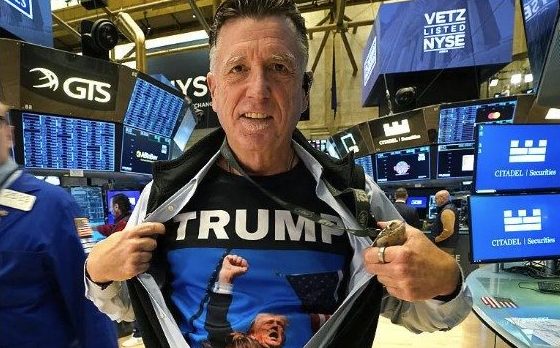
‘The financial sector grew to envelop the world economy’. (Timothy A. Clary/AFP)




President Trump, who has so far acted with impunity, humiliating his political allies abroad and brushing aside domestic opposition, might have just found his match in Fed Chair Jerome Powell. On 11 January, the President’s months-long conflict with the unrelenting lawyer-turned-central banker reached boiling point. US federal prosecutors officially opened an investigation into Powell over costs of the Fed’s renovation projects, only for the Chair to shoot back in a rare video statement, describing the charges as political “pretexts”.
While markets appeared to shrug off Sunday’s events quickly, a surprising number of people came out in support of Powell. Central bankers across the world rallied behind the Fed Chair, but even fervent critics of the notion of central bank independence, an ideological cornerstone of neoliberalism, made their case. “I’m seeing actual communists on my timeline backing this,” one Harvard student commented, “this might be the most unified the online left-of-center has ever been.”
Such a reaction is at odds with the widespread populist anxieties about technocratic overreach that marked the 2010s, when independent central banks, already far outside the purview of democratic control, were gradually expanding their originally narrow remits into highly political territory without further accountability or oversight. But now the renewed tension between Trump and the Fed has rekindled debates about the unelected power of monetary policy makers in democratic societies. In this context, it is worth recalling how central bank power evolved — and that formal “independence” may not be that important.
Half a century ago, central banks had a relatively limited role: they supported government policies and acted as a “lenders-of-last-resort” to banks. This changed drastically at the dawn of the neoliberal era in the late Seventies, when high inflation prompted a sea change in monetary policy. The subsequent decades saw the financial sector grow to envelop the world economy, greatly expanding the scope of central bank responsibilities and the importance of targeting inflation (a euphemism for preserving the value of financial assets). Full “operational independence” is a product of the Nineties, but even then central banks required cooperation from their respective states. And in the relative stability in the world before the financial crisis, this arrangement suited both.
After 2008, two things happened that spelled the end of this compromise. Firstly, governments reneged on their end of the bargain and ceased cooperation by conducting long grinding austerity regimes, putting the onus of stimulating the economy on central bankers. Secondly, and most importantly, large parts of the financial sector not only grew and consolidated but became dependent on low interest rates and regular liquidity injections through central bank asset purchasing programmes such as quantitative easing (QE). As a result, the central banks became “lonely stewards” of the economy: using elaborate means to fend off deflation while incurring blame for stagnant growth, increasingly forced to overstep their mandates while provoking political backlash for doing so.
Populist critiques of neoliberal technocracy flourished in the post-2008 era. But when it comes to central bank policies, most of the objections have been rather baseless. Across the new Right — from the AfD to Curtis Yarvin — there is a stubborn notion that central banks have debased currencies and created inflation, with some vague gestures towards the money supply and low interest rates. Some of these critiques are hard to take seriously, given how the same MAGA types stand firmly behind Trump as he hectors Powell to lower rates. The view on the populist Left, perhaps most competently expounded by Yanis Varoufakis, is that independence is a pretence and somehow both “an antidemocratic travesty”, placing political decisions beyond democratic accountability, and at the same time “entirely at the mercy” of governments wishing to impose deflationary policies.
Not only was inflation persistently low throughout the 2010s (frustratingly, given inflation would have rendered the repayment of large stocks of public debt cheaper in real terms), but QE and other unconventional monetary policies, almost certainly didn’t inflate asset prices, even if they kept them from falling. The impact of these policies on bank lending and investment ultimately proved negligible. And while it is undeniable that low interest rates produced redistributive effects favouring the wealthy, in lieu of sufficient government stimulus programmes, this was the price of preventing a new financial crisis and of the persistent decline in unemployment rates all the way to the pandemic. What is more, the “normalised” interest rates after the 2021-2023 inflation surge have hardly put a stop to runaway asset prices and epic financial grift.
What really happened during these years has little to do with the autonomy of central bank technocrats. In fact it was a grand failure of fiscal policy and permanently depressed investment, exacerbated by steady worsening of inequality and affordability crises on the back of asset price growth. The attendant economic stagnation bred the economic populist backlash that made the confrontation between elected leaders and technocrats inevitable.
This political dynamic seems to have led us to overstate the relevance of formal independence. If the last decades have shown anything it is that independence has always been a convenient political construct, not a subordination of sovereign decision-making. What matters is everything around it: accountability, transparency, operational quality (staff and research), coordination with the fiscal authorities, etc. It is tempting to think of central banks as the guardians of a room which contains the levers of the economy which can be yanked by politicians in the service of short-term electoral gain. There is, however, no strong established relationship between a central bank’s formal status and the soundness of its monetary policy choices, nor, as it happens, between monetary policy and inflation outcomes in general. Jerome Powell himself has conceded that over the last decades the Fed’s monetary policy was too restrictive on balance.
The developmental miracles in East Asia provide another example of why independence is not the key variable. During their main growth periods, Japan, Korea, Taiwan and of course China all completely subjugated their central banks — while experiencing modest inflation and historically unprecedented and lasting growth. In all cases, it was domestic banks and the mobility of inbound capital that were strongly curtailed. It turns out that what mattered was boxing in finance. Those who departed from this arrangement, such as Japan in the Eighties, collapsed into financial turmoil. And the reason why Japan has maintained some of the highest living standards in the world is largely due to the innovative and now fully independent Bank of Japan supporting the government’s fiscal policy.
When it comes to autonomy from political influence, then, thinking about central banks may not be fundamentally different from thinking about other government agencies. The incompetence of a central bank no more invalidates the concept of statutory independence (with appropriate oversight) than the repeated fiscal policy failures of elected governments invalidate the concept of electoral democracy.
What matters is not independence but power. We tend to think about power in the context of competing strength. But the relationship between central banks, states and financial markets has shown that, in a crisis, strength can derive from weakness and vice versa. As political economist Cornelia Woll has argued, the apparent “weakness” of financial markets and states (their dependency on central banks) is their strength in that it allows them to force the central bankers’ hands.
Discussion of Powell’s clash with Trump misses the mark in another way too: the Federal Reserve is not just any central bank. To call it such is like calling Citizen Kane a film about a newspaper owner. As the sole issuer of dollar reserves, the Fed sits at the apex of a global economy in which the dollar is the main currency for trade invoicing and funding. Almost everyone transacts and borrows in a currency they neither earn nor issue. In times of crisis, they fully depend on dollar liquidity extended by the Fed to their respective central banks. During the financial upheavals of 2008, and particularly 2020, the so-called “dollar swap lines” were part of how the Fed averted total disaster.
This status quo greatly augments the power of the Fed, and, with it, the geopolitical leverage of the American government. This very much implies that Trump’s desire to replace Powell could be about more than accommodating the effects of his domestic policies. As economist Mona Ali has pointed out, the stakes of the Powell–Trump clash may be less about domestic rule-of-law versus presidential mobsterism than it is about executive control over the levers of global financial hegemony. Of course, it could be argued that US financial coercion isn’t what it used to be; the relatively ineffective sanctions regime directed against Russia over the last years showed as much. Then again, the beneficiaries of the standing and unlimited dollar credit lines from the Fed are America’s partners in Europe and Asia-Pacific, as well as Canada, Mexico and Brazil. Thus, there is a direct link between Trump’s desire to take over the Fed and his tendency to browbeat and coerce US allies, a tendency growing more pronounced in light of China’s apparent victory in the trade war.
American financial power, though, depends on a constant need for dollar assets: not just by the global monied elite but also by banks, firms and other entities that have dollar liabilities. The most obvious way to get dollar liquidity when you need it is to sell off your dollar assets: stocks, bonds, etc. Such runs on the dollar have become more frequent in Trump’s second term, as we saw after his Liberation Day in April (when he first announced his tariff system) and, a month later, after the US credit rating was downgraded. Over the last year, the United States has looked less like a hegemon and more like an emerging market, facing persistent capital flight and a dollar that is losing ground to virtually all major currencies. The primary purpose of the Fed’s swap lines is not charity but to de-risk the US financial system by preventing exactly such sell-offs of dollar assets and the spill over of financial risk from abroad.
The irony is that Trump risks undermining the very power he seeks. Perhaps because he misidentifies its source. Anyone who professes to care about unelected power, should be struck not just by the Fed’s untenable influence over the fate of billions, but by the fact that it is itself ultimately shaped by its deep structural dependence on the global financial system. In a pinch, the interests of banks win out over those of the public.
In view of all this, fears over central bank independence and technocratic overreach seem awfully misplaced. If discretionary economic policy-making is central to how we think of democracy and national sovereignty, then what raises concern is the aggrandisement of unaccountable power by an authoritarian executive and by international finance. These should be the focus of populist ire. Everything else is a distraction.

Join the discussion
Join like minded readers that support our journalism by becoming a paid subscriber
To join the discussion in the comments, become a paid subscriber.
Join like minded readers that support our journalism, read unlimited articles and enjoy other subscriber-only benefits.
Subscribe