




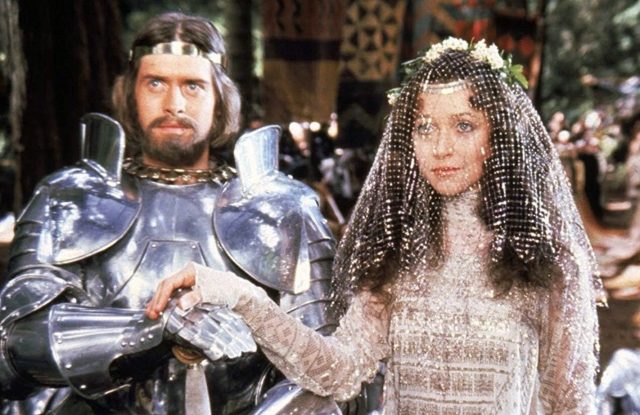
'Light gleams from his heroes’ burnished Gothic armor, beaten from polished aluminum for added brilliance'.('Excalibur'/IMDB)





Imagine, if such a scenario is not too outlandish, a broken and unhappy Britain, where poor governance has spread across the land like a noxious blight. Since the dawn of modernity, the scholar of nationalism John Hutchinson remarks, at such moments of “extraordinary crisis”, across the Western world artistic “counter communities became the launch pads of revolutionary action, generating myths that legitimized the hegemony of new governing elites and nation-state structures”. Nationalism was born after Western man lost his simple peasant faith in crown and altar: it has defeated every ideological challenger since, whether fascist imperialism, communism or now, it seems, liberalism itself. Yet that nationalism’s appeal is dependent on myths is not, as many liberal or communist debunkers appear to assume, its weakness: it will not die, like one of J.M. Barrie’s fairies, when a Verso editor declares his unbelief.
Instead, as Hutchinson declares, it is precisely in mythmaking that nationalism draws its power, as disaffected intellectuals, and particularly artists, find themselves “generating at times of crises novel myths based on romantic acts of sacrifice by heroic elites that legitimize new national projects”.
Such was the director John Boorman’s explicit task with his 1981 epic Excalibur. It is “The Dark Ages”, the title sequence flashes portentously over Wagner, when “The Land Was Divided And Without A King”. As academics have noted, Boorman’s masterwork was released “shortly after Britain’s winter of discontent”, and “can be seen as a reaction to the economic and political crises of the 1970s, meditating on a Britain in decay, presided over by the female Prime Minister, Margaret Thatcher”. Yet if Excalibur is a critique of Thatcher’s Britain, it is not obviously one made from the political Left. The film’s driving fixation with will, heroic destiny, and the mystical unity of land and leader is strikingly transgressive to postwar liberalism. “I believe that the popular, lasting stories are really about great deep psychic events in human history that have bitten themselves into the racial memory and which we remember in our unconscious,” Boorman would later write. “The retelling of these stories is like the rediscovery of them — it ‘catharizes’ and then gives solace.”
In Boorman’s intention to reattach Britain to its mythical roots, and so restore the nation’s mystic and psychic unity — the director is a convinced Jungian — Excalibur is overtly a work of cultural nationalism. Indeed, it is arguably the most deeply British, or at least consciously British film ever made: even more so for the fact that the names “Britain” or “England” are never once uttered. The ultimate, sacred source of yearning and duty is always “the Land”, tapping into and devoting itself to something far older than the modern British state, now palpably withering around us.
Excalibur’s immediate genesis was in Boorman’s failed attempt to adapt The Lord of the Rings, whose “great brew of Norse, Celtic and Arthurian myth”, the director declared, was “the Unterwelt of my own mind”. Yet unlike Tolkien, who viewed Ireland “as a country naturally evil”, haunted by a deep and ancient malignance emanating from its very bogs, trees and mountains, and only “held in check by the great devotion of the southern Irish to their religion”, Boorman found in the dramatic mountain landscape that had become his home a source of great and regenerative artistic power. “The valley in the Wicklow hills where my house sits is as close to Middle Earth as you can get in this depleted world,” Boorman would write, “The soft, feminine folds of the hills, the bleak bogs, the ancient oak woods, the black lakes, the urgent streams somehow corresponded to an inner landscape… It felt like a setting for the Arthurian legend.”
And, indeed, the Arthurian epic Boorman would create is dependent, for its visual appeal, on the Irish landscape surrounding his home: “with a few exceptions, all the scenes in Excalibur were shot within a couple of miles of my house.” In Ireland, the director had found an aesthetic hyper-Britain where the hills were steeper, the forests gloomy and primeval wildwood, and, most importantly, water was ever-present. Excalibur is surely the dampest film ever made on land: battles are fought in ice-cold moats, knights clash in front of plunging waterfalls and babbling streams or, drowning, find psychic truths in the weedy beds of lakes. His characters crawl and die in mud, their glittering armor sinking into the land itself. The woods themselves, wet with dew or shrouded in lake-mist, their moss and lichen-covered trunks and boulders lit a lurid green to heighten the raw, natural power emanating from them, are palpably rank with leaf-mold and mildew: it is the only film ever to capture the uncanny magic of our native Atlantic rainforests.
Even the air, and light itself, is heavy with water, for “the Irish climate is heartbreaking to a filmmaker — unpredictable, constantly changing, but mostly raining”. It rained steadily for almost every day of the five-month production, Boorman said later, with the rare bursts of sunlight breaking through capturing a luminosity more intense for its doomed struggle against the Irish rain. Yet unlike Kubrick, Boorman would later praise the “wonderful light in Ireland, because it’s moist, because there’s so much moisture in the air even when it’s not raining that you get this refraction, this light, so you get a kind of softness”. That, he suggested, lent the film a hazy dreamlike radiance that “felt like a myth rather than reality.” In just this way, Boorman’s understanding of his native England was refracted through Ireland’s clarifying light.
Even still, only England could have made him. In Boorman’s personal mythology, both woods and water are central, fitting for the director of both the riparian horror of Deliverance and the pre-lapsarian fantasia of The Emerald Forest. Growing up in wartime London — his film memoir of the time, Hope and Glory, opens with the future director playing with a toy knight and wizard in the suburban rockery that served as mountain forest to the child’s imagination — Boorman was formed, he tells it, in a once-enchanted land that had only just lost its magic. As he writes in his autobiography, Suburban Boy, the “Tudor gables, leaded panes, bow windows” of suburbia — “eclectic fragments from pre-Industrial Revolution England” — masked the hard truth that “This was a new land and the England of old was gone for ever. Oh, what the English inflicted on the English: misery, deprivation and bondage on a scale quite equal to that visited upon their colonial vassals.”
Mocking the attachment of his father, George, to the Union Jack-and-Royal Family patriotism of the Westminster state, the young Boorman nevertheless remarks with wonder that, in his youth as a soldier in the Great War, like a warrior saint, the “young George, who lived to see a man walking on the moon, rode into battle against the Turks with a drawn sword on an Arab mare”. Though of London’s low church lower-middle class, Boorman’s parents would send him, for unromantic and practical reasons, to a cost-effective Catholic private school that was “my first contact with Irishness in all its glory and grim horror”, so seizing his imagination that “Ireland was to have an insidious influence on my life and work, drawing me and keeping me there for thirty years almost against my will”.
“During my Catholic schoolboy experience,” Boorman observes in his second memoir, Conclusions, “I used to study the holy water in those little enameled troughs that hung on the wall of the chapel. You dipped your finger in and crossed yourself. Here was a magical mystery: a priest could pray over ordinary water and invest it with spiritual power.” For Boorman, inverting Tolkien’s moral view of Ireland, “I felt Catholicism was only skin deep, that underneath it was a pagan place.” It could just as easily be said that Boorman’s English paganism had developed a markedly Irish Catholic flavor. Either way, the war would soon give Boorman his own watery baptism into the old ways.
Released from suburban boredom by the German bomb that destroyed his unloved house, the young director and his family moved to his grandfather’s wooden bungalow along the wooded stretch of the Thames at Shepperton. Skipping school, playing in and along the river, once he fell into the rushing waters of an open lock: “I opened my eyes to a turbulent green world… I exhaled and sucked water in again. No longer struggling, I felt a perfect ease as I breathed my beloved river. I was the river.” Rescued by his brother, “I resented the violent intrusion into my communion with water.” We see this scene recast in Excalibur, made mythic, in the drowning vision of Sir Percival, shedding his armor in the weeds, which permits him to find the secret of the Grail, that “You and the Land are one.”
Once, idly shooting a kingfisher with boyish callousness along the Thames’ wooded banks, Boorman “was consumed with shame and remorse. I had killed the spirit of the river, god’s messenger: the kingfisher. Something broke in me. I became the Fisher King whose wound would not heal until the grail was found and harmony restored,” a quest he would seek in filmmaking. For all Ireland’s influence, then, Excalibur is the product of his deeply English imagination: “my childhood in river and oak forest had been steeped in the legend.” Even so, like many others before and after him, from Edmund Spenser to Paul Kingsnorth, Boorman’s Irish exile crystallized his English romanticism into something harder, and sharper.
“When I came to this simple Georgian house in the Wicklow Hills of Ireland some thirty-four years ago, the ancient oaks I inherited cast their spell on me. They rooted me to the place,” Boorman writes. In his extraordinary film autobiography, I Dreamt I Woke Up, the director pens a dreamlike ode to the Church of Ireland rectory and 100 acres of forest he called home, set above the wooded, holy fjord of Glendalough. We see him planting trees, conversing with bog bodies and roguish peasants, setting up carved standing stones and swimming with a friendly priest in his own private stretch of the river Avonmore. The enclave, a wild and haunted place, was sacred to the Irish mystic and hermit Saint Kevin, revered for his attachment to nature, and long before him, at least in Boorman’s personal mythos, it had been a site of great power in native Irish belief. Even in Boorman’s own time, he writes, the local Church of Ireland vicar reverted to Druidism under Glendalough’s spell, now blessing births and weddings with oak fronds in the flowing waters. “The druids, the Dark Ages, the monks in the monastery up the way; the cruelty of man and nature,” all here came together in Glendalough’s primeval oak forest, for Boorman “the atavistic homeland, the repository of fairy tales and myth”.
Conveniently close to Dublin society, Boorman’s bohemian village of Annamoe was also once a favored spot for Anglo-Irish literary artistic converts to Irish cultural and political nationalism. The Gaelic Revivalist playwright J.M. Synge, whose brother was once Annamoe’s Protestant rector, “wrote in this room where I now write”, Boorman is pleased to relate. Iseult Gonne, Yeats’ muse, had lived there in “the smallest castle in all of Ireland, a castellated doll’s house”, with her husband, the writer Francis Stuart, who would spend the war making propaganda broadcasts on Nazi Germany’s Redaktion Irland radio service (while Iseult, from whom he was separated, would harbor a German spy in her faux-medieval folly). The Edwardian British imperialist and thriller-writer Erskine Childers was a scion of Glendalough’s landowning family, and following his conversion to Irish revolutionary nationalism, was hunted down by the forces of the Free State in his own family’s Big House: before being executed as the military commander of the anti-treaty IRA. What made these children of Ireland’s Protestant ruling caste, so dependent on British rule, in Glendalough nevertheless throw in their lot with a highly-mythicized and Irish nationalism? Whether quirks of personal temperament, the grand and impersonal logic of social forces, or simply of the spirit of place, the same strange magic also cast its spell on Boorman.
And so, in Excalibur, we see Boorman create in Ireland his highly aestheticized hyperreal Britain, in which he restores his rejected, blighted native land to the world of myth. The film, which asserts itself to be an adaptation of Mallory, in fact plays with the entire Arthurian corpus: Tennyson’s “Idylls of the King” are in there, along with T.H. White’s The Sword in the Stone, Tolkien’s syncretic national dreamtime, and even Monty Python’s then-recent satirical effort. Boorman is not retelling the myth, but playing with the building blocks of myth itself. Setting the film at a moment when, as Merlin puts it, “The one God comes to drive out the many gods, the spirits of wood and stream go silent,” Boorman nevertheless spurns the Romano-British historicizing of Rosemary Sutcliff for a dream of the High Middle Ages. “We were taking it out of time, out of period, into the world of myth,” Boorman would later remember. “It’s a great mistake trying to make it real [because] the myth is much stronger than the reality.”
As Hutchinson, undercutting the attempted debunking of nationalism’s demonstrable power by advocates of the modernist thesis like Hobsbawm and Gellner, observes, “many theorists have regarded nationalists as inventors of tradition and their claims to continuities with the past as either self-delusion or a form of deceit”. Yet this is simply a category error. Instead, we should see nationalism’s conscious appeal to myth as something akin to Boorman’s creative process, “a quest for an alternative world which is more satisfactory than the one we live in”, as the director states, “hopefully a bit better, braver, more beautiful than it was”. In the 21st century just as much as the 19th, a shimmering dream of the past stands as both a rebuke to the dysfunctions and humiliations of the present, and as a vision of the future to come. Rather than a retreat to past glories, real or imagined, as its detractors assume, nationalism’s appeal to myth is a modernizing, futurist mission, which recreates the present as an anomalous Dark Age to be overcome. Just as Hutchinson observes, against the dead hand of tradition, at moments of national crisis, historically “national revivalists argued that it was a misunderstanding to conceive of tradition as a passive repetition of custom. Traditionalists must recognize that tradition had continually to be renewed.” We see just this process in Boorman, beating together the varied ancient and modern components of the Arthur myth, to forge something new in service of his own spiritual and opaquely political purpose of personal and national regeneration. Or as he pithily declared, “Realism is limited and boring — and fundamentally dishonest. It doesn’t tell the truth.”
And so, light gleams from his heroes’ burnished Gothic armor, beaten from polished aluminum for added brilliance, as if glowing from within. Boorman would later write that the 19th-century fantasia of Neuschwanstein, a classic product of German romantic nationalism, is far superior to any medieval relic. His is an extraordinarily Victorian dream of the Middle Ages, drawing from the same cultural wellsprings as the Gothic Revival, of Young England, whose romantic Tory peers would joust in armor to banish industrialism and its democratic excesses, as the pre-Raphaelites whose visual imagery Boorman would freely plunder, and indeed from the Wagnerian epics whose most bombastic sequences punctuate the film’s soundtrack.
Writing and filming his epic in an Irish setting that inspired the romantic nationalism of disaffected intellectuals, Boorman thus draws directly from the same Romantic aesthetics and impulses as England’s abortive and Germany’s ominous classical nationalism, essentially leaning on them for his film’s mythic power. He even openly reworked the aesthetics of fascism in his bricolage, as just another source of primal, irrational power, to some disquiet from critics. Knights kneel, as lightning strikes, before a blood-red solar cross; the inlaid marble knotwork patterning of the Round Table owes more, visually, to Wewelsburg, favored castle of the SS, than it does to Tintagel. Indeed, the film was particularly poorly received in West Germany, where its imagery of torchlit ceremonies, and of glittering knights riding forth under red pennants to battle for their sacred leader, all set to the most stirring excerpts of Wagner and Carl Orff, did not chime with the mood of the moment. What is the meaning of Percival’s Grail revelation that “you and the land are one”, after all, but nationalism’s great mystery of faith for which men sacrifice themselves? Boorman draws on the headiest strain of politics for his art, plundering nationalism for effect, as a dark and double-edged magic of fearsome power.
And like nationalism, when viewed from those outside its spell, the film is utterly ridiculous. It possesses, throughout, a definite end-of-pier quality. The performances are strange and stilted, Nicol Williamson’s Merlin is oddly camp and slapstick, and the whole thing is in the worst possible taste, a monument to excess as absurd as anything by Ken Russell. As a narrative, it barely hangs together; yet it is driven forward by imagery of strange and compelling power. Battles in bluebell woods, dead knights hanging from Mordred’s thorn tree, food for crows; the glittering, barely Christian wedding sequence, as if overseen by Glendalough’s renegade vicar; the apple orchards blossoming back into life as, restored by the Grail, Arthur leads his knights towards their final battle: and everywhere the presence of gushing, living water. We begin to believe, despite ourselves, that Boorman has indeed tapped into some Jungian essence, something that could only spring from the deep memory of these islands.
“When you’re in that state of grace where you’re wholly concentrated on making the film, you can draw on unconscious forces to help you,” Boorman writes, with absolute sincerity. “For a century now, we’ve been rushing headlong into the future; we’ve made a cult out of progress and we’ve forgotten our former selves, our former patterns of behavior, whose origins can be traced to the Middle Ages. We no longer have roots,” he mourned, and so, purely for our own survival, there is now “a pressing need to investigate the Matter of Britain”.
And it is only because of Boorman’s sincerity that any of it works. The vision of the just and rightly ordered state, of the Grail, and the restorative power to be found, if only searched for, in the land itself: he means all of it, with religious fervor, and it is enough to carry us along with him. A London mystic like Blake, he had found in Ireland not his Jerusalem but a dream of Camelot, sleeping dormant in the native woods and waters of these ancient, sacred isles. In Excalibur, more than any other modern adaptation, the great tradition has been worked on, made anew and handed on, glittering, to us. “I felt great satisfaction in having made it against all the odds,” Boorman writes, “It was a lifelong quest: I had found the Grail.” Like any national revivalist of the 19th century, or Anglofuturist of today, he perceived that the only way to cut our way out of the wreckage of modernity lay in reshaping the myths of a golden past to arm us for the great struggles ahead.
