




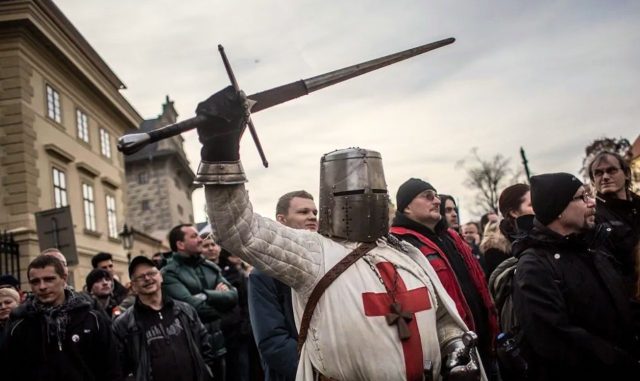
‘Christianity also played a part in the development of modern antisemitism closer to home.’ (Matej Divizna/Getty Images)




In the early hours of Saturday 10 January, the oldest synagogue in Mississippi was burned down. The suspected arsonist, Stephen Spencer Pittman, is only 19 years old; he now faces about that much time behind bars. He had a lot going for him. He was a good student and a good baseball player. At the scene of the crime, according to the FBI, he bragged on the phone to his father, expecting that he could escape undetected, that he was due a “homerun”. “I did my research”, he is supposed to have said — but not, it would seem, enough. Having suffered burns to his hands, he was apprehended by the police at hospital. He has been denied bail and is set to stand trial next month.
Of course, the trial will reveal further details about Pittman and the attack on the Beth Israel Congregation. For now, though, we may sketch out the following picture. The teenager’s alleged actions seem to have been premeditated: members of his gym claim to have heard him say that he wanted to set fire to a synagogue. It appears, moreover, to have been the culmination of the suspect’s increasingly erratic and threatening behaviour: his mother has told the FBI that she had recently considered locking the bedroom door during the night. It should go without saying, too, that the attack was antisemitic in nature: Pittman has apparently admitted that he went after the synagogue for its “Jewish ties”.
Crucially, there is good reason to suspect a religious motive. Pittman is said to have referred to his target as “the synagogue of Satan”, a staple of Christian anti-Judaism going all the way back to the 4th-century homilies of John Chrysostom. On social media, he describes himself as a “follower of Christ”; when read out his rights he said, “Jesus Christ is Lord”. It would not be the first time, as it happens, for this synagogue to have been attacked in an act of terror by extremists of the Christian Right: in 1967, it was bombed by the Ku Klux Klan.
There is a powerful tendency to regard modern, racial antisemitism as a phenomenon fundamentally distinct from an earlier, religious anti-Judaism. This is seen most clearly in discussions of Nazism and the Holocaust. “Nazism owes nothing to any part of the Western tradition,” Hannah Arendt asserted: Auschwitz marked a total break from the course of Europe’s Christian civilisation. In 2000, more than 220 Jewish intellectuals and rabbis signed a document called Dabru Emet, “Speak the Truth”, affirming that “Nazism was not a Christian phenomenon”. All this complemented a certain view of Nazism, making it the very antithesis to Christianity, and instead either atheistic to its core, like Soviet Communism, or else pagan and esoteric — perhaps even amounting to a religion in its own right.
The notion that the Nazis had nothing in common with the fanatical, Christian Jew-haters of earlier centuries is no longer tenable. There was no straightforward transition from “religious” to “racial” thinking: in fact anti-Judaism had already long had an important “racial” component. Jews were identified as a group in the Middle Ages not only on the grounds of their rejection of Christianity, but also by their immutable physical characteristics. A Jewish handbook, Sefer Nizzahon Yashan, written in Germany in the early 14th century, tells us how Christians would often taunt their Jewish neighbours by asking, “Why are most Gentiles fair-skinned and handsome while most Jews are dark and ugly?” Around the same time, Jews were already being depicted with hooked noses.
Moreover, modern racial antisemitism, epitomised by National Socialism, was more fundamentally religious — more Christian — than has often been supposed. An influential book by Richard Steigmann-Gall, The Holy Reich, argued more than 20 years ago that there was a “religious dimension to Nazi antisemitism, which coexisted with and in some ways even informed the racist dimension”. Much of Nazi Christianity was built atop the fancy that Jesus had really been an Aryan. “I can imagine Christ as nothing other than blond and with blue eyes,” said Hitler in 1921; “the devil, however, only with a Jewish grimace.” Seeking to keep the SS from fracturing along religious lines, even the pagan Heinrich Himmler forbade “any attacks against Christ”, including the attack, “without doubt historically false”, that Christ had been a Jew. Some Christian Nazis hoped to reform their religion by jettisoning the Old Testament from the Biblical canon. But still there were plenty of others who were perfectly conventional and orthodox in their beliefs.
In Michael: A German Destiny in Diary Form, Joseph Goebbels’s strange semi-autobiographical novel, the protagonist insists that “Christ is the genius of love, [and] as such the most diametrical opposite of Judaism, which is the incarnation of hate”. The Nazi struggle, thought Goebbels, was one “between Christ and Marx”, to be waged “until victory or the bitter end”. Hans Schemm, the head of the National Socialist Teachers’ League, put it more succinctly when he declared that “Our religion is Christ, our politics Fatherland”. The law of race did not need to contradict the revealed law of Christianity; race, after all, could be construed as an integral part of God’s Creation. “We, the racists, are the only ones who render to Christ the homage that is his due,” wrote the Nazi lawyer Herbert Meyer. Whatever his private beliefs, Hitler too presented himself as having been charged with a religious mission. As he wrote in Mein Kampf: “I believe that I am acting in accordance with the will of the Almighty Creator: by defending myself against the Jew, I am fighting for the work of the Lord.”
Those who emphasise the distance of Christianity from the theory and practice of Nazism are often, it would seem, committing a No True Scotsman fallacy: no true Christian would be an antisemite, because Christianity is really a religion of meekness, self-sacrifice, and neighbour-love; and no true Christian would be a Nazi, because no true Nazi would ever wish to be a Christian.
Christianity also played a part in the development of modern antisemitism closer to home. The British Union of Fascists had several churchmen in its ranks. George Henry Dymock, vicar of St Bede’s in Bristol, inveighed against the Jews in 1935 for engaging in “vile usury”. The Reverend M. Yate Allen, influenced perhaps by the religious declarations of Hitler’s top brass, thought that Nazi Germany was “truly on the side of Christ”. The newspaper British Fascism came up with a pithy formula in 1930: “There can be no true Fascism that is not Christian, for Fascism is military Christianity.” An earlier group produced a “Children’s Fascist Creed” in 1925, whose opening is unmistakably Nicene: “I am a Fascist. I believe in God, the Father Almighty, and in Jesus Christ His only Son Our Lord, and in the Holy Spirit…”
Under the leadership of John Tyndall — and under the spell of postwar neo-Nazi mythmaking — the BNP was broadly anti-Christian. When Nick Griffin set out to “modernise” the party, he therefore had to Christianise it. He succeeded. In 2008, the party underscored the point that “Christianity is so large a part of our identity that to give it up would mean giving up that identity”. In the European elections of 2009, in which the BNP won two seats, the party (much to the dismay of the established church) ran an expressly Christian campaign. A poster cites John 15:20: “If they have persecuted me they will also persecute you.” “What would Jesus do?,” it goes on to ask. The answer: “Vote BNP.”
Shortly before the attack in Mississippi, an account belonging to Pittman posted the “happy merchant” antisemitic meme. This account also promotes a website called “One Purpose”, which advocates “scripture-backed fitness” and “biblical nutrition”. He would seem therefore to belong to a subculture familiar to any young man who has spent time on the online Right — one which mixes edgy internet humour and aspirational self-improvement with an ultra-reactionary, identitarian version of Christianity. The antisemitism draws from both these sources. Sometimes, these cohorts are written off as “nihilistic”, their religion as mere “LARP”; but here, again, the No True Scotsman rears its head. “Christ is King”, sounds the battle-cry of the Groypers. There is no reason whatsoever to believe that the “trad” Catholicism of Nick Fuentes and his ilk is anything other than sincerely felt. Indeed, it underpins everything they say and do. It is central to their entire narrative about the decadence of modern liberal, secular society — which, predictably, is imagined to have been engineered by the “perfidious Jews”.
For all this, we ought not to miss the wood for the trees. It remains obvious that the major threat to Jewish life in the West comes not from Christian, but rather Islamic, religious extremism. The attacks in Manchester and Sydney amply demonstrate as much. Insofar as the blood libel — an English invention — is alive and well in modern Britain, it has principally sustained itself as a more recent import. Muslim antisemites, as Christopher Hitchens once put it, often “have to borrow — when they want to be anti-Jewish — the rubbish of medieval Roman Catholic and Eastern Orthodox antisemitism”; though Hitchens was quick to add that they equally possess a vigorous antisemitic tradition all their own. Mel Gibson’s The Passion of the Christ is probably the 21st century’s most concerted effort to revive the kind of Catholic antisemitism or anti-Judaism that was de rigueur prior to Vatican II and Nostra aetate. Not for nothing did it prove a smash hit across much of the Arab world.
The institutions of mainstream Christianity deserve credit for opposing antisemitism on theological and moral grounds. Fuentes might hold Jews collectively responsible for the death of Christ, and advance an extreme form of supersessionism, dictating that the New Testament replaced, rather than fulfilled, the Old. But when he does so, his fellow Roman Catholics can appeal to the contrary pronouncements of another Chicago native, Pope Leo XIV.
Indeed, Christianity has always possessed strong tools for opposing antisemitism. In the medieval Rhineland, itinerant preachers launched crusades against Jews — yet local bishops also offered sanctuary to the victims. It may well be that Protestant Christianity was not incidental to Nazi ideology; that Jozef Tiso, a Catholic priest, oversaw the Holocaust in Slovakia; and that the ratlines which conveyed several high-ranking Nazis to Latin America ran through the Vatican. But none of this can dampen the Christian courage of Dietrich Bonhoeffer, Martin Niemöller, or the Scholl siblings. Their courage might now serve as an encouraging example, much as the attack in Mississippi ought to serve as a warning. There is, so to speak, a homegrown strain of antisemitism which is quickly gaining ground. If we are now witnessing a resurgence of antisemitism in the West, we should not be surprised to sometimes find it clad in its ancient, Christian garb.
