




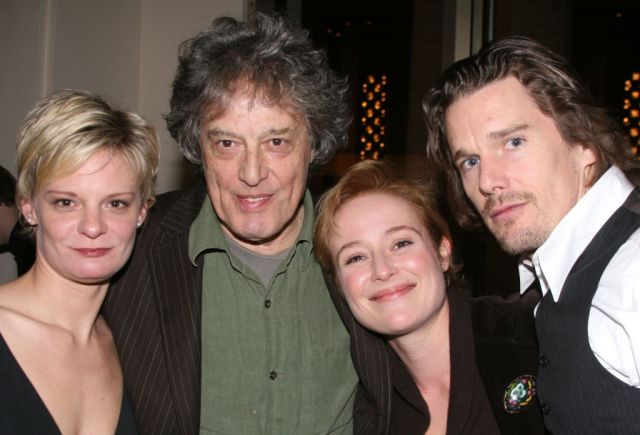
Tom Stoppard with the cast of Shipwreck: The Coast of Utopia Part 2.(Credit: Bruce Glikas/FilmMagic)




If language lies at the core of our existence, it’s also a playground without frontiers where we can sport, and a process which never comes to an end. Language is infinite; it is the atheist’s equivalent of the Almighty.
You might think, then, that the best place for a writer to be is as far inside the language he is using as possible. But that’s not really true. The writer needs to feel language like a second skin, but if he pushes this too far, it will end up feeling more like a set of old clothes — too familiar to engage attention. If he’s too much on the outside of a language, by contrast, he will know its grammar and vocabulary, but not its rhythms, tones and textures. And so writers must be constantly engaged in a double act — they must pay attention to language, but also to the world it registers.
The playwright Tom Stoppard occupied that most privileged of vantage-points, being simultaneously inside and outside of a language. He inhabited English more fully and deeply than almost any of his artistic compatriots, partly because he came to it as an émigré. For the expatriate, language can never be taken for granted and Stoppard never lost a sense of its freshness and strangeness. He occupied this inside/outside position in his life as well as his art: lionised by the Establishment but never quite at home there. Those on the outside can sometimes see more than the insiders, and often in a satirical light, but as Oscar Wilde discovered, they may have to pay a high price for doing so.
Wilde could never quite decide whether he wanted to join the English aristocracy or to put a bomb beneath the lot of them. Stoppard, who dined with Margaret Thatcher and rode to hounds, seems to have been plagued by no such dual alliance. But it does invade the language of his drama, as language is at once a taken-for-granted medium and an object on which loving care is to be lavished. Much English theatre is marked by this ambivalence. One of the nation’s best-loved comedies, for example, is Oliver Goldsmith’s She Stoops To Conquer, which concerns the trouble which ensues when a couple of gallants mistake a private house for an inn. In a sense, Goldsmith himself was similarly confused, treating the public space of Britain as though it were his home, which it wasn’t (he came from County Kildare and studied in Dublin). And there were times when Samuel Johnson’s group, of which Goldsmith was a member, made his alien status abundantly clear to him. It’s hard, though, to see how “English” stage comedy would have survived without Irish immigrants: Richard Steele, Thomas Sheridan, George Bernard Shaw, Oscar Wilde, J.M. Synge, Samuel Beckett, Brendan Behan… All of these men lived at the conjuncture between two cultures, allowing one to show up the strangeness of the other — and something of the same can be said to a limited extent of Stoppard.
The outsider or semi-outsider is always tempted to outdo the insiders at their own game, which is no doubt one reason why Tom Stoppard enjoyed a spot of grouse-shooting. This simultaneous baiting and imitating of the insiders was also true of Wilde, who was an English aristocrat in the way that only a non-English non-aristocrat can be. For him, imitation was both flattery and mockery. He acted himself far better than anyone else could have done, and, like Stoppard, frequented many a country house party, even though he believed that Ireland should rule over Britain and not vice versa. Joseph Conrad fled from revolutionary upheaval in his native Poland, rather as Stoppard was the child of parents in flight from the Nazis, and ended up as a sailor in the British merchant navy. One consequence of this transition was to remould him as a highly conservative pseudo-Englishman, patriotic and patriarchal, plus Anglais que les Anglais.
The same was true of TS Eliot, who was born in Missouri and became a Tory Anglo-Catholic in England. Eliot remarked of his fellow American, Henry James, that he was a European in the way that only a non-European could be, which also applies to Eliot. All these writers brought to a highly insular United Kingdom a range of experience to which it had been largely closed, and went on to produce major art on this basis. It’s one of the few forms of immigration of which the British have approved, though there are doubtless those among them who regret the fact that we outsourced our art to a bunch of foreigners for whom free verse is perilously close to free love. Other outsiders, notably James Joyce, passed disdainfully over the UK and headed straight for Paris. Authors such as Stoppard, Salman Rushdie and V.S. Naipaul belong to the tail-end of this tradition. If you hail from somewhere beyond Britain yet make a significant contribution to its cultural life, you’re as much in line for a knighthood as an MP who has served his time on all the right committees.
Tom Stoppard was no Anglo-Catholic Tory, though, but a mainstream, middle-class liberal. This was the social world in which he moved, which makes for a tedium far removed from the flair and brio of his plays. It was where he was most utterly unoriginal. He cherished the usual middle-class liberal pieties and was much exercised by the issue of freedom and censorship, though not conspicuously by such questions as poverty, unemployment and exploitation. There’s always something a little self-serving about artists championing freedom of speech. It’s a vastly important matter, to be sure, but one might be rather more persuaded of the fact if some of those who advocate it also turned their attention to political questions less bound up with their own lives. Stoppard had some urgent comments to make about political freedom, but none which we hadn’t heard before.
There’s one way, however, in which he flouted liberal pieties without anyone really noticing. He first came to fame with the magnificent Rosencrantz and Guildenstern Are Dead, in which one of the jokes is that the eponymous characters are impossible to tell apart. This isn’t supposed to happen in British theatre, preoccupied as it is by “character”. You have to have rich, complex, well-rounded, highly individuated characters if you’re to end up outside Buckingham Palace shyly displaying your gong. Aristotle, however, didn’t agree. In his view, what mattered in the theatre was the dramatic action, on which, so he claims, character is a kind of “colouring”. No gong for him, then. He can even, he tells us, imagine a drama without any characters at all, a fantasy which Samuel Beckett would later put into practice.
Stoppard also transgressed the conventions of British theatre with his passionate interest in ideas. The British don’t much care for ideas, which like cheese and wine are largely the product of freedom-loving foreigners — and which might encourage people to think in ways which end up endangering the stock market. They enjoy biography instead, since it’s more “human” to hear about what a great sculptor had for breakfast than to indulge in a lot of fancy aesthetic talk about their art. Stoppard’s Arcadia pushes against this prejudice as obstinately as it can — though I’ve seen members of the audience shaking their heads in bemusement. There are also times, however, when the humour and wordplay defuse the power of the ideas, rendering them more consumable. Like all good liberals, Stoppard knew when not to go too far.
Stoppard’s work is celebrated for its wit — a form of humour which it seems you don’t have to work at, and which is, therefore, more appropriate to the English gentleman than the honest bourgeoise. It can be a form of frivolity, but one that redeems itself from the merely vacuous by its agility of mind. It can be funny and coruscatingly intelligent; it can convert the serious into the sportive, but it can also be stinging, rapier-like, combining style and poise with a devious form of aggression. The gag, by contrast, is more impersonal, more capable of being passed from hand to hand and less expressive of a unique individual. We relish witticisms partly because they jolt us into thought, but also because they seem apposite, spot-on, hitting off a truth at a single casual stroke. Wit is the enemy of sentiment and empathy, laced with a hard-boiled quality which puts it a long way from the tear and the twinkle. Gags or jokes are sporadic events — but the wit or dandy is never off-duty. Their permanent mild amusement is possessed by those remote from the grind and rigour of this world, an everyday form of art admired for its well-crafted form as well as for its scintillating insight.
Aristotle speaks of the “great-spirited man”, by which he means not a hero but an individual whose life has gone supremely well. Virtue for Aristotle is a kind of success — not just success in the way Jack Nicolson might understand it (though Aristotle thought it included getting one’s hands on the best theatre tickets), but also in the sense of having enjoyably fulfilled one’s powers and capacities. From the outside, this would seem true of Tom Stoppard. Yet all authentic achievement probably draws at some deep level on damage, anxiety and failure, so it’s fitting that the final work of this superbly accomplished artist should be Leopoldstadt, in which he poignantly explores his own Jewish origins. Not to know for sure whether you are a Jew — it is a hesitation between identity and non-identity which today’s so-called identity politics surely needs to confront.
Join the discussion
Join like minded readers that support our journalism by becoming a paid subscriber
To join the discussion in the comments, become a paid subscriber.
Join like minded readers that support our journalism, read unlimited articles and enjoy other subscriber-only benefits.
Subscribe