




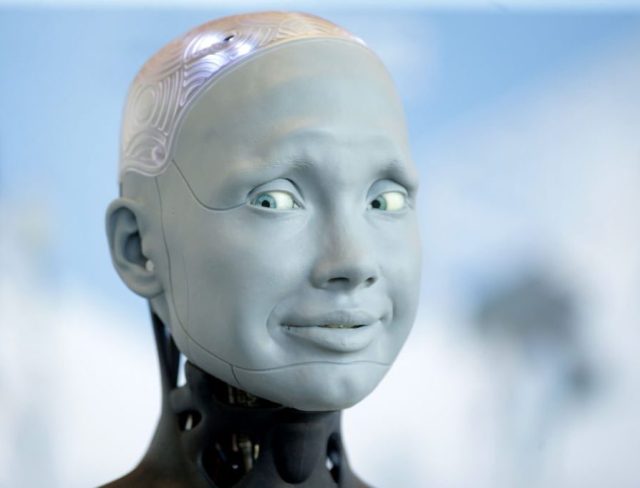
'It is still possible to hear our ancestors’ human voices, there beneath the drone of the Machine' (Johannes Simon/Getty)





The first half of the 20th century saw the publication of a handful of great dystopian novels — warning readers of a future in which present technological and political forces, left unchecked, have stripped our humanity like bark from a tree. Aldous Huxley’s Brave New World (1932), George Orwell’s Nineteen Eighty-Four (1949), and Ray Bradbury’s Fahrenheit 451 (1953) each anticipate essential dimensions of our contemporary ills. Huxley and Orwell both drew on the technological totalitarianism of Yevgeny Zamyatin’s brilliant novel We (1921), a sci-fi protest against the Bolshevik regime that founded the USSR a year later. Like Fahrenheit 451, We ends in civilizational collapse, accompanied by a glimmer of hope for the future. You could say the same of an even earlier work of dystopian fiction, one that likely influenced both Zamyatin and Bradbury: E. M. Forster’s short story The Machine Stops (1909), a chilling prophecy of the comprehensive decay we now face today.
Best known for his novels — A Room with a View, A Passage to India, Howard’s End — Forster had a keen eye for concrete particularity and individual character. These are qualities largely absent in the colorless world of The Machine Stops. The story is set in the distant future, when human beings have retreated from the Sun, the source of light and life that shines upon the surface of the Earth. Isolated, alone, and terrifically self-involved, they live in underground hexagonal cells, where all their needs are met by something called the “Machine”. Contact with others is almost exclusively electronically mediated. Vashti, the only named character in the story besides her son, Kuno, “knew” several thousand people she’d never met in the flesh, e-friends who could be seen and spoken with on something like Zoom. Vashti is surrounded by buttons “to call for food, for music, for clothing” — even for Machine-made literature and poetry, the equivalent of today’s AI-generated pap. She has no need or desire ever to leave her room.
Forster grasps that a life so dependent on technology would be one of comprehensive decay. A “swaddled lump of flesh” with “a face as white as fungus”, Vashti lacks teeth and hair, organs that have little use in a predigested, temperature-controlled world. Perpetually sedentary, she walks with great difficulty, is highly irritable (“a growing quality in that accelerated age”), and — like everyone else in the great subterranean hive — can no longer hazard the Earth’s surface without a respirator. Leaving her room for the first time in years, she is initially “seized with the terrors of direct experience” and retreats to her armchair. And when a woman later “barbarically” puts out her hand to keep her from falling, she becomes irate, for “people never touched one another”.
Culture, too, is marked by decadence. It no longer renews itself through immediate openness to the world, a necessary stimulant of intellectual imagination. Like algorithmic chatbots, or Hollywood producers making endless iterations of a past blockbuster, it instead feeds on the creations of bygone epochs. Vashti spends her time listening to lectures on topics like music during “the Australian Period” or “the pre-Mongolian epoch”. She and her intellectual circle long for new “ideas”, demand for which far exceeds supply. Unfortunately, the riches of the past stimulate few ideas in the abstract age of the Machine, when strong individual personality is considered a “taint”, and when feckless intellectuals, to echo Nietzsche, stand like eunuchs before the “great historical world-harem”. “First-hand ideas” acquired by direct observation are thought to be of little value, for they are disturbed by love, fear, and other passions.
The most trustworthy ideas, in Forster’s world, are “tenth-hand”, arrived at by a sequence of intermediary historians counteracting previous interpretations. Yet the result is a flat and narrow presentism masquerading as science. To study the French Revolution in this way, it goes without saying, is to purge it of the powerful passions of its participants and contemporaries — to see it “as it would have happened, had it taken place in the days of the Machine”. History done thus levels understanding rather than expanding it. It no longer connects people to other times and places, rooting them in a cherished past and offering models of excellence to which they may aspire. Rather, it merely generates counterfactuals that reflect the predominant assumptions of the present.
And if this is a prophecy of the withered historical sense of our time, you might say the same of technology. The Machine is no longer developed in new directions, but merely mended as needed. Travel has ceased to generate ideas, “for, thanks to the advance of science, the earth was exactly alike all over”. Though there are airships on which people are occasionally compelled to travel for official purposes, like the propagation of the race, the sight of the earth below and the heavens above conveys no new ideas. One is reminded, here, of the disappointment of the internet, where great expectations of cultural cross-pollination are drowned in a flood of pornography and echo-chambered rage.
Instincts of veneration and familial attachment do persist even in this deracinated era. The only printed volume in Vashti’s room is the richly bound Book of the Machine, published by the Central Committee (the functions of government are evidently performed by worldwide bureaucratic and technocratic organs that are supposed to keep the Machine in working order). This Book is but a shadow of the one it has replaced: while the ancient Bible taught how to live free and responsible lives, this one contains “instructions against every possible contingency” — a comprehensive list of buttons to press should one be “hot or cold or dyspeptic or at a loss for a word”. Human agency is thus made to assume the binary form — on/off, 1/0, thumbs up/thumbs down — that is alone comprehensible to the Machine. Yet when she is troubled, Vashti caresses the volume, which she ritualistically kisses while uttering “O Machine!” Even so, the Book’s comforts are limited; late in life, she asks several times to be euthanized, an expedient at least as popular in her time as it is in ours. In the end, Vashti’s requests are denied: too many people want the same thing, and the number of deaths cannot exceed the number of births.
Into this tragic, broken world steps Kuno, who lives in another hemisphere but wants to see his mother in person and “not through the wearisome Machine”. In his longing for direct experience — for connection with the natural world, historical lands and peoples, and the whole of things; in brief, for a human home lost centuries ago — Kuno defies the spirit of the age. He speaks to Vashti about some stars he saw from an airship, in which he discerned the figure of a man with a sword. He wants to see the stars from the surface of the Earth, “as our ancestors did thousands of years ago”. Vashti at first refuses to visit him, but maternal attachment — and, perhaps, curiosity about his statement that “any moment, something tremendous may happen” — ultimately convinces her that she must.
When Vashti arrives after a miserable flight, Kuno tells her that he’s been threatened with “Homelessness”: death by expulsion through a “vomitory” onto the surface of the Earth. For the tremendous thing had happened: he’d found “a way of my own” to the sunlit uplands of the world, and his crime, going outside without a permit, had been discovered. His preparation for that upward journey had been an education in its own right. He’d never thought of space as anything but an empty container of things, but in walking to build up his stamina, he began to recover a sense of human place. “Man is the measure,” he tells Vashti. “Man’s feet are the measure for distance, his hands are the measure for ownership, his body is the measure for all that is lovable and desirable and strong.”
When he finally climbs to the surface through a hole in a railway tunnel, his ears are pierced by silence. Only now does he realize that the Machine hums with a hum that “penetrates our blood, and may even guide our thoughts”. In the silence, Kuno hears the call of “all the generations who had lived in the open air”; the spirits of the dead comfort him, just as he “was comforting the unborn”. Forced to breathe the painful new air because he has lost his respirator, he climbs a slope and sees sleeping hills that “commune with humanity in dreams” — “the hills of Wessex as Ælfred saw them when he overthrew the Danes”.
Kuno passionately explains to a weary Vashti what else he now sees. The Machine has “robbed us of the sense of space and the sense of touch, it has blurred every human relation and narrowed down love to a carnal relation, it has paralyzed our bodies and our wills, and now it compels us to worship it”. This talk shocks her. But when he tells her that the flexible mechanical arms of the “Mending Apparatus” came from the shaft to drag him back down, and that a woman of the surface ran to his aid and was killed, she thinks him mad as well as blasphemous — no higher forms of life were thought to exist above ground. Then she leaves. Mother and son don’t speak for years, even after he is transferred to a cell near her own.
The rest of the story describes the suffering by which Vashti learns Kuno’s truth. Having stripped us of humanity and made us its slaves, the Machine finally breaks down, at first slowly, then suddenly. For at some point, no one alive understands “the monster as a whole” well enough to repair it — a distinctly modern fatality of which the philosopher José Ortega y Gasset warned in The Revolt of the Masses (1929), and one that may already have befallen us with respect to AI. Murky bathwater, distorted music, and unrhyming poetry are excused, but when beds fail to appear from the cell floors, the air grows foul, and euthanasia is no longer available, the situation becomes grave.
Finally, communications systems fail, a terrifying silence nearly kills Vashti (“it did kill many thousands of people outright”), the walls crack, the floor heaves, and all is plunged into primeval darkness. The desperate moment of reversal and recognition is at hand. Vashti encounters Kuno in the passage outside their rooms, and they weep for humanity, and for mankind’s sins against body and soul. Yet before they die in each other’s arms, touching, talking, and kissing, their minds and hearts are opened to what was important on Earth. And the existence of people on the surface — men and women Kuno has seen, spoken to, and loved, who are “hiding in the mist and ferns until our civilization stops” — gives them some hope that human culture may once again take root beneath the stars.
Huxley and Orwell give their readers no such hope: the rebellious individuals of Brave New World and Nineteen Eighty-Four are crushed beneath the ineluctable weight of totalitarianism. But like Forster, Zamyatin and Bradbury leave us with the consolation that humanity can never be completely extinguished — that even, in the most terrible tyrannies, it survives in a few independent souls, and that all regimes must inevitably collapse. We ends in a civil war started by rebels who’ve made contact, as Kuno has, with people living in the wild lands beyond the walls of the One State; in Fahrenheit 451, seeds of a post-apocalyptic civilization are contained in the minds of survivors who’ve memorized great books. Our own fate is still undecided, but there is some reason for optimism. For as Forster reminds us, it is still possible to hear our ancestors’ human voices, there beneath the drone of the Machine.