








December 21, 2025 - 8:00am
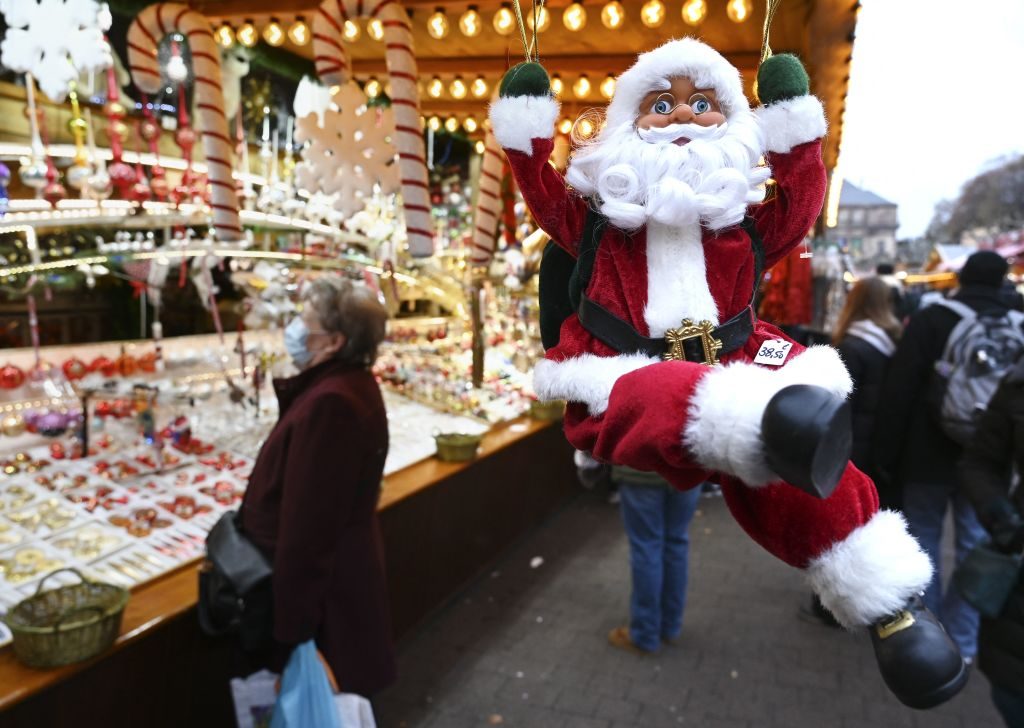
Over the years, I have developed an aversion to Christmas markets. Despite the promise of warmth, merriment and Christmas cheer, on looking around one can’t help but notice that something isn’t right.
Someone doles out mulled wine from a stainless-steel vat, next to a stall selling handbags. There might be another stall selling ornaments, but those angel figurines will be made in China. There are identical scenes across Europe, the same tat being sold in Paris, Vienna, Manchester or Birmingham. You could be anywhere. In a sense, you are nowhere.
Yiwu, a city in eastern China, produces an estimated 60% of the world’s Christmas decorations. Global supply chains have made it cheaper to import resin ornaments from Zhejiang than to carve them locally. Stall fees in major markets have risen to the point where only vendors with access to bulk-manufactured goods can afford entry. Local artisans, as a result, have been priced out.
Christmas markets were not always like this. They began in late-medieval Central Europe as winter fairs to provision households before roads froze over, and the festive character came later. In Catholic Europe, gifts were exchanged on St Nicholas Day, early in the month. Meanwhile, Protestants, seeking to diminish the cult of saints, shifted the occasion to Christmas Eve. This gave the December markets a second purpose. Craftsmen who made toys, carved ornaments, and baked gingerbread began to set up stalls alongside the meat vendors.
By the 17th century, thanks to the patchwork of principalities, bishoprics, and free cities in the Holy Roman Empire, these markets had become highly regionalised. Each had its own guild traditions, craft specialisations and patronage. This tradition was carried into the 20th century, when the offerings in Strasbourg remained different from those found in Cologne.
For the new middle classes who could afford to travel, that was the appeal. However, postwar consumerism transformed Europe, as both mass manufacturing and department stores made cheap, standardised goods widely available all year round. Markets lost their role as essential retail spaces and survived instead as quirky cultural relics.
By the Eighties, cities were increasingly competing for tourists, weekend visitors, and discretionary spending. German-style markets were identified as prime candidates for attracting footfall in struggling city centres, and so spread rapidly beyond their historical heartlands. Manchester launched its German-style market in 1998; Birmingham partnered with Frankfurt in 2001. Invariably, with export came standardisation.
Yet this surrender to globalisation is not inevitable. Some cities have chosen a different path. Since 2011, Strasbourg, which calls itself the “capital of Christmas”, has imposed a strict charter banning mass-produced goods and requiring vendors to source regionally. Similarly, Nuremberg prohibits mass-produced goods at its Christkindlesmarkt, preserving a dense ecosystem of local artisans. Helsinki frames its market explicitly as an alternative to industrial gifts, favouring small producers and sustainable sourcing. These markets accept limits in order to protect character.
Christmas markets are unlikely to disappear any time soon. They are too useful, too profitable, too easy. But the promise of warmth and spice no longer compensates for what lies inside: the same steel urns, the same imported ornaments, the same cheerful nowhere. Perhaps that is simply what happens when a foreign tradition is imported and sanitised to make it accessible to everyone.

Join the discussion
Join like minded readers that support our journalism by becoming a paid subscriber
To join the discussion in the comments, become a paid subscriber.
Join like minded readers that support our journalism, read unlimited articles and enjoy other subscriber-only benefits.
Subscribe