




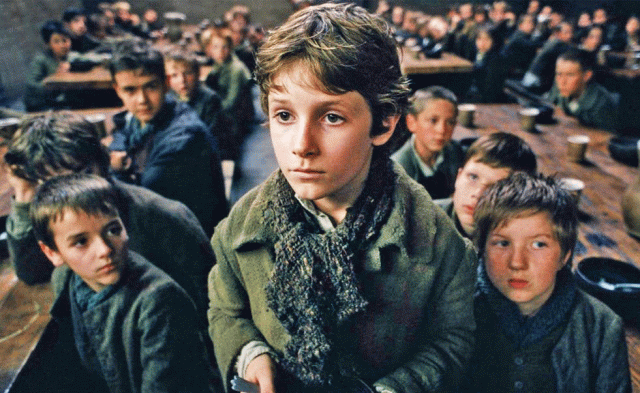
Please sir, could I read a good state of the nation novel? Credit: IMDB




Charles Dickens hated Oliver Twist. Rarely in English letters do we find a case of an author so embarrassed, so fundamentally ill at ease with his own creation. Oliver spends the first half of the novel crying, begging, whining, and being stooped over by lachrymose teenage girls. And then he disappears for the second half, like a naughty child sent away by a disappointed parent.
Once he’s gone, Dickens can focus on what really pops his toast — sexy, scarred, vicious murderers like Bill Sykes. Dickens can enter Sykes’s thoughts with ease. But when Oliver is around, pointlessly whimpering, Dickens can’t scale the orphan’s goodness. Dickens can never decide whether to torture him, or tease him, or have him chased through the streets of London by a mob. So he does it all.
The tone in the novel’s famous gruel begging scene is a masterpiece of cruelly vindictive comedy. When Dickens describes the suffering of the workhouse children, he is flippant, educated, and knowing. The mealtime soup is a “festive composition” of which the boys are given no more than one “porringer” except on “on occasions of great public rejoicing”. Boys, writes a winking Dickens, “have generally excellent appetites”. One of the lads is so hungry that he warns the others he will eat them, unless he has “another basin of gruel per diem”.
When Oliver rises from the table to get the “please sir, I want some more” over with, he is described as “somewhat alarmed at his own temerity”. This is amoral writing, ironically ornamental, a low moment given high treatment. These boys were the victims of a monstrously utilitarian system, of which Dickens was supposedly a savage critic. But any concern we might have for Oliver and his tiny starving colleagues is blotted out by Dickens’ sarcastic laughter — which is all the more infectious for being inappropriate.
Charles Dickens did not aim to disgust his audience. He wanted them lightly appalled, chuckling with him, and thoroughly entertained. That’s a far more lucrative emotional mix for an author to create in a reader.
Yet Oliver Twist is remembered either for the pious little boy who triumphed over adversity, or as a hit musical. And Dickens is, in popular culture, defanged, desexed and without a crackle of danger. Or he is, in Hollywood terms, “The Man Who Invented Christmas.” I would guess that most subscribe to George Orwell’s reckless judgment that Dickens was a man full of jolly, slightly angry laughter; a “free intelligence” who represented the best of 19th-century British.
Remove the gooey sentiment and false perceptions though, and who was Charles Dickens? For over 150 years we have received nothing but terrible news about him. It began in 1874, the year John Forster’s Life of Charles Dickens appeared. Forster was a close intimate of his subject, and his biography was the 19th century’s answer to Boswell’s Life of Samuel Johnson. Yet Boswell’s Johnson is a moral hero you’d happily swim in a vat of brandy with; Boswell’s goal was to make indestructible myths from their friendship, and he succeeded. Forster’s Dickens is not the man you might expect; not the generous paterfamilias, not the jovial inventor of Christmas, not the sentimental comic with a twinkle in his eye.
He is not heroic. Forster’s Dickens is typically, helplessly Victorian: hard-charging and aggressive, impetuous, overbearing, dynamic and absurdly productive, with enormous desire for activity. And like almost every Victorian I can think of, Forster’s Dickens is haunted. Full of overwhelming, difficultly buried fears. What shadowed him until the end was a childhood stint in a blacking warehouse, where he covered pots of boot polish “first with a piece of oil paper, and then with a piece of blue paper” for 10 hours a day, six shillings a week, while his father was in the Marshalsea debtor’s prison. The people closest to Dickens — his wife and children — first learned of this essential trauma in Forster’s pages. They had no idea who he was.
Oliver, like all Dickens’s child heroes, is a chip off the block of these memories. A self stuck in amber, that he can take off the shelf and dwell on. And if Twist is pathetic, it’s because Dickens felt he was pathetic too. If Dickens can’t hide his contempt for Oliver, it’s partly a reflection of his own deep self-loathing.
There were more leaking pipes, stagnant ponds, and open sewers to be discovered under the national monument. Thomas Wright’s 1935 Life gave us Dickens’s queasily neurotic affair with the actress Ellen Ternan, a secret for decades. One 1952 biography has Dickens sanding down Ternan’s reluctance to sleep with him with all the grinding persistence of a competent professional novelist; “Dickens had won Ellen against her will, wearing down her resistance by sheer force of desperate determination.” Fred Kaplan’s 1988 Life opens with Dickens suspiciously bonfiring “every letter he owned not on a business matter” in his country house garden. What secrets were turned to ashes? Worst of all was Claire Tomalin’s speculation that Dickens slept with the ‘fallen women’ who were cared for at Urania Cottage, Angela Burdett Coutt’s home for reformed prostitutes. The evidence for this is thin (one letter; one cryptic remark) but the thought is so irresistible — another Victorian hypocrite caught with his pants down! — that I’ve never been able to shake it off.
According to taste, those of Dickens’s generation either shame us by being better than us, or shame us by being worse than us. We take a ladder up into the historical attic, and poke around the broken furniture and damp old papers, looking for clues in the rot. How could they be so prudish? So rigid, so dogmatic, so racist, so hypocritical? And why were they all so obsessed with crinoline?
If you spend any time with them, though, you soon realise that the Victorians exposed every failing of their own minds long before we did. Matthew Arnold described his contemporaries as “shutting their eyes and professing to believe what they do not… rushing blindly together in herds”. Dickens put revolting specimens on paper — Pecksniff, Bounderby, Squeers, Mrs Gamp — and his audience confirmed the truth of these satirical drive-bys when they made him the most famous author in the world. The Victorians knew they were hypocrites, just as I suspect Dickens knew, down in the gut, that the hollow plaster purity of characters like Oliver was the weakest expression of his talent.
Why did Dickens contaminate his art with moral earnestness then? Simply: he was praised from it, right from the start. The anxieties of educated Victorians — generated by economic boom and bust; their grating fears of violent revolution from below; their slow realisation that Christianity was not literally true — demanded a procession of Oliver Twists to salve their jittery consciousnesses. Dickens (sensibly) put commerce ahead of art. Like every great showman he gave them what they wanted. The Edinburgh Review praised Oliver Twist in 1838 for its “comprehensive spirit of humanity”, and the tendency of Dickens’ writings “to make us practically benevolent”. They could not detect the other side of Dickens; the grey ambivalence born of his misanthropy, the black edge to his clownish humour.
Once Dickens’s combination of scornful merriment and soppy earnestness made him wealthy, he bought a big country house just off the old Dover Road. As a sad child, Dickens had walked past it and reflected that such wealth would be forever out of his reach. Now it was his. The road was still travelled by small tramping boys, little beggars, all as desperate as David Copperfield, all as famished as Oliver Twist.
Dickens did not have time for them. They were far too close to the bone, far too reminiscent of the bleakest chapters of his own youth. He had two large hounds chained to each of the entrance gates. He hated Oliver Twists, whether they were imagined or real. When they trudged up the road to his home, with hope in their hearts, they were not about to meet the creator of Little Nell and the father of Christmas. They were headed for the jaws of his dogs.
Join the discussion
Join like minded readers that support our journalism by becoming a paid subscriber
To join the discussion in the comments, become a paid subscriber.
Join like minded readers that support our journalism, read unlimited articles and enjoy other subscriber-only benefits.
Subscribe