




Credit: Zerbor, Getty Images




In his column earlier this week, ‘From Jeremy Corbyn to Bernie Sanders to Elizabeth Warren; what the Left is getting right’, Liam Halligan highlighted Jeremy Corbyn’s focus on housing and Democrat Senator Elizabeth Warren’s call for banking reform as examples of ‘what the Left gets right’. In her column Charlie Pickles adds the minimum wage and capital spending to that list.
***
UnHerd has been exploring the global march of the Left.
Think Iglesias in Spain, Tsipras in Greece, Melenchon in France, and Corbyn and Sanders in the UK and US. Some have established new parties, others have radicalised old ones. Either way, in capturing the popular imagination, these socialist candidates have helped shake up mainstream political parties which had become overly comfortable in their grip on power. The financial crash – with its big bank bail outs and years of austerity – created a sense that ‘traditional’ parties and politicians just weren’t serving the people. That the rich have largely recovered their pre-crash wealth while lower and middle-income families continue to struggle appears to prove the point.[1. See, for example, Larry Elliott, ‘Top 1% of households in UK fully recovered from financial crisis’, the Guardian, 15 July 2017; Jim Tankersley, ‘The wealthy have nearly healed from recession. The poor haven’t even started’, The Washington Post, 18 August 2016]
It’s easy to dismiss the populist positions espoused by the hard-Left (and from the hard-Right, too, who uncannily often promote the exact same populisms). And certainly, basic economics shows that some of the policies put forward – from protectionism to huge, unfunded increases in public spending – would end up hurting the very people they are supposed to help. It is lazily partisan to reject their platforms entirely, however.
So, further to Liam Halligan’s “What the Left gets right” column, here are two other policies that sensible people should get behind.
First… minimum wages DO need to rise
“Millions of Americans are working for totally inadequate wages. We must ensure that no full-time worker lives in poverty. The current federal minimum wage is starvation pay and must become a living wage. We must increase it to $15 an hour over the next several years.”[1. ‘A Living Wage’, Bernie, accessed 5 September 2017]
There is undoubtedly merit in Bernie Sander’s argument, which has clearly been recognised by the 19 US states that, with varying levels of generosity, raised their minimum wages at the start of this year[2. Michael Edison Hayden, ‘19 States Increase Minimum Wage at the Start of 2017’, ABC News, 1 January 2017] – a mixture of both Democrat and Republican. In Britain, George Osborne, the Chancellor in a Conservative government, legislated for what he called the National Living Wage in 2015.
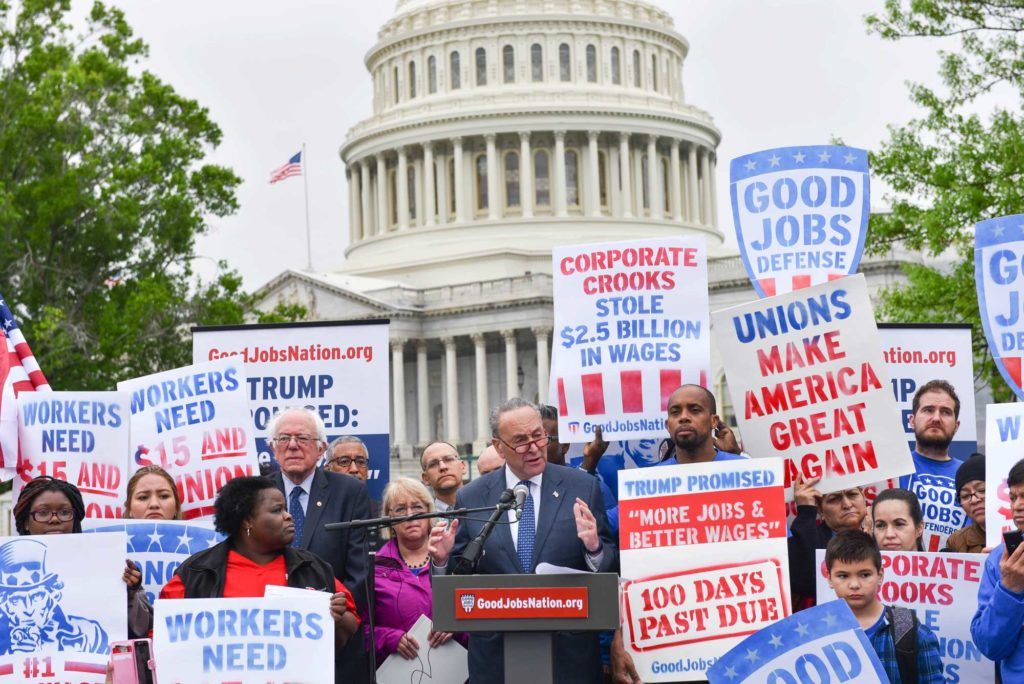
Across advanced, capitalist economies, the share of wealth going to labour has decreased. As Ryan Avent highlights in his book The Wealth of Humans:[3. Ryan Avent, The Wealth of Humans, Penguin Books, 2016]
“[In America] Prior to the early 1970s… as workers got better at generating output, the fruits of those improvements accrued to the workers themselves, in the form of higher pay. Thereafter productivity growth slowed and workers failed even to capture the benefits of that slower growth; from 2005 to 2014, for instance, productivity grew at about 1.4 per cent per year, or about twice as fast as growth in real wages.”
In fact, as Avent goes on to say, the use of averages masks an even worse reality – instead, using median wages, “since 2000 the real wage for the typical American has not risen at all”, and “from 1995 to 2012, the average real wage in Germany, Italy and Japan all underperformed that in America”. At the extreme, between 2011 and 2013, Greece saw three consecutive years of 10% reductions in total gross wages.[4. ‘Wage developments in the euro area Increasingly unequal?’, Briefing, European Parliament, July 2015]
Productivity gains are increasingly going to the owners of capital (exacerbating income inequality). Around half of the decline in the labour share (i.e. that going to workers) can be explained by automation, and a further quarter by globalisation (especially the offshoring of jobs).[5. Mai Chi Dao, Mitali Das, Zsoka Koczan and Weicheng Lian, ‘Drivers of Declining Labor Share of Income’, IMF Blog, 12 April 2017] While this makes sense, rational explanations, of course, do nothing for the low and middle earners struggling to make ends meet and turning to the politicians promising a pay rise. And many of the (typically big) businesses reaping the benefits of technology and globalisation could afford to give one.
Critics of minimum wage hikes will shout about job losses. Indeed, the UK Office for Budget Responsibility – tasked with providing independent scrutiny and forecasts for the public finances – predicted 60,000 job losses as a result of 2015’s National Living Wage. It will be some time before we can assess the accuracy of that projection, but several studies looking at the impact over time challenge this common pessimism. One study of US federal minimum wage increases between 1938 and 2009 found that:[6. Paul Sonn and Yannet Lathrop, ‘Raise wages, kill jobs? Seven decades of historical data find no correlation between minimum wage increases and employment levels’, National Employment law Project’, 5 May 2016]
“Basic economic indicators show no correlation between federal minimum-wage increases and lower employment levels, even in the industries that are most impacted by higher minimum wages. To the contrary, in the substantial majority of instances (68 percent) overall employment increased after a federal minimum-wage increase. In the most substantially affected industries, the rates were even higher”.
This is in line with UK evidence that minimum wage rises since 1999 have had no negative employment effects on the overall labour market (though part-time workers do seem to have been impacted, which deserves attention).[7. Marco Hafner, Jirka Taylor, Paulina Pankowska, Martin Stepanek, Shanthi Nataraj and Christian Van Stolk, ‘The impact of the National Minimum Wage on employment: A meta-analysis’, RAND Corporation, 2017]
More generally, where there is evidence of a negative impact on jobs, it invariably focuses on the lowest skilled, and in particular low-skilled young people.[8. David Neumark, ‘The effects of minimum wages on employment’, Federal Reserve Bank of San Francisco, 21 December 2015] That is why any pay-rise for those on the lowest wages should be accompanied by a much greater focus on up-skilling, something which businesses have failed to invest in (unsurprisingly given the abundance of cheap labour). A recent report by think tank IPPR found English businesses are spending £5 billion less on training, in real terms, than a decade ago; and spend per employee per year is half that of the European average.[9. Skills gap threat to post-Brexit economy – UK employers spend £6bn less on skills than Euro average, IPPR, 18 February 2017] The risk to youth employment posed by increasing the minimum wage is also why pay levels staggered by age are important (in the UK, the rate for under-18s is almost half that for over 25s), and why training schemes such apprenticeships that provide a partial wage are key.
Of course, while a pay-rise is a worthy (even essential) policy in the short to medium-term, the longer-term challenge is preparing the labour force for an era of robots and algorithms. As my colleague Nigel Cameron highlights in a recent piece on the rise of robots, we just don’t know what the employment impact is going to be, but we do know the future world of work is going to require different skills (ones Nigel sees as more suited to women). Which is another reason for politicians of all stripes to prioritise not just fair wages, but the skills that will equip workers to earn them.
Second… BIG infrastructure investment is essential
Big spending promises are at the heart of the platforms put forward by the Left. And while extravagant general increases in public spending – pushing more and more debt on to younger generations – is poor policy and fiscally dangerous, there is one area in which they are bang on the money: infrastructure spending. Well, let me caveat that, big spending on the right infrastructure under the right circumstances (more on that later).
Bernie Sanders’ 2016 presidential campaign pledged $1 trillion of investment over five years via his ‘Rebuild America Act’ – promising to upgrade everything from bridges and railways, to electricity and broadband.[10. ‘Creating Jobs Rebuilding America’, Bernie, accessed 5 September 2017] In the UK, Labour’s 2017 manifesto included a £250 billion ‘National Transformation Fund’ to invest in infrastructure projects over ten years, including rail, housing and energy.[11. For the Many Not the Few. The Labour Party Manifesto 2017, accessed 5 September 2017]
It’s a form of investing to save – or at least investing to stimulate. Infrastructure is ‘pillar two’ of the World Economic Forum’s Global Competitiveness Index, one of four ‘basic requirements’ for a competitive economy. The US ranks third overall for competitiveness, but is outside the top ten at number 11 for infrastructure. The UK is seventh overall, but ninth for infrastructure – and it ranks just 27th for roads and 19th for rail.[12. Klaus Schwab, ‘The Global Competitiveness Report 2016-17’, World Economic Forum, 2016]
For Sanders and Corbyn, however, pledges of serious spending for infrastructure renewal are couched in a more fundamental truth: the building blocks of economic success matter on a human level. As Harvard Business School Professor Rosabeth Moss Kanter puts it in relation to transport:[13. Rosabeth Moss Kanter, ‘Why Can’t We Move? Solving America’s infrastructure problems’, Harvard Magazine, July-August 2015]
“The state of transportation infrastructure touches every important societal issue: health and safety, air quality, family budgets, productivity and use of time, inequality and social mobility, the nature of cities, jobs for today and jobs for the future. Public transportation in particular, I found, is an important ride out of poverty and into the middle class if it provides access to jobs and education.
Once America was the world’s acknowledged innovator. Now we’re stuck on the way to the future—stuck in traffic, stuck in congressional gridlock, and stuck in history.”
One Harvard study found lower commuter time is a strong factor in low-income families escaping poverty and achieving upward mobility.[15. Mikayla Bouchard, ’Transportation Emerges as Crucial to Escaping Poverty’, The New York Times, 7 May 2015] Which when you think about it, is not that surprising: employment is the best route out of poverty, but you have to be able to get to work. Common sense.

Crucially though, back to my caveat, not all spending is equal – or even good. Over-runs in time and budget are common in public projects (the UK’s high speed rail project HS2, for example, was reported to be £7 billion over budget in 2016[16. ‘HS2 rail link is $7bn over budget and facing delays say MPs’, Sky News, 14 September 2016]), wasting taxpayer funds. But as Tyler Duvall – a former under secretary for policy at the US Department of Transportation – argued in 2010, the greatest waste comes from the failure to act strategically:[17. Tyler Duvall, ‘Unclogging Transportation’, National Affairs, Spring 2010]
“Put simply, a business starts by asking the question: ‘What will the project achieve for us?’ The company then compares the expected return on the project’s investment with other potential uses of capital — treating the company’s available funds as fungible across a wide array of investment opportunities, and estimating the benefits of alternative projects in order to ensure the best use of a limited budget. Once a project is undertaken, a post-investment assessment is conducted to determine whether it was a success, and whether the returns on investment met the company’s expectations. The results of the review then shape decisions about future investments. The private-sector approach is hardly rocket science: It requires simply prioritizing needs, investing in the projects that will yield the most benefit and value, and keeping track of what works and what doesn’t.”
Again, common sense. It also means, as Duvall points out, considering that the best approach might not create the best photo-op. Congestion charges and market pricing, for example, enable more efficient use of existing transport capacity, but don’t generate the ‘local investment’ headlines of pork barrel projects. The difference is, they actually deliver value: in 2005, to deal with congestion, differential pricing (based on peak and off-peak times) was introduced at the ports of Los Angeles and Long Beach, within two months around a third of shipping traffic was shifted to off peak.[18. Ibid]
Likewise, the political bias is often towards a shiny new, ribbon-cutting opportunity rather than the essential upgrade of crumbling infrastructure. Yet, as a paper by Brookings argues: “It’s easier to allocate maintenance money efficiently than money for new projects.”[19. Peter Olson and David Wessel, ‘The case for spending more on infrastructure maintenance’, Brookings, 31 January 2017]
Big investment is needed, but, as is invariably the case with public spending, it’s how you spend it.
(Steve Hilton Discusses the populism sweeping many Western economies, and his belief that it can be converted into a positive agenda for a change.)
The policies of the Left are imbued with a sense of hope and a promise of change
Both these policies have clear, tangible benefits to people’s lives. They are not abstract arguments about debt and deficit (as important as those are); they are about giving not taking, in the form of a hand up not a hand out. They are, ultimately, a promise of a better standard of living. And that, perhaps, is the most compelling part of the Left’s platform. They offer hope. In his essay for UnHerd last week, Angus Robertson, Deputy Leader of the Scottish National Party, argued that:
“In Greece and Spain, Syriza and Podemos ran on a ‘hope agenda’ that things can and must be better for society, something that resonated especially for many young voters in countries with mammoth levels of youth unemployment.”
Pablo Iglesias, Secretary-General of Spain’s Podemos party, says “we saw ourselves as a force for renewal”, which in an era of stagnation for many is compelling.[20. Pablo Iglesias, Understanding Podemos, New Left Review, May-June 2015]
In an interview with UnHerd, Steve Hilton, former adviser to UK Prime Minister David Cameron and current Fox talk show host, advocated ‘positive populism’. Hilton sees in the populism sweeping the West a chance to turn “it into an agenda for real reform and for change, that actually ends up really improving the daily lives of people.” If mainstream politicians are to compete, if the centre is to regain ground, then it is ‘positive populism’ they must embrace. They could do worse than starting with policies that increase low wages and create opportunity.
***
FURTHER READING
For a discussion, and evidence review, of the decline in labour share see Silvia Merler, ‘The decline of the labour share of income’, Bruegel, 24 April 2017
Klaus Schwab, ‘The Global Competitiveness Report 2016-17’, World Economic Forum, 2016
Tyler Duvall, ‘Unclogging Transportation’, National Affairs, Spring 2010
Join the discussion
Join like minded readers that support our journalism by becoming a paid subscriber
To join the discussion in the comments, become a paid subscriber.
Join like minded readers that support our journalism, read unlimited articles and enjoy other subscriber-only benefits.
Subscribe