







 Prefer us on Google

December 12 2025 - 4:00pm
On Yom Kippur earlier this year, Jihad al-Shamie attacked a synagogue in Crumpsall, Manchester. It was the first fatal antisemitic attack in Britain in years (the last one, by a paranoid schizophrenic in 2008, also occurred in the same Manchester suburb). The next day, Deputy Prime Minister David Lammy attended a vigil. As he spoke about “one people, one United Kingdom” which “we must not let them divide”, the crowd heckled and booed him. The Jews of Crumpsall, it appeared, were looking back in anger.
This may have fed into the relative silence from Britain’s Jewish community over alleged antisemitic comments made by Reform UK leader Nigel Farage when he was at secondary school. Yesterday, journalist Jonathan Freedland, writing in Jewish News, mused that one reason why Britain’s Jews had largely kept shtum on the matter was because “they have made a pragmatic calculation”. Don’t beat the future prime minister with the antisemitism stick, the thought went, as many of his supporters will lean into it rather than shy away from it. While that possibility should not be dismissed out of hand, there are other more salient reasons for the Jewish apathy toward Farage’s alleged comments.
Received wisdom dictates that Britain’s ethnic and religious minorities are Left-of-center. But this hasn’t corresponded with the reality of Anglo-Jewry for some time — unlike America, where Jews reliably lean Democratic. In 1979, Paul Rose, then Labour MP for the constituency encompassing Crumpsall, observed that there had been a “movement away from the traditional affinity between the Anglo-Jewish community and the Labour Party”. After all, the Conservative MP for Finchley — a constituency which has for decades been home to one of the country’s largest Jewish communities — had just become prime minister that year.
Margaret Thatcher’s cabinet, it was quipped, contained “more Old Estonians than Old Etonians”. Jewish politicians were often on the Right of the party: Leon Brittan, Nigel Lawson, Michael Howard, and Thatcher’s lodestar Keith Joseph. Some years earlier, the most outspoken Jew in politics had been Gerald Nabarro, a flamboyantly-moustachioed Powellite. Thatcher herself had a close friendship with Chief Rabbi Immanuel Jakobovitz; in 1990 she joked that “he has had a deep effect on me […] whether this makes me a Jakobovite or him a Thatcherite, I would not like to say.”
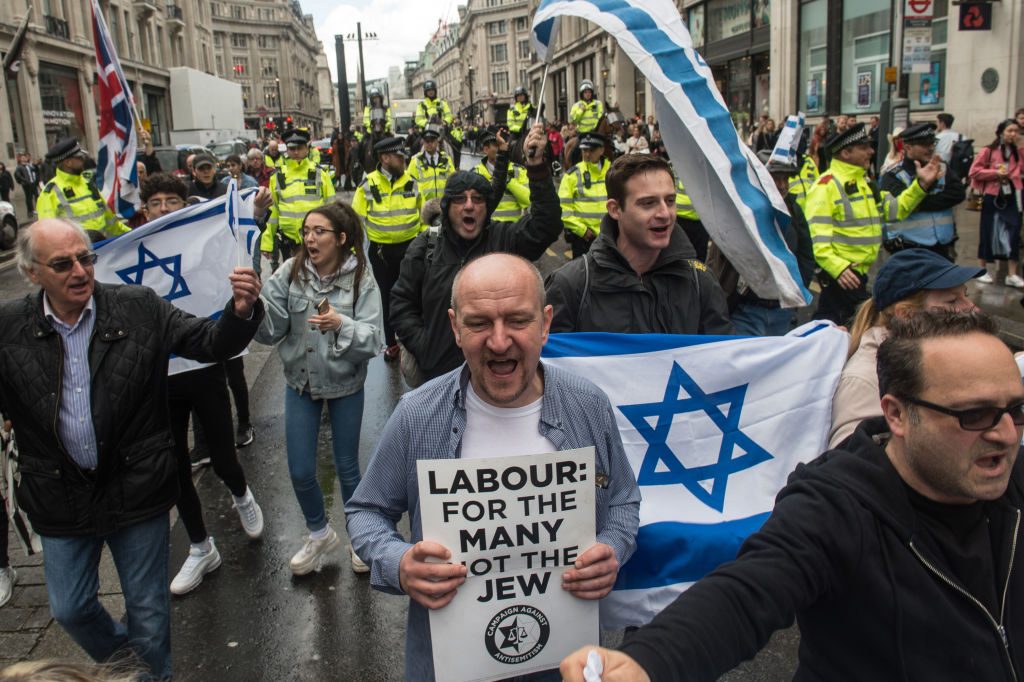
Even in the mid-Nineties, when John Major was gray and Tony Blair fresh-faced, British Jews were breaking for the Tories. Fast-forward to the 2015 general election and 64% of Jews voted Conservative, compared with only 15% for the Labour Party. Seen in this light, Jeremy Corbyn’s rise to the Labour leadership changed the pitch of Jewish attitudes more than actual voting behavior. Jakobovitz’s successor as Chief Rabbi, Jonathan Sacks, in a reckless and histrionic intervention, declared in 2018 that, faced with the prospect of Corbyn in Downing Street, Jews “cannot but feel an existential threat”. In 2019, 11% of British Jews voted Labour, the decline having already become entrenched in the Ed Miliband years.
Partly, this shift is a matter of bread-and-butter economics. As the historian William Rubinstein put it in his 1982 book The Left, the Right and the Jews, once British Jews had entered the upper-middle class, “the old Leftist enthusiasms of the shtetl are abandoned for the warm security of the center-right.” Partly, too, it reflects polarization over Israel. One reason that Miliband, himself a Jew, was so unpopular among the Jewish community was that he supported recognizing a Palestinian state.
But, today, British Jews have also grown increasingly concerned about multiculturalism and immigration. Jewish support for Reform UK is consequently increasing. Only 6% of Britain’s Jews voted for Reform in the last election. On current polling, that has risen to 20%, placing the party in second place — still a good way behind the Tories, but the gap is narrowing.
We are years away from the next election, and there is still all to play for. If Reform moves in an isolationist or more overtly Christian direction, British Jews will remain faithful to the Conservative Party. It would not be surprising, though — especially if Reform supplants the Tories as the party of the Right — if the plurality of British Jews end up calculating that a Farage government would be in their interests.
What really explains the silence over Farage’s alleged teenage antisemitism is that the Jews of Crumpsall — and of the country more broadly — do not realistically feel threatened by it. They are far more concerned about Jihad al-Shamie.
