









April 1 2026 - 7:00pm
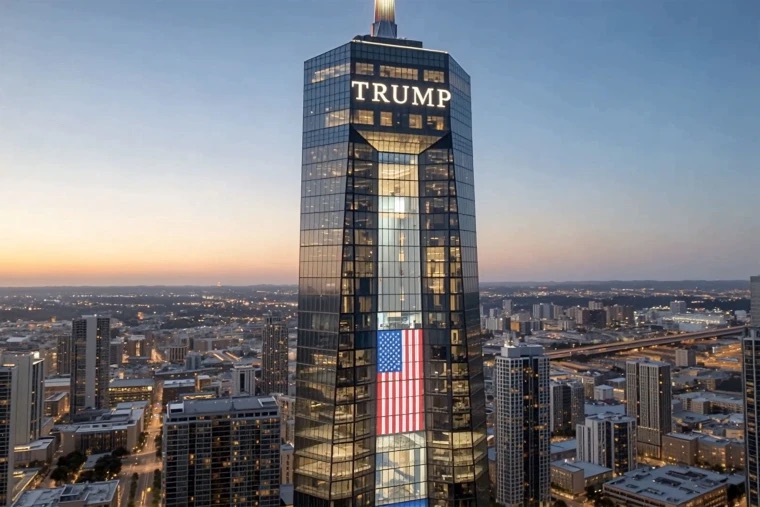
This week, Eric Trump released a video about the planned Donald J. Trump Presidential Library in Miami, Florida. “This landmark,” he wrote in an accompanying post, “on the water in Miami, Florida will stand as a lasting testament to an amazing man, an amazing developer, and the greatest President our Nation has ever known.”
In the video, against a backdrop of stirring music, computer-generated visitors swarm a digital cityscape, ascend a Sauron-like tower rising above the shoreline, marvel at Air Force One and its escorting fighter jets, sip cocktails on rooftop gardens, and network in atria and forums, including replicas of the Oval Office and West Colonnade. The escalators are gold-trimmed. The floors are clean enough to eat off. In one image, a computer visualization of the richly classical recreated White House ballroom emerges within the uber-modernist presidential tower, like a Fabergé egg in a chicken factory.
One thing, however, that is notably absent in all the breathless CGI visualizations of the library is anyone reading books, or in fact any books for study at all. Evidently, this library is a place to make deals, not a place to read. As Trump himself said: “I don’t believe in building libraries or museums… It’s going to be most likely a hotel, this concept.”
Presidents Trump and Obama — so different in every other respect — share one thing: their presidential libraries resemble Bond villain towers with no books in sight. Obama’s is worse still: lumpen, windowless, and awkwardly misshapen, a monument to architecture for architects rather than the public. Even George W. Bush’s presidential library near Dallas — a more restrained, classical affair by Robert A.M. Stern — appears book-free on its website, though a few volumes are reportedly tucked away. We have come a long way from the early presidential libraries: the papers and books of Presidents Thomas Jefferson and James Madison, for instance, still reside in the literal libraries of Monticello or the University of Virginia’s Shannon Library.
Similarly, basilicas evolved from Roman magisterial halls of local government into early churches. Cathedrals were defined by their throne, the kathédra, on which the early Christian bishops sat. Vanishingly few still have them, and none prominently, though it is still possible to see a kathédra between the apse and nave in the former cathedral at Torcello near Venice, the earliest cathedral in the Veneto. However, the meaning is lost.
As smartphones, AI, and social media overtake the world, do we still need libraries? Will we still have them in 10 years’ time? I hope so. Libraries, I must confess, are my happy place. I did my homework in my school library, a drawing room filled with books. I loved working and reading in my lusciously arcaded college library. I researched my master’s in the austerely elegant University Library at Cambridge. My study at home aspires to be a library, which I feed with my ever-growing book habit. Books make the best wallpaper, and pilasters or columns between the shelves create the perfect blend of dignity and learning.
Many of the world’s best buildings are libraries: the Sainte-Geneviève Library in Paris has the world’s most beautiful iron-framed roof. The gloriously sinuous Radcliffe Camera in Oxford defines the city and embodies learning in rusticated, honey-hued limestone. Its architect James Gibbs was, via his published pattern books and his design for London’s St Martin-in-the-Fields, one of the primary architectural influences on early America.
Will Americans 50 years hence still visit libraries? Or will a library mean a modernist tower built by a former president in which airplanes serve as props for networking and fundraising opportunities? If it does, then that might be the ironic shared legacy of the Barack Obama and Donald J. Trump presidential libraries.